Richard Donner had a medieval love story about a knight, a lady and a curse, and he had a cassette habit. While scouting castles in Italy for Ladyhawke, the director kept The Alan Parsons Project playing, and by the time he came home he could no longer picture his film without that sound. So the 1985 fantasy got a score built on synthesizers, drum machines and rock guitar, produced by Alan Parsons himself and composed by his longtime collaborator Andrew Powell.
Four decades on, that choice is still the first thing many viewers mention, and it surfaced again this week when fans of the film swapped notes about it in a large Reddit film community.
The story the music had to carry
The plot is pure fairy tale. Matthew Broderick plays Phillipe “the Mouse” Gaston, a young thief who escapes the dungeons of the Bishop of Aquila. Rutger Hauer is Etienne of Navarre, a disgraced former captain of the guard, and Michelle Pfeiffer is Isabeau of Anjou. The jealous Bishop, played by John Wood, has cursed the pair: she is a hawk by day, he is a black wolf after dark, and they are never human at the same moment.
The only way out, according to the old monk Imperius (Leo McKern), is to stand before the Bishop together on “a day without a night and a night without a day.” The answer turns out to be a solar eclipse.
Why Ladyhawke sounds like 1985
Powell mixed three layers that rarely share a room: a traditional orchestra, Gregorian chant and prog-rock synth lines. It fit a wider mid-1980s habit, when several fantasy films stepped away from the big symphonic sound associated with John Williams, James Horner and Jerry Goldsmith in favor of something more like the radio.
Powell was no stranger to that blend. The English composer, born in 1949, studied with Karlheinz Stockhausen and György Ligeti, arranged and conducted for The Alan Parsons Project from its first album, Tales of Mystery and Imagination, and produced Kate Bush’s debut, The Kick Inside, in 1978.
Not everyone bought it. Critics have described the score as clashing with the period setting, it has topped at least one ranking of the worst film scores, and one commentator labeled it among the most “widely mocked soundtracks in the history of film.” Powell has pushed back, pointing out that he used less rock than people remember and that an orchestral score would have been just as out of place in the Middle Ages. Fans of the film tend to hear it the way Donner did: as the sound of the movie itself.
A listening timeline
- April 12, 1985: Ladyhawke opens in US theaters, released by Warner Bros. at home and by 20th Century Fox elsewhere.
- 1985: the original soundtrack album comes out; the score is later nominated at the Saturn Awards for Best Music.
- 1995: the album is reissued with extra tracks.
- February 10, 2015: a two-disc expanded edition limited to 3,000 copies arrives with previously unreleased cues.
Beautiful film, small box office
The music was not the only gamble. The film cost $20 million and took about $18.4 million in North America, landing 48th for the year. Kurt Russell had originally been cast as Navarre and left during rehearsals, which opened the door for Hauer three years after his Blade Runner replicant; that world is still expanding, as the Blade Runner 2099 final trailer showed this month.
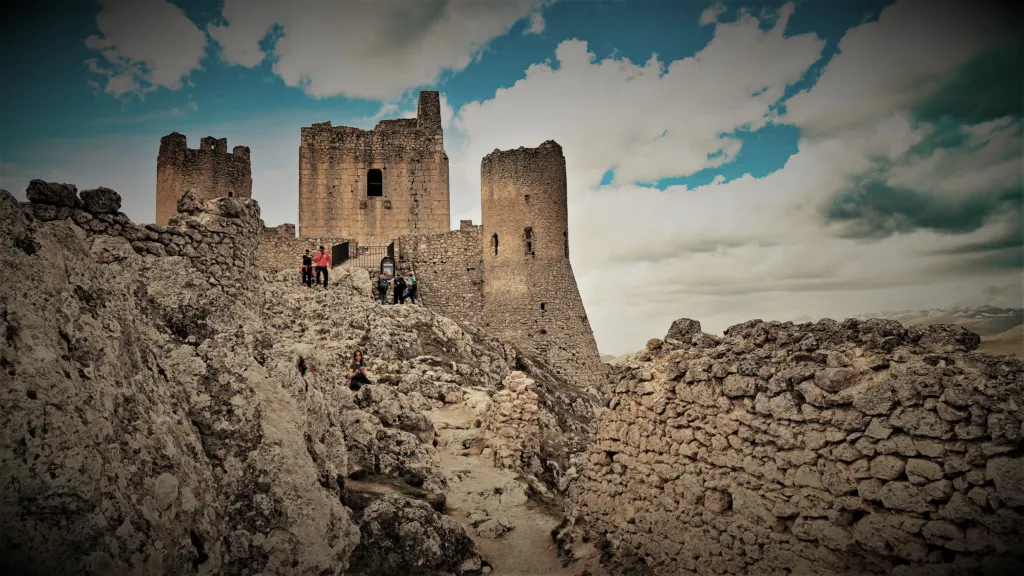
Cinematographer Vittorio Storaro shot the whole thing in Italy, using the Campo Imperatore plateau in Abruzzo and the ruined mountaintop fortress of Rocca Calascio, where the monk shelters the wounded lovers, along with Castell’Arquato, Torrechiara and Soncino. The film won the Saturn Award for Best Fantasy Film and picked up two Oscar nominations, for Best Sound and Best Sound Effects Editing.
For more film history, browse our Entertainment section. Powell went nearly 30 years without another film score until a 2017 science-fiction short, which makes the 3,000-copy 2015 set the fullest record of his biggest Hollywood job.
Further reading
Image: Vincedelbenàco, CC BY-SA 4.0 via Wikimedia Commons
This article was produced with AI assistance and reviewed by our Editorial Desk. How we work.