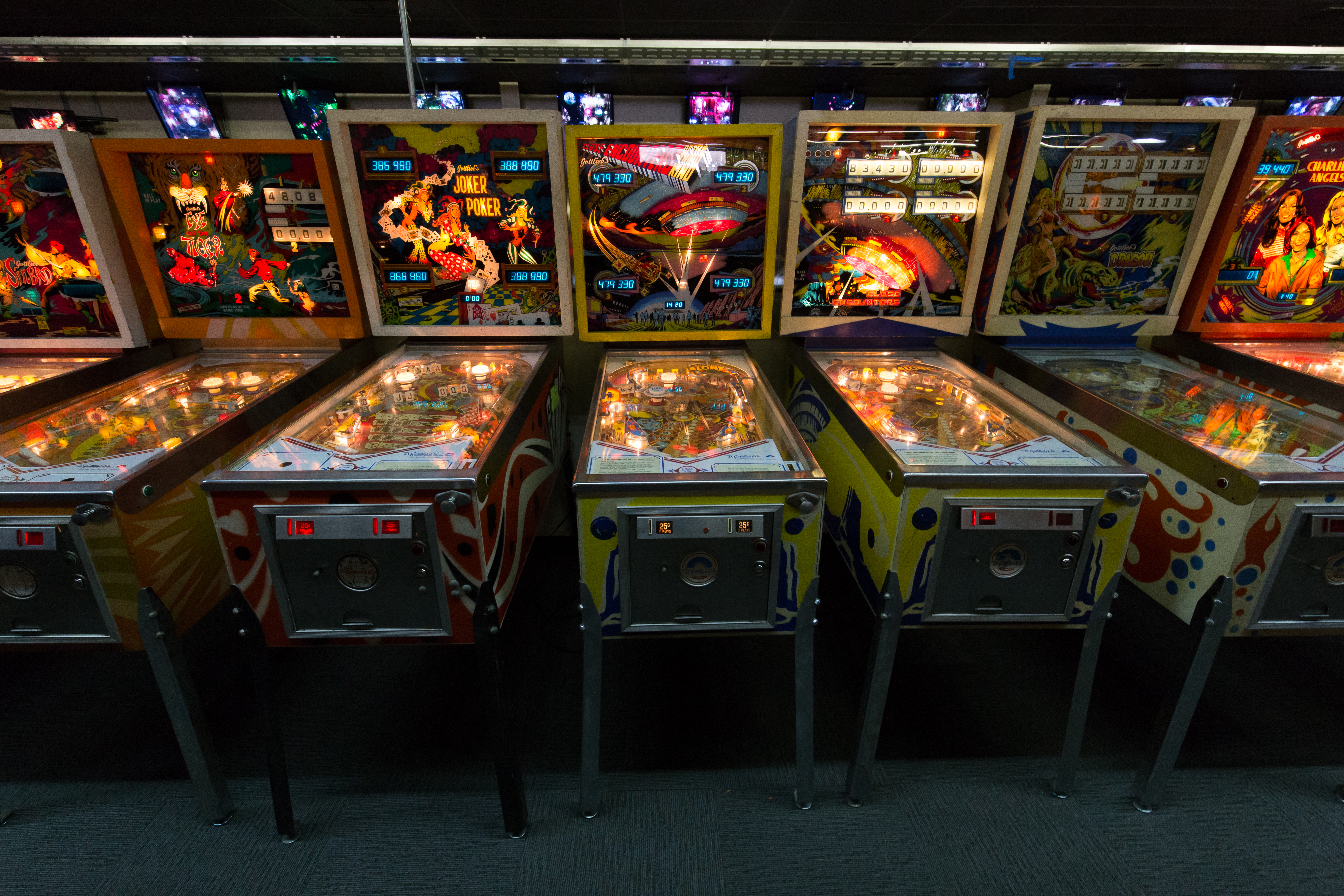
In April 1976, a pinball historian named Roger Sharpe walked up to a machine in a Manhattan courtroom, announced exactly which lane he would hit, and hit it. That one shot helped end New York City's pinball ban, in place since the early 1940s, when Mayor Fiorello La Guardia had machines smashed with sledgehammers and dumped in the rivers, according to Wikipedia's history of pinball.
The tables Sharpe was defending had no chips and no code. Yet they kept score for several players, ran their own rules and remembered every target you had hit. A new interactive explainer by developer Matt Makai shows how, and the short answer is that the machine itself was the memory.
Plastic targets that work like memory bits
Start with the drop targets, the little plastic blades that sink when the ball strikes them. Each one hooks on a steel ledge. A hit knocks it off, a spring yanks it flush with the playfield, and a switch underneath stays closed for as long as it is down. No relay has to remember anything: the sunken blade is the record. When the ball drains, a reset solenoid swings a bar up and shoves every target back onto its ledge.
Makai's "How Electromechanical Pinball Works" guide builds the whole lesson around one table: Gottlieb's Solar City, Model 393, dated February 1977, which carried 15 of these targets, four flippers and a three-bar chime box, all driven by 25-volt alternating current, copper coils, cams and springy metal switches.
The flipper problem, and Gottlieb's fix
Gottlieb also gave pinball the flipper. Its 1947 game Humpty Dumpty, designed by Harry Mabs, was the first with player-controlled electromechanical flippers, and it needed six of them because they were so weak, according to the company's Wikipedia history and the pinball article.
By the 1970s the flippers were strong enough to cause a new headache. Batting the 2.8-ounce ball takes a surge of roughly 8 to 10 amps. But players love to trap the ball, holding a flipper up for 10 seconds or more, and that much current for that long would burn out the coil.
The fix is two windings on one spool. A thick power winding snaps the flipper up in about 25 milliseconds. At the top of the swing, the crank pushes open a tiny end-of-stroke switch, which sends current through a thin hold winding too. The draw drops from about 10 amps to under 1 amp, enough to keep the flipper raised without cooking the wire.
The 40-millisecond kick
Pop bumpers react from any direction. When the ball brushes the plastic skirt at a bumper's base, a stem underneath tilts against a switch, a relay adds 100 points, and a heavy solenoid jerks a steel ring down onto the ball. The ball is gone in about 40 milliseconds.
Everything else, from the score motor and bonus unit to the tilt pendulum, sits in the lower cabinet, while the scores spin on mechanical reels in the backbox.
The end of an era
Solar City arrived just as the industry switched to microprocessors. Gottlieb's first solid-state games in the late 1970s were remakes of its electromechanical tables, Cleopatra among them, and it was the last major maker to stop building the old kind. Count the jobs those relays and springs did, and these tables look like mechanical cousins of the first arcade video games.
For more on how classic machines work, read Badiyaa on Atari's Pong prototype that broke because its coin box overflowed and how Citroën's hydropneumatic suspension made the DS float.
Sources
- Pinball, Wikipedia, 2026
- How Electromechanical Pinball Works, Part I: Playfield and Action, Matt Makai, 2026
- Gottlieb, Wikipedia, 2026
Image: el-toro, CC BY 2.0 via Wikimedia Commons
This article was produced with AI assistance and reviewed by our Editorial Desk. How we work.