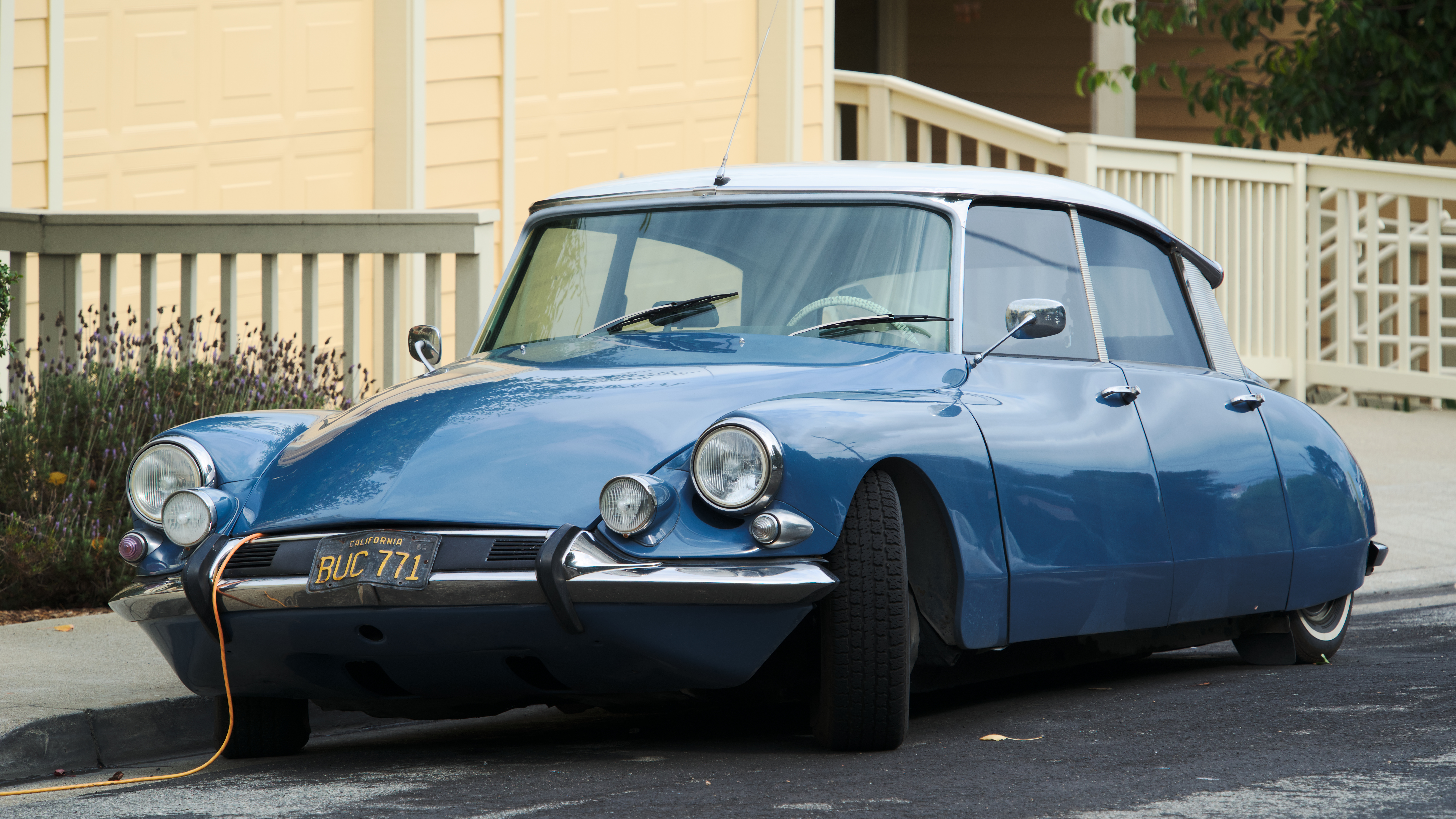
When the Citroën DS 19 rolled onto the stand at the Paris Motor Show on October 6, 1955, visitors placed 743 orders in the first 15 minutes, according to the Citroën DS article on Wikipedia. By the end of the 10-day show the car had 80,000 deposits. Its space-age body got the headlines, but its party trick was underneath: a suspension with no steel springs at all, one that let the car float over bad roads and even rise and sink on command.
The man with no engineering degree
The system was the work of Paul Magès, born in 1908, who joined Citroën at 17 to maintain equipment and had no formal engineering training. His Wikipedia biography says he became a technical draftsman in 1936, and in January 1942 the company's boss, Pierre-Jules Boulanger, moved him to the development department to fix braking and suspension problems. During the Second World War he worked on the idea in secret.
The puzzle he set himself was the old trade-off: soft springs ride well but handle badly. His answer was a suspension that is supple at low speed and stiffens as speed and load rise. Magès kept on his desk a line from the playwright Marcel Pagnol: "Everyone thought it was impossible, except an idiot who did not know and who created it."
How the spheres work
Each wheel connects not to a spring but to a hollow metal ball, the sphere, about 12 centimeters across. A rubber membrane splits it in two. The top half holds nitrogen at up to 75 bar; the bottom is joined to the car's hydraulic circuit. When the wheel hits a bump, a piston pushes fluid into the sphere and squeezes the gas, which acts as the spring. A two-way valve at the mouth of the sphere does the damping, the job a shock absorber does in an ordinary car.
An engine-driven pump keeps the system pressurized, at roughly 130 to 180 bar depending on the model, according to Wikipedia's hydropneumatic suspension article. Height corrector valves add fluid when the car is loaded and let it out when it is lightened, so the ride height stays the same. In the DS the same high-pressure fluid also ran the brakes, power steering, clutch and gearbox.
The driver could pick from five heights. Two of them existed for changing a flat: raise the car, slip a stand under it, lower the suspension, and the bad wheel lifts off the ground by itself. The DS never needed a jack.
A timeline of the float
- 1954: the system debuts on the rear of the Traction Avant 15H.
- 1955: the DS gets it on all four wheels.
- 1965: Rolls-Royce licenses the technology for the Silver Shadow.
- 1967: the moisture-absorbing red LHS fluid gives way to green mineral LHM.
- 1989: the Citroën XM adds Hydractive electronic control.
- 1999: Mercedes-Benz launches Active Body Control, an electronic hydropneumatic system.
The fluid change explains one well-known quirk: Citroën dyed LHM bright green so mechanics would never mix it with the old red fluid, since each would wreck the other's seals. Spheres also slowly lose gas through the membrane and need recharging, roughly every three years, the main reason the cars earned a fussy reputation.
Magès also went on to design the DIRAVI speed-sensitive steering on the 1970 Citroën SM. The DS itself placed third in the 1999 Car of the Century vote, behind the Ford Model T and the Mini, so the magic-carpet ride outlived its inventor, who died in 1999.
For more quirky French engineering, read Badiyaa's guide to the Citroën Ami and Europe's tiny quadricycles, or our report on Ford's GT41 Le Mans hypercar.
Sources
- Citroën DS, Wikipedia, 2026
- Paul Magès, Wikipedia, 2026
- Hydropneumatic suspension, Wikipedia, 2026
Image: Dllu, CC BY-SA 4.0 via Wikimedia Commons
This article was produced with AI assistance and reviewed by our Editorial Desk. How we work.