Socks with a tight knitted band around the ball of the foot cut the energy people burned while walking by 2%, University of Texas at Austin researchers Hui Tang and Owen Beck report in a paper in Proceedings of the Royal Society B. Ten of their 12 volunteers used less energy in the stiffening socks than in ordinary ones.
The authors put the saving in everyday terms: it is about what a walker would gain by shedding 2 kilograms, roughly 4.4 pounds, carried at the waist.
How the socks work
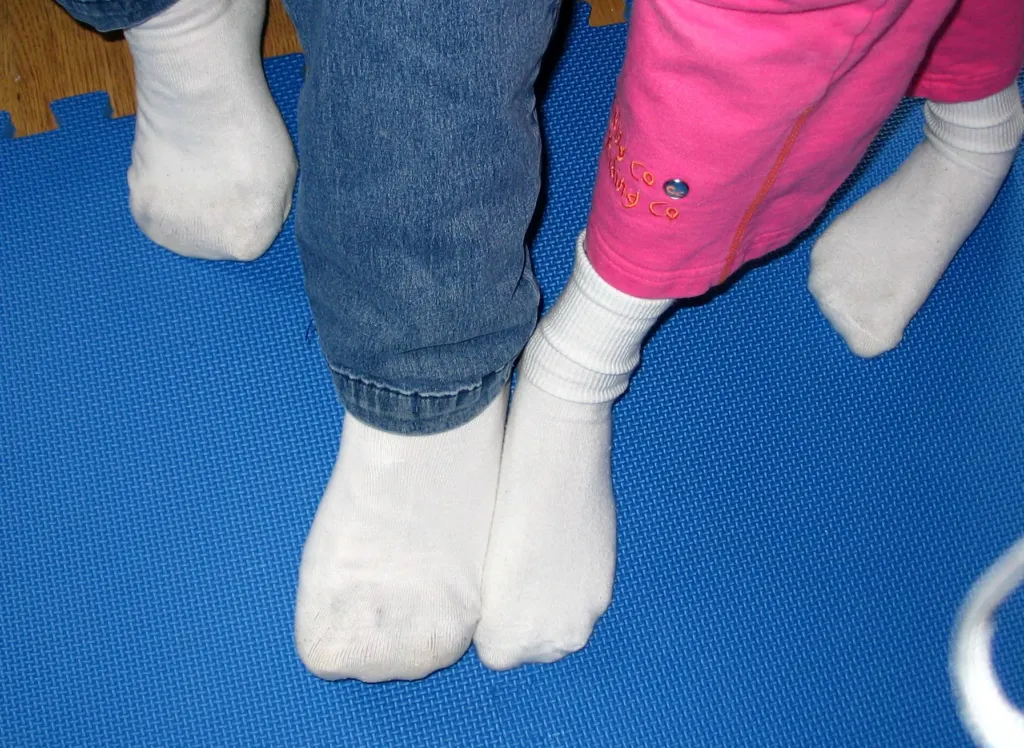
A normal foot spreads sideways a little each time it takes the body’s weight, a motion called foot splay. The custom socks press on the forefoot about 12 times harder than common store-bought socks, along a 3-centimeter strip that wraps the heads of the long foot bones behind the toes.
Limiting that spread has a knock-on effect. Through what the team calls cross-axis coupling, a narrower forefoot makes the arch along the inner side of the foot, the medial longitudinal arch, stiffer. The question was whether a stiffer arch would save energy without blocking the push-off at the end of each step.
The treadmill test
Twelve healthy young adults, average age 28, walked on a force-measuring treadmill at 1.25 meters per second, a steady pace of about 2.8 miles per hour. Each wore shoes over either the stiffening socks or control socks, in a balanced order, for five-minute bouts. The team worked out energy use from the oxygen breathed in and carbon dioxide breathed out, and tracked how the calf muscles behaved.
The muscle data explain the saving. With stiffer feet, the ankle turned more slowly during the stance part of each stride, and fibers in two calf muscles, the soleus and the medial gastrocnemius, shortened 15% to 20% more slowly. Muscles that contract more slowly can make the same force more cheaply, and the estimated volume of active leg muscle fell 9% to 12%.
Why it matters: a clue to why human feet are stiff
Human feet bend far less in the middle than the feet of other apes. According to the anatomy of the foot’s arches, the inner arch holds springy tissue that stores and returns energy with each step, and the bony arch began taking shape in early human relatives such as Australopithecus afarensis. A long-running idea holds that stiff feet were selected because they make upright walking cheaper, but the evidence has been thin.
Earlier attempts to test it mostly failed. The paper notes that shoes with stiffer midsoles have not reduced the energy cost of walking for young or older adults at normal speeds, and arch-restricting shoe inserts did not either. Read against that record, the sock result is the first in the paper’s account to stiffen the foot itself and show a measurable energy drop, which is why the authors present it as support for the evolutionary idea.
Walking studies show up often on Badiyaa, from an Italian study of how dogs reverse their footfall order to swim to the Japanese monks who walk about 40,000 km in 1,000 days.
Limits
The sample was 12 young, healthy adults walking on a flat treadmill in five-minute trials at one speed. That says nothing yet about older walkers, rough trails, hills or a full day of wear, or whether people would find the tight band comfortable for hours. A 2% drop is real but small, and two of the 12 volunteers did not show it.
The authors call the socks a low-cost, easily adopted idea and suggest they may help with running too, a claim the team has not yet tested in this paper. The study was published on November 4, 2026.
Further reading
- Tang and Beck (2026), Foot-stiffening socks reduce the metabolic cost of walking (PMC)
- Wikipedia: Arches of the foot
Image: RichardBH from Hamilton, Canada, CC BY 2.0 via Wikimedia Commons
This article was produced with AI assistance and reviewed by our Editorial Desk. How we work.