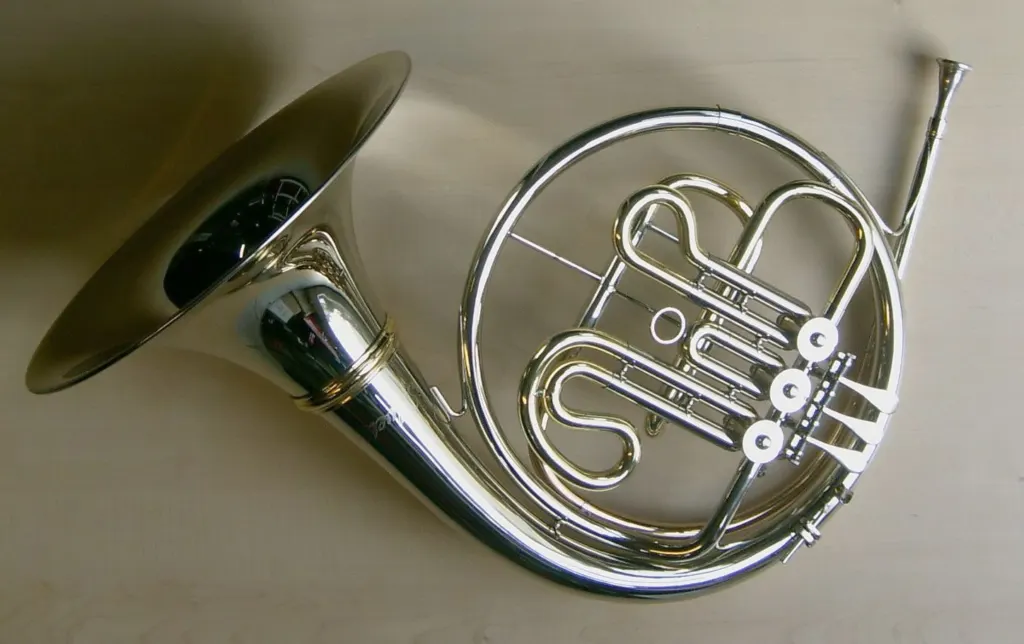
Felix Klieser was born without arms, and he plays the French horn at the highest level anyway: the German soloist works the instrument’s valves with the toes of his left foot while the horn rests on a tripod in front of him.
Clips of the 35-year-old performing Mozart have been doing the rounds online this week, and the timing fits his calendar. His official concert list shows him in Den Haag, the Netherlands, on November 13, playing Mozart’s Horn Concerto No. 4 and Richard Strauss’s Horn Concerto No. 1 with the Residentie Orkest under conductor Richard Egarr.
How he plays it
A horn is normally a two-handed job. Players press the three or four valves with the left hand and tuck the right hand into the flared bell, using it to shade and adjust the tone and pitch.
Klieser’s setup removes both of those habits. The tripod takes the weight, his left foot handles the valves, and nothing goes inside the bell. That means he controls color and tuning almost entirely with his lips, breath and embouchure, the same muscles every brass player relies on, but without the hand in the bell as a backup.
From age 4 to the Proms
Klieser was born in Göttingen on January 3, 1991, and started on the horn at the age of 4. He later studied at the Hochschule für Musik, Theater und Medien Hannover, one of Germany’s major music colleges.
- 2016: He receives the Leonard Bernstein Award.
- March 2019: He releases a recording of Mozart’s Horn Concertos 1 to 4 with the Camerata Salzburg.
- August 2023: He makes his Proms debut in London with the Bournemouth Symphony Orchestra and conductor Kirill Karabits, playing Mozart’s Horn Concerto No. 4.
- August 2026: Back at the Proms, he joins the Academy of St Martin in the Fields for Mozart’s Horn Concerto No. 3, then plays “‘O sole mio” as an encore.
Why Mozart is the test piece
Mozart wrote his four horn concertos for Joseph Leutgeb, a friend he had known since childhood and a gifted player. The music was built to show off: on the valveless natural horn of the 1780s, it called for lip trills, constant hand-stopping inside the bell and quick tonguing.
That history makes Klieser’s choice of repertoire especially pointed. The hand-in-bell technique Leutgeb would have leaned on is exactly the one Klieser cannot use, yet modern valves and his own approach let him play the same lines. No. 4, in E-flat major and catalogued as K. 495, dates from 1786 and runs well under 20 minutes, which is part of why it has become a calling card for soloists.
Klieser’s work also reaches beyond the stage. His website lists a November 20 appearance in Saalfelden, Austria, as a keynote speaker on resilience and problem-solving at a private corporate event, and he has published a book alongside his recordings.
For more unusual musicianship, read how violinist Ray Chen’s E string snapped mid-concerto at the Royal Albert Hall, or why Liszt’s La Campanella demands a leap many toy pianos cannot reach. You can find more in our Entertainment section.
His next date after Den Haag is a matinee at Tivoli Vredenburg in Utrecht on November 15 at 2:15 p.m., with the same orchestra and the same Mozart concerto.
Further reading
Image: Berndt Meyer, CC BY-SA 3.0 via Wikimedia Commons
This article was produced with AI assistance and reviewed by our Editorial Desk. How we work.