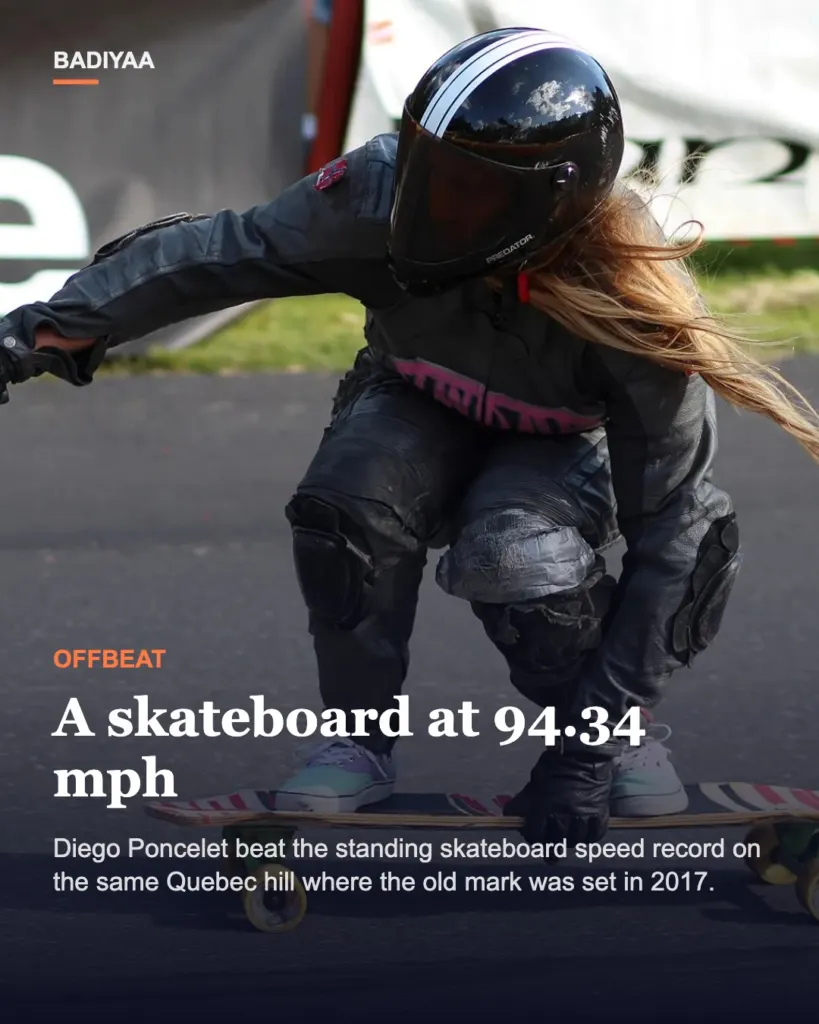
Spanish downhill skateboarder Diego Poncelet has been certified as the fastest person ever to ride a skateboard standing up, after reaching 151.83 km/h (94.34 mph) on a closed road in Les Éboulements, Quebec, on September 22. Guinness World Records and Red Bull, his sponsor, made the record public on Thursday, October 15, more than three weeks after the run.
The mark he beat was 146.73 km/h (91.17 mph), held by British rider Peter Connolly and set on the very same road in 2017. Poncelet, 27, was born in Mexico, grew up in Spain and Switzerland, and won the world downhill skateboarding title in 2022 before defending it in 2023 in Erzincan, Turkey.
What 151.83 km/h means on a skateboard
The gain over the old record is 5.10 km/h (3.17 mph), or about 3.5 percent. That sounds small until you convert it: at 151.83 km/h a rider covers roughly 42 meters every second (151.83 divided by 3.6), so the steep 600-meter straight on this road would pass in a little over 14 seconds. There is no braking at that point. Crouching lower makes him faster; standing taller is his only way to scrub speed.
The road itself has history. Les Éboulements, a village of about 1,465 people on the north shore of the St. Lawrence River, takes its name from the French word for landslides, after a February 1663 earthquake sent a slope down to the water. The same descent, Route du Port, produced a street luge record of 157.41 km/h in September 2008. That means a rider lying flat on a luge still went 5.58 km/h faster than Poncelet did standing up, which is a fair measure of how much drag an upright human body creates.
Poncelet’s team attacked that drag from every angle. He refined his tuck in wind-tunnel sessions in Geneva. His helmet shape was picked after about 20 designs were tested in computer airflow simulations, he said in an interview released with the record. Prada Linea Rossa made asymmetric shoes and gloves, Seismic delivered a prototype urethane wheel the day before the attempt, and a carbon-fiber shell, called a fairing, covered the board. Guinness World Records says World Skate approved that fairing.
“I never truly admitted to myself that my real objective was to get to 150kph; I was scared that it wouldn’t be doable,” Poncelet said after the attempt.
Wind decided the day. His team says a tailwind of 10 to 14 km/h (6 to 9 mph) carried him on the record run. Red Bull says he already passed the old mark on his first test day, at 146.88 km/h (91.27 mph), then waited five days for better conditions. On September 22 itself, according to adjudicator Andrew Glass, Poncelet made seven runs and three of them beat Connolly’s record. The fastest came on his first try of the afternoon, nearly six hours after he started.
The clip: 94 seconds of speed, very little context
The video embedded here is the official upload from the Guinness World Records channel, published on October 15 and running 1 minute 34 seconds. It opens with Poncelet in a red and blue Red Bull suit pushing off under an inflatable start arch. Most of what follows is filmed from the chase car, a Porsche according to the organizers, sitting behind him as he folds into his tuck and the river opens up below the road. It closes with an embrace at the bottom of the run.
As a document of the run it works. The chase-car angle shows the yellow center line streaking past and how little the rider moves, which is the whole skill at that speed. What the short cut leaves out is almost everything that makes the number meaningful. Its description does not explain how the speed was timed, does not mention the six other runs that day, and does not say how much the tailwind helped. Viewers who want those details have to find them in the written announcements.
There is also a fair question about what counts as a skateboard. Guinness World Records itself notes that fairings are rarely seen in professional racing, because ordinary courses are not long enough to need them. The board under the shell was a regular deck and the kit was approved, so the record stands on its own terms, but it is a specialized speed machine rather than the setup most racers use. It is equally fair to say the run was a commercial production: Red Bull, Prada and Porsche were all partners, and both bodies publishing the footage have a stake in it.
For a fuller picture, Red Bull has posted its own 16-minute 48-second film of the attempt on its channel, and it has drawn about 2.4 million views against roughly 289,000 for this shorter cut at the time of checking. The next benchmark sits on the same road: the 157.41 km/h street luge mark from 2008, still 5.58 km/h ahead of the fastest standing rider.
Further reading
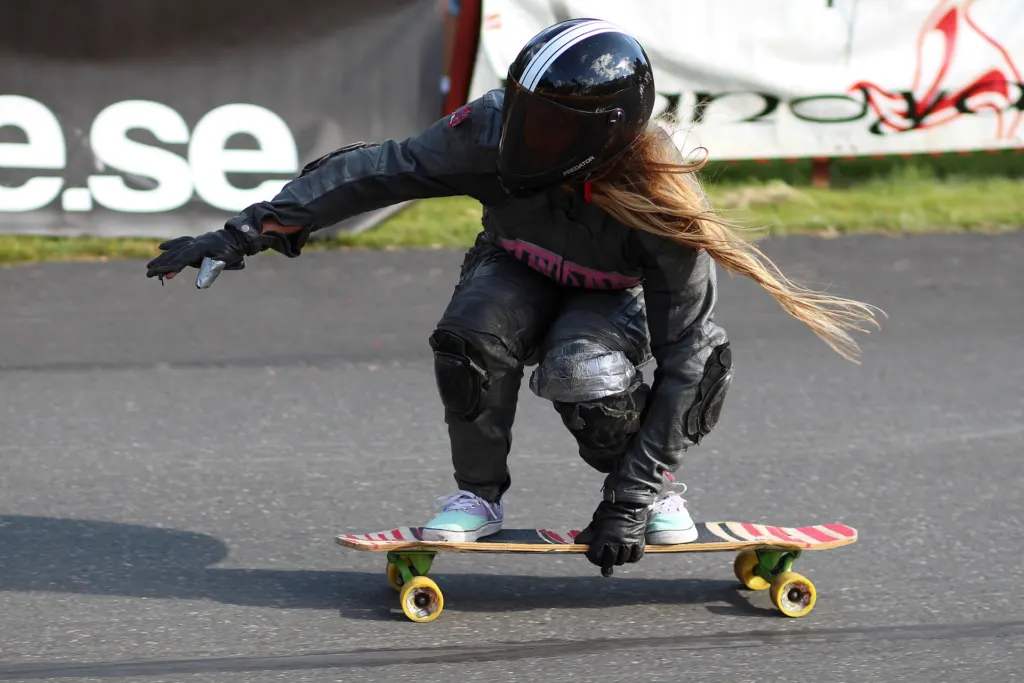
Image: TheSwordfish, CC0 via Wikimedia Commons
This article was produced with AI assistance and reviewed by our Editorial Desk. How we work.
Spot an error? Help verify this story
The story in 5 slides