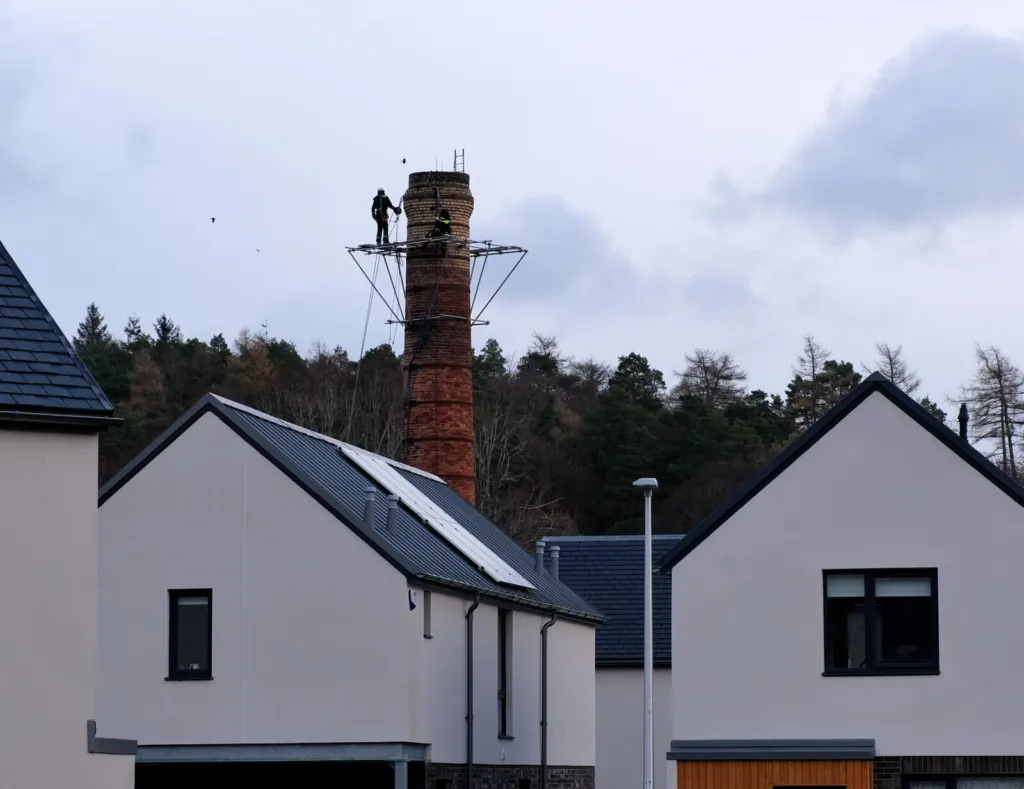
A crew of steeplejacks shifting scaffolding high up the side of a brick chimney has become one of the more stomach-turning clips on Reddit this weekend. “Making me anxious just watching it,” one viewer wrote. “I get sweaty palms watching this kind of stuff,” said another.
The caption says only that these are modern day steeplejacks moving scaffolding on a brick chimney. We could not identify the crew, the chimney or the country, and one commenter complained the video is a vertically cropped copy of a longer original. Nothing in the thread suggests it is staged, but nobody in it names the job either.
What a steeplejack does up there
A steeplejack is the tradesperson who goes up tall structures to repair, maintain, build or take them down: church spires, industrial chimneys, cooling towers, clock towers. The work on the clip follows an order that has been refined for generations.
- Ladders first. Long modular ladders are fixed to the structure section by section. In the UK, crews clip a belay rope fall-arrest line to them as they go, much as rock climbers do, which removes solo climbing from the job.
- Then a seat or a rope. A bosun’s chair, a stout plank the worker can raise and lower, was the traditional next step. Abseiling gear is taking over because it weighs less.
- Then the platform. Anchors go into the brick, stone or concrete, and the scaffold is “kicked” off those fixings.
So the unnerving part of this video is not a stunt. It is the ordinary midpoint of a repair job, where the platform has to travel with the work. Asked why a chimney would need scaffolding at all, one commenter answered: “Repointing the brickwork, replacing failing bricks, installing banding.” Skip that upkeep, the same commenter wrote, and these stacks eventually fall apart uncontrollably.
Another viewer pointed out that height is not only about carrying smoke away, and that taller stacks pull a stronger draft.
The man every commenter brought up
One of the first replies points to Fred Dibnah, the Bolton steeplejack who became a British television fixture. His 1979 documentary won a BAFTA. As a teenager he climbed a 262-foot chimney at Barrow Bridge for a 10-shilling bet and left two Union Flags at the top. Decades later he was hired to repair that same stack.
He felled 90 chimneys in his lifetime, usually without explosives, by cutting into the base, propping the brickwork with timber and burning the props away. In 1997 on Canvey Island a concrete chimney began to go early. He tripped while running and looked up at 2,500 tonnes leaning his way before it righted itself and fell the other direction.
The thread splits along exactly that fault line. Some viewers miss the old bravado. One commenter, describing 40 years in industrial safety, was having none of it: “Folk go home after work now, in the 70s and 80s it was often not the case.” Another viewer spotted what looked to them like a missing safety clip on a hook, a claim we cannot check from the video.
A very old trade
The profession goes back at least to the 11th century, and the Bayeux Tapestry includes a steeplejack among its scenes.
The modern version is swapping the plank for harness and rope. Dibnah’s own tally stopped at 90 felled chimneys, the last of them at Royton, near Manchester, in May 2004.
Further reading
Illustrative image. Image: Jim Barton, CC BY-SA 2.0 via Wikimedia Commons
This article was produced with AI assistance and reviewed by our Editorial Desk. How we work.