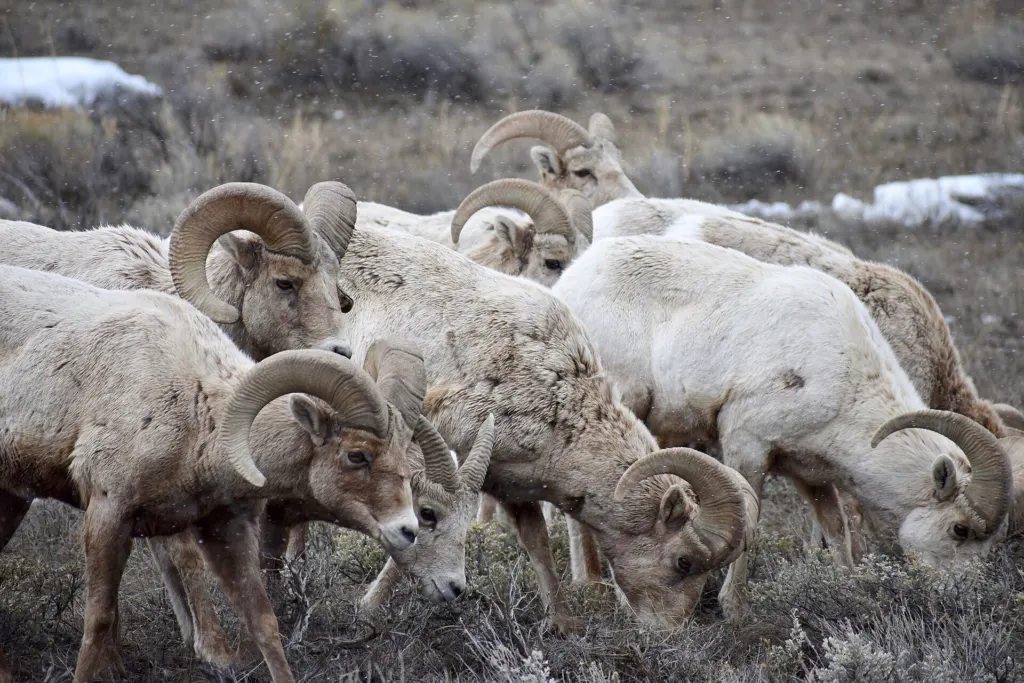
A bachelor band of bighorn rams turned a Colorado front lawn into a lounge this week, bedding down on the grass in a tight cluster and chewing their cud a few steps from someone’s house. The clip, credited to the outdoor account Colorado Wild Adventures, spread across social media around November 10, according to a report on the footage.
Nothing dramatic happens. No horns crash, nobody charges a car. The rams simply lie there, jaws working, as if the yard had been rented to them for the afternoon. Commenters joked about property lines and free lawn mowing, and one quipped that the animals were “seated in the horn section.”
Why a group of rams lies down and chews
The jaw movement is the giveaway. Bighorn sheep are ruminants, like cattle and goats. They grab grass quickly, swallow it, then lie down later to bring the food back up and chew it a second time. Resting in a group lets each animal keep one eye out for danger while the slow work of digestion goes on.
Rams lean into this more than ewes do. Field studies summarized on the bighorn sheep entry describe females spending more time foraging and walking, likely to keep lambs away from predators, while males tend to eat, then rest and ruminate, a habit linked to better digestion and bigger bodies. A row of full-curl rams parked on a lawn is that strategy in plain view.
Why November puts rams in odd places
Timing matters too. Colorado Parks and Wildlife says bighorn breeding runs through November and December, peaking in early December, and adult rams normally live apart from ewes except during the rut. Mid-November is when bachelor groups start shifting, sizing each other up and drifting toward winter range, which usually sits lower than summer range. Lower ground in parts of Colorado means foothill neighborhoods.
The state agency calls the bighorn Colorado’s official animal and says the state holds the largest population of the species anywhere, an estimated 7,000 animals. That number is a comeback story. Disease spread from domestic livestock and unregulated hunting had pushed the sheep close to extinction around 1900, and only a small remnant survived in Colorado in the early 1900s.
Rebuilding took decades of moving sheep around. The agency ran its first transplants in the 1940s, releasing bighorns between Georgetown and Silver Plume, and has completed more than 100 transplants since, most of them in the 1970s and 1980s. The Georgetown herd now numbers 250 to 350 sheep and is one of the best-known places in the country to watch them.
How big are these lawn guests
For scale, here is a quick calculation using Colorado Parks and Wildlife figures. A ram weighs 150 to 250 pounds, and the agency says mature horns can make up as much as 10 percent of body weight. On a 250-pound ram, that works out to about 25 pounds of horn carried on the head, roughly the weight of a full bag of dog food. Rams reach full curl at about seven or eight years old, so a lawn full of big curls is a lawn full of veterans.
- Weight: 150 to 250 pounds for rams, 120 to 200 for ewes
- Height: about three feet at the shoulder
- Lifespan: 15 to 20 years is possible, but rarely reached in the wild
Watch, but give them room
Lounging rams look calm, but they are wild animals in rut season, built to absorb head-on collisions. Watching from a window or a distance, and keeping dogs inside, lets a herd finish its cud and move on by itself. Pets and people crowding a resting group are the usual way a funny clip turns tense.
Colorado is not alone in deer and sheep turning up in suburbs each fall; our story on a Texas Panhandle rule that let mule deer bucks grow older shows how wildlife managers shape herds behind the scenes. More animal stories live on our Pets & Animals page.
The rut peaks in early December, so Colorado homeowners near foothill herds may see more visitors like these over the next three weeks.
Further reading
Image: USFWS Mountain Prairie, Public domain via Wikimedia Commons
This article was produced with AI assistance and reviewed by our Editorial Desk. How we work.