His hat was shot off. On another day, so was his belt. Bass Reeves still rode home unwounded every time, and over a career of more than three decades he is credited with more than 3,000 arrests across the wildest stretch of the American West.
He did it after escaping slavery. And one historian thinks he may be the real man behind the Lone Ranger.
From enslaved servant to federal lawman
Reeves was born enslaved in Crawford County, Arkansas, in July 1838, and was later taken to Texas by the family that held him. During the Civil War he broke away and fled into Indian Territory, in what is now Oklahoma. There he learned the languages of the Cherokee, Choctaw, Chickasaw, Seminole and Muscogee nations, along with the tracking skills that would make his name, according to Wikipedia's biography of Bass Reeves.
In 1875 Judge Isaac C. Parker's federal court at Fort Smith, Arkansas, needed 200 deputy marshals to police a territory of more than 75,000 square miles. Reeves, then 37, was hired, one of the first Black deputy US marshals west of the Mississippi River. His paperwork survives: an 1897 oath of office for Deputy Marshal Bass Reeves held by the US National Archives comes from the Fort Smith court's own series of deputy oaths.
The legend in numbers
The figures read like dime-novel fiction. Reeves stood 6 feet 2 inches tall at 30. He worked about 32 years in Indian Territory, carried Winchester rifles chambered for the same cartridges as his handguns, and leaned on sharp detective work as much as on his aim. Accounts credit him with more than 3,000 arrests; his obituary said he killed 14 outlaws in self-defense.
The hardest warrant came in 1902, when his own son, Bennie, was charged with murder. Reeves insisted on handling it himself, and Bennie was convicted in Muskogee in 1903.
The Lone Ranger theory
Here is where the story gets juicy. Historian Art T. Burton has argued that "Bass Reeves is the closest person to resemble the Lone Ranger," pointing to the Native American partners Reeves rode with and the souvenir silver dollars he handed out. It remains a theory, not a documented fact; no creator of the radio hero has been shown to have based him on Reeves.
The masked rider has had a bumpy run on screen, as Badiyaa found in its look at how Disney's The Lone Ranger lost up to $190 million. Reeves, meanwhile, keeps getting new fans: Taylor Sheridan's series Lawmen: Bass Reeves, starring David Oyelowo, began on Paramount+ on November 5, 2023.
Where to find him today
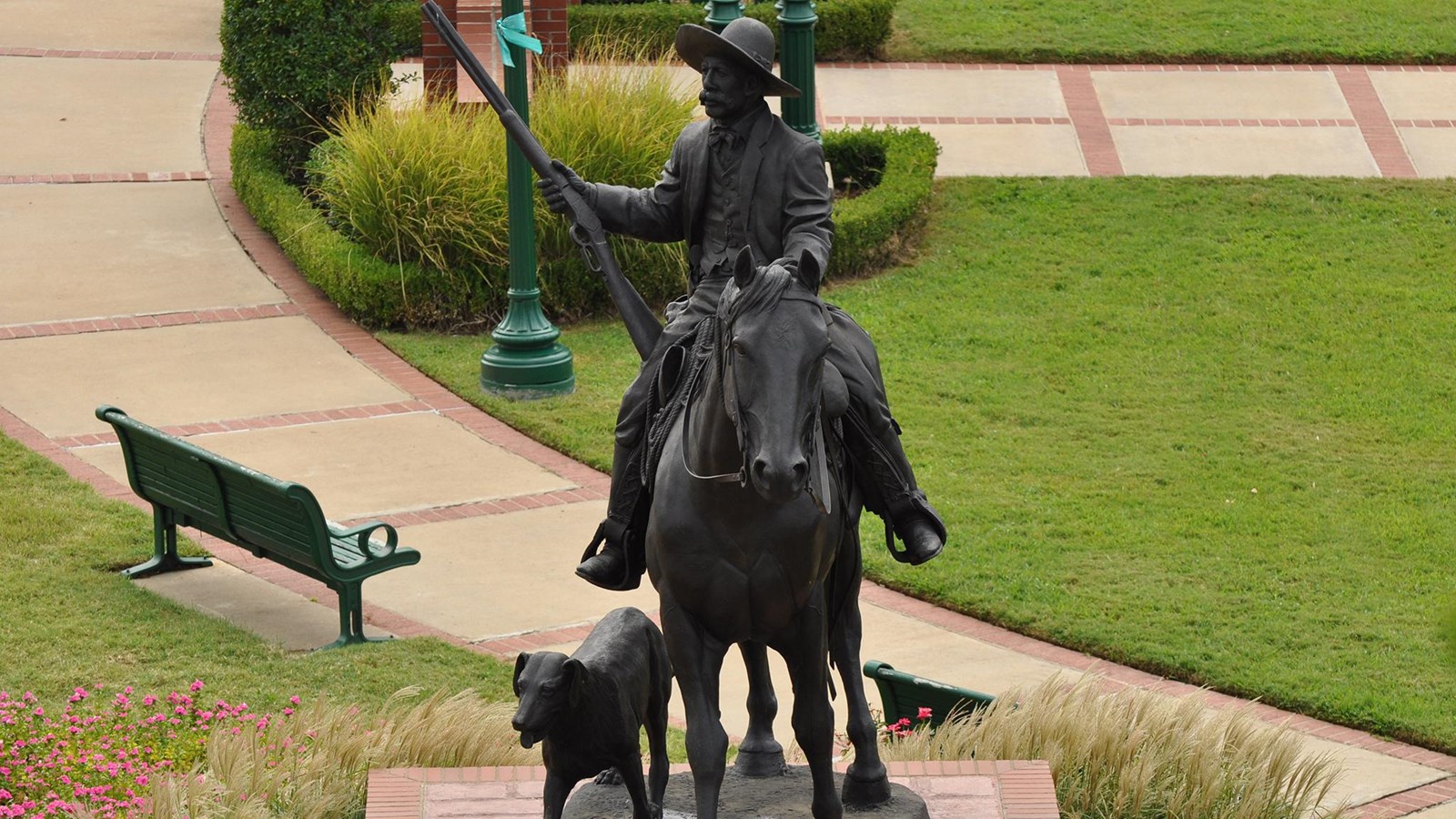
Reeves became a Muskogee police officer at 68 after Oklahoma statehood in 1907 and died on January 12, 1910. In Fort Smith, the National Park Service's page on the Bass Reeves statue describes a larger-than-life bronze of him on horseback in Ross Pendergraft Park, next to Fort Smith National Historic Site. For another Black pioneer who waited decades for credit, read Badiyaa's story of Matthew Henson and his long wait for the Hubbard Medal.
The statue, unveiled in May 2012, shows Reeves riding with his rifle raised and a dog running at his horse's side.
Sources
- Bass Reeves, Wikipedia, 2026
- Oath of Deputy Marshal for Bass Reeves (NAID 6851120), US National Archives via Wikimedia Commons, 1897
- Bass Reeves Statue, US National Park Service, 2025
Image: National Park Service, Public domain via Wikimedia Commons
This article was produced with AI assistance and reviewed by our Editorial Desk. How we work.