On November 24, 1542, about 3,000 English horsemen routed a Scottish army of 15,000 to 18,000 at Solway Moss, a peat bog on the English side of the border. Roughly 1,200 Scots were taken prisoner. Within three weeks the Scottish king was dead, and his throne passed to a six-day-old girl: Mary, Queen of Scots.
That is the short version of a day that reshaped British history, 484 years ago today.
Why the armies met
The quarrel was a family one. Henry VIII of England had broken with the Catholic Church and pressed his nephew, King James V of Scotland, to do the same. James refused, and then failed to turn up for a planned meeting with his uncle at York. After a Scottish win at Hadden Rig in August 1542, Henry sent a major raid into southwest Scotland, and James ordered Robert, Lord Maxwell, the warden of the West March, to raise an army in reply.
A rout between two rivers
The Scots crossed into England and met Thomas, Lord Wharton, near the River Esk. According to Wikipedia's account of the Battle of Solway Moss, the fight was badly coordinated on the Scottish side and is best described as a rout. Later chronicles claim the command fell apart when Oliver Sinclair, a royal favorite, announced he was in charge, though an English commander reported that Maxwell still led the army.
Either way, the Scots ended up boxed in on English ground between the Esk and the bog. After hard fighting they surrendered to the English cavalry, along with 10 field guns. Several hundred more may have been lost in the marshes and the river.
The lopsided numbers are the striking part. One modern estimate puts the dead at about 20 Scots and seven Englishmen, against the 1,200 prisoners. Badiyaa's arithmetic: the Scots outnumbered Wharton's force by five or six to one, yet had about 60 men taken prisoner for every Scot killed.
Prisoners with gold chains
The captives included the earls of Cassilis and Glencairn, Lord Maxwell himself and Sinclair. In London, the Privy Council ordered Scottish prisoners to wear a red St Andrew's cross. On Christmas Day they appeared at Henry's court, and the king gave each a gold chain. Henry was not being sentimental: he hoped that once ransomed, the lords would push his interests back in Scotland.
A king's death and a baby queen
James V was not at the battle; he had stayed at Lochmaben. He fell ill at Falkland Palace in early December, and on December 8 his wife, Mary of Guise, gave birth to a daughter at Linlithgow. The Wikipedia biography of James V records the line John Knox put in the dying king's mouth: "It cam wi' a lass, and it will gang wi' a lass." James died on December 14, aged 30.
Legend says shame over Solway Moss killed him. The same biography argues he more likely died of cholera or dysentery, noting he had been sick repeatedly over the previous decade.
Here is how fast it moved:
- November 24, 1542: defeat at Solway Moss.
- December 8: Mary is born at Linlithgow Palace.
- December 14: James V dies, 20 days after the battle; Mary becomes queen at six days old.
- September 9, 1543: Mary is crowned in the chapel of Stirling Castle.
- December 1543: Scotland's parliament rejects the Treaty of Greenwich, which would have married Mary to Henry's son Edward, as the Wikipedia biography of Mary, Queen of Scots sets out.
Henry answered with years of raids known as the Rough Wooing. For earlier Scottish royal drama, read Badiyaa's story on how John Balliol was chosen King of Scots in 1292, and on Elizabeth I's accession in 1558, the cousin who would one day hold Mary captive.
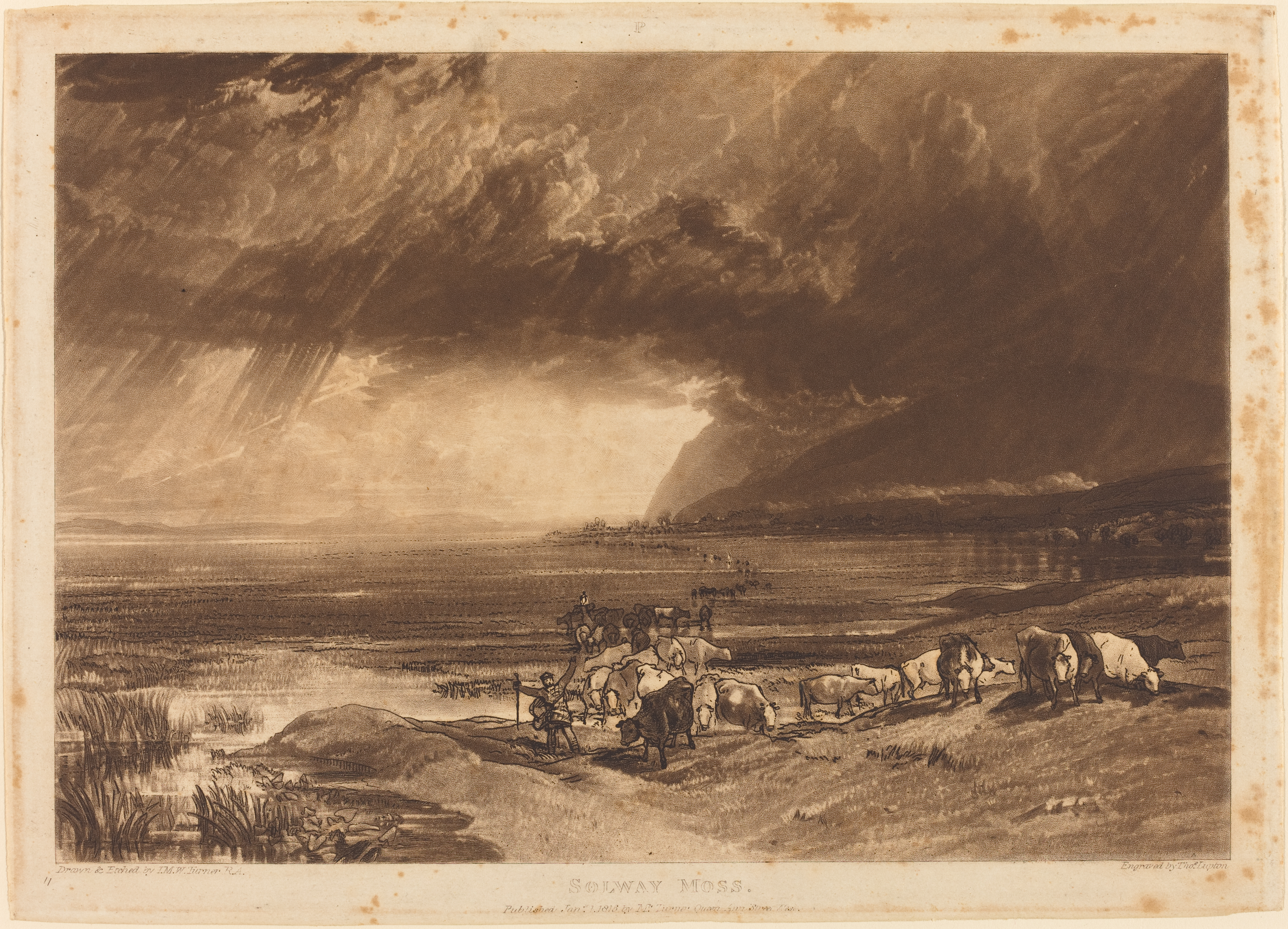
The bog itself later drew J. M. W. Turner, whose moody view was engraved as a print in 1816; a copy held by the National Gallery of Art is on Wikimedia Commons. Today the battlefield sits on England's register of historic battlefields, with the battle's Wikipedia entry noting that Scotland is researching it too.
Sources
- Battle of Solway Moss, Wikipedia, 2026
- James V, Wikipedia, 2026
- Mary, Queen of Scots, Wikipedia, 2026
- Solway Moss, J. M. W. Turner and Thomas Goff Lupton, 1816 print, Wikimedia Commons (National Gallery of Art), 1816
Image: Joseph Mallord William Turner and Thomas Goff Lupton, CC0 via Wikimedia Commons
This article was produced with AI assistance and reviewed by our Editorial Desk. How we work.