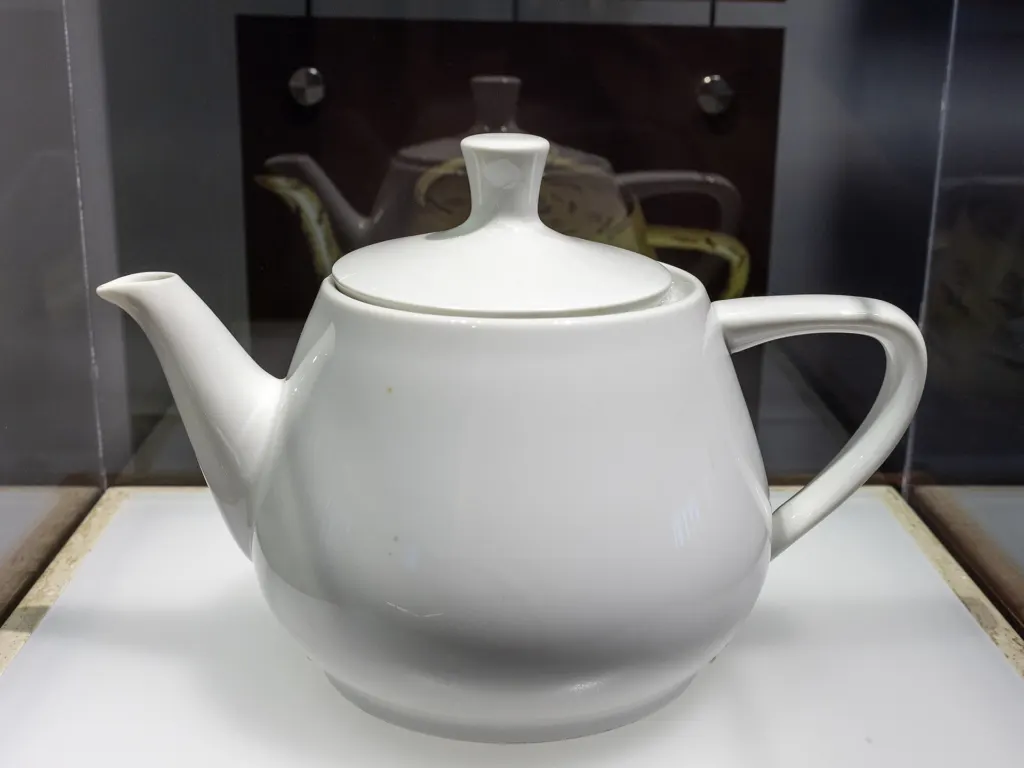
The most famous object in computer graphics is a white Melitta teapot bought at a Salt Lake City department store in 1974. Martin Newell, then a doctoral student at the University of Utah, turned it into a digital model in 1975, and graphics students have been rendering the Utah teapot ever since.
It is the 3D world’s version of a programmer’s “Hello, World!” test. Load the teapot, add a light, and you can see at once whether your shading, shadows and reflections work.
Why the digital teapot looks squat
Put the real teapot beside the model and something is off. The physical pot is about a third taller. Jim Blinn, who joined Newell’s Utah lab, squashed the data during a 1976 demonstration and kept it that way. “A thing that I’m most famous for is that I squashed the Teapot,” Blinn said at the 2026 talk. “I still think it looks better this way!”
That clears up an old story that the shrink was a fix for rectangular pixels. Blinn says he had already handled pixel shape; he simply liked the look.
A quick calculation shows the difference. The Computer History Museum, which holds the real teapot, lists it at 16.51 cm (6.5 inches) high. With the model at three-quarters of that height, a teapot built to the famous digital proportions would stand only about 12.4 cm tall.
Born over a cup of tea
Newell wanted curved models that a computer could store efficiently and break into as many flat polygons as a picture needed. His wife, Sandra, supplied the subject. As Newell recalled at an anniversary talk this year, she pointed at the tea service on their table and asked, “Why don’t you model these?”
He drew the profile on engineering paper, laid out a grid of Bézier patches (curved surface pieces defined by a handful of control points) and typed the coordinates in by hand. The teapot turned out to be an ideal test subject: it is round, its handle and spout cast shadows onto its own body, and it has a hole through the handle that simple shapes like spheres lack.
Six versions in 51 years
A University of Utah account of the anniversary traces the model through six major versions, every one tied to the school:
- 1975: Martin Newell’s original.
- 1976: Jim Blinn’s shorter proportions.
- 1987: Frank Crow adds a rounded bottom, since the original had no base at all.
- 1992: Hank Driskill builds the first solid version with an inside.
- 2006: Russ Fish refines that interior.
- 2026: Cem Yuksel’s Version 2026, unveiled at SIGGRAPH 2026 in Los Angeles on July 23, with smoother curves where the handle and spout meet the body.
The early renders ran on a PDP-11 at about 3 megahertz with 64 kilobytes of directly addressable memory. Today a phone renders the same teapot in real time, which is part of the joke: graphics engines from AutoCAD to 3ds Max ship it as a sample, and the OpenGL helper library GLUT even has a dedicated glutSolidTeapot() call.
Hiding in plain sight
Animators treat it as an in-joke. The teapot turns up in a tea-party scene in Toy Story, in The Simpsons “Treehouse of Horror VI,” and as a painting called “Handle and Spout” in The Sims 2. In 1987 James Arvo and David Kirk crowned it the “Teapotahedron,” a sixth Platonic solid.
Modern rendering keeps moving, from Nvidia’s AI neural rendering in Hogwarts Legacy to studies of how AI image models picture the world, yet new techniques still get shown off on a 1975 teapot.
The physical pot sits in the Computer History Museum in Mountain View, California, under catalog number X398.84, a gift from Newell. The manufacturer only learned of its fame in 2017 and renamed the product the “Utah Teapot,” but production ended after a 2023 fire at the factory.
Further reading
Image: The wub, CC BY-SA 4.0 via Wikimedia Commons
This article was produced with AI assistance and reviewed by our Editorial Desk. How we work.