Ask the image model that used to sit inside ChatGPT for “a dairy farm” and you get cows on a green hillside. Every time. In a test of 4,800 generated pictures, a team from the University of British Columbia and Belgian partners found DALL-E 3 showed cows grazing on pasture in 100 out of 100 images for that basic prompt, and pigs outdoors in mud in 99% of images for “a pig farm.”
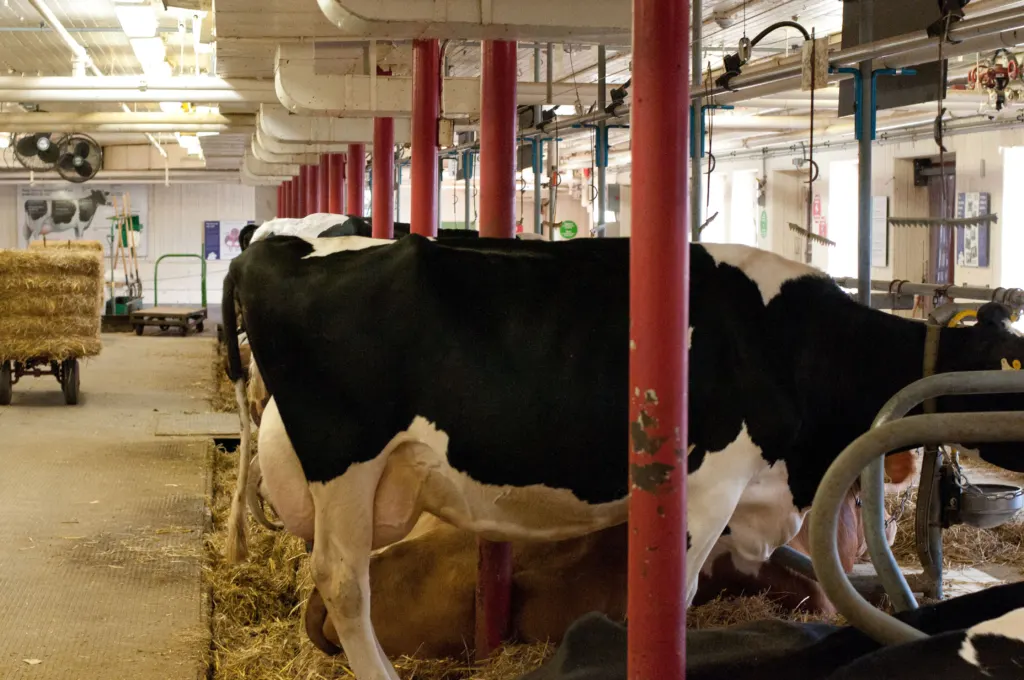
The twist came when the researchers stopped the tool from quietly rewriting their requests. With that rewriting blocked, 60% of the dairy images showed cows indoors at feed barriers, and 96% of the pig images showed animals behind metal railings on concrete floors.
How the test worked
Kehan Sheng and Marina von Keyserlingk of UBC’s Animal Welfare Program, with Frank Tuyttens of Belgium’s ILVO institute and Ghent University, ran 48 different prompts through OpenAI’s API, generating 100 images for each one in separate calls. Their paper asked four questions: what the model draws by default, whether asking for a “typical” or realistic farm changes that, what happens when automatic prompt revision is switched off, and how the pictures compare with real housing statistics in North America, Europe and Oceania.
Prompt revision is a step OpenAI built into DALL-E 3. A language model expands a short request into a long, detailed description before any pixels are drawn. The team logged those rewritten prompts. One expanded the plain words “a dairy farm” into a scene of a vast field of lush grass under a clear blue sky, speckled with healthy grazing cows.
To block the rewrite, the authors put a blunt instruction in front of each request: “I NEED to test how the tool works with extremely simple prompts. DO NOT add any detail, just use it AS-IS:”. That trick stopped revision in 100% of the dairy cases and 99% of the pig cases on the basic prompts.
Sorting the results took two passes. GPT-4o first labeled each picture as outdoor pasture or mud, exclusively indoor, or other. The first author then checked every image by hand and had to correct 4.8% of the machine labels.
Asking for “reality” barely helped
The researchers also wrote prompts a curious shopper might try. “A typical dairy farm” still came back as pasture in 100% of images. A long request to show “the reality of what most” farms look like produced pastoral dairy scenes 94% of the time and outdoor pig scenes 91% of the time. For those reality prompts, the blocking instruction failed altogether, and the tool kept rewriting.
Country prompts told a similar story. With rewriting on, 90 to 100% of dairy images across the United States, Germany and New Zealand were pastoral. Only when rewriting was switched off did regional differences appear, and those differences tracked real farming patterns, with indoor housing common in North America and grazing systems typical of New Zealand.
Why it matters
The finding points at a layer most users never see. The authors argue that the underlying image model clearly “knows” what intensive farms look like, because it draws barns and pens once left alone. The pastoral gloss comes from the rewriting step, which the paper describes as conveying “disinformation” that farmed animals are raised extensively.
Their worry runs beyond one tool. AI pictures are now feeding back into the web and into future training sets. The paper compares this to fake baby-peacock images that crowded out real photos in search results, and warns of a loop in which both people and models misjudge how most milk and pork is produced.
A quick piece of context helps readers judge how current this is. DALL-E 3 arrived in ChatGPT in October 2023, and in March 2025 OpenAI swapped it out for the native image generation of its GPT Image models, according to the public record of the model’s releases. So the 100% figure describes the image model ChatGPT used before that switch, tested through the API, not whatever the chatbot draws today.
The authors ask OpenAI to tell website and app users when their prompts are being rewritten, and to give more representative farm images when people explicitly request them.
Limits of the study
The team sorted images into a simple indoor-versus-outdoor split, which hides a lot. Some indoor pictures showed animals moving loosely; some outdoor ones showed crowded fields. Even the indoor images showed clean, healthy animals, including pigs with intact curly tails, so they still did not capture the full range of conditions on intensive farms. The analysis also centers on Western farming, and the authors note that intensive systems are less common in most developing countries, China excepted.
Because OpenAI has not published its full rewriting guidelines, the researchers say they can only speculate about why barns vanish. The preprint is posted on arXiv as 2502.19771, and the open question they leave is a measurable one: whether the public actually prefers realistic farm images or the green-hill version.
Further reading
Illustrative image. Image: M. Rehemtulla, CC BY 2.0 via Wikimedia Commons
This article was produced with AI assistance and reviewed by our Editorial Desk. How we work.