On November 28, 1660, after a lecture by the young astronomy professor Christopher Wren at Gresham College in London, 12 men agreed to start something with a gloriously clumsy name: a "Colledge for the Promoting of Physico-Mathematicall Experimentall Learning." It became the Royal Society, the oldest scientific academy in the world that has existed without a break, and it turns 366 on November 28.
The Royal Society's own history dates its first meeting to that evening and says Wren believed the new fellowship should transform knowledge, profit, health and the conveniences of life. Its members would observe nature, run experiments, argue about the results and publish them.
The invisible college
The 12 had been circling each other for years. In letters from 1646 and 1647, the chemist Robert Boyle mentioned "our invisible college," and the history of that informal network shows it traded findings by post long before it had a building or a charter. In Oxford, John Wilkins ran a philosophical club out of Wadham College. Alongside Wren, Boyle and Wilkins, the founders included William Brouncker and Robert Moray.
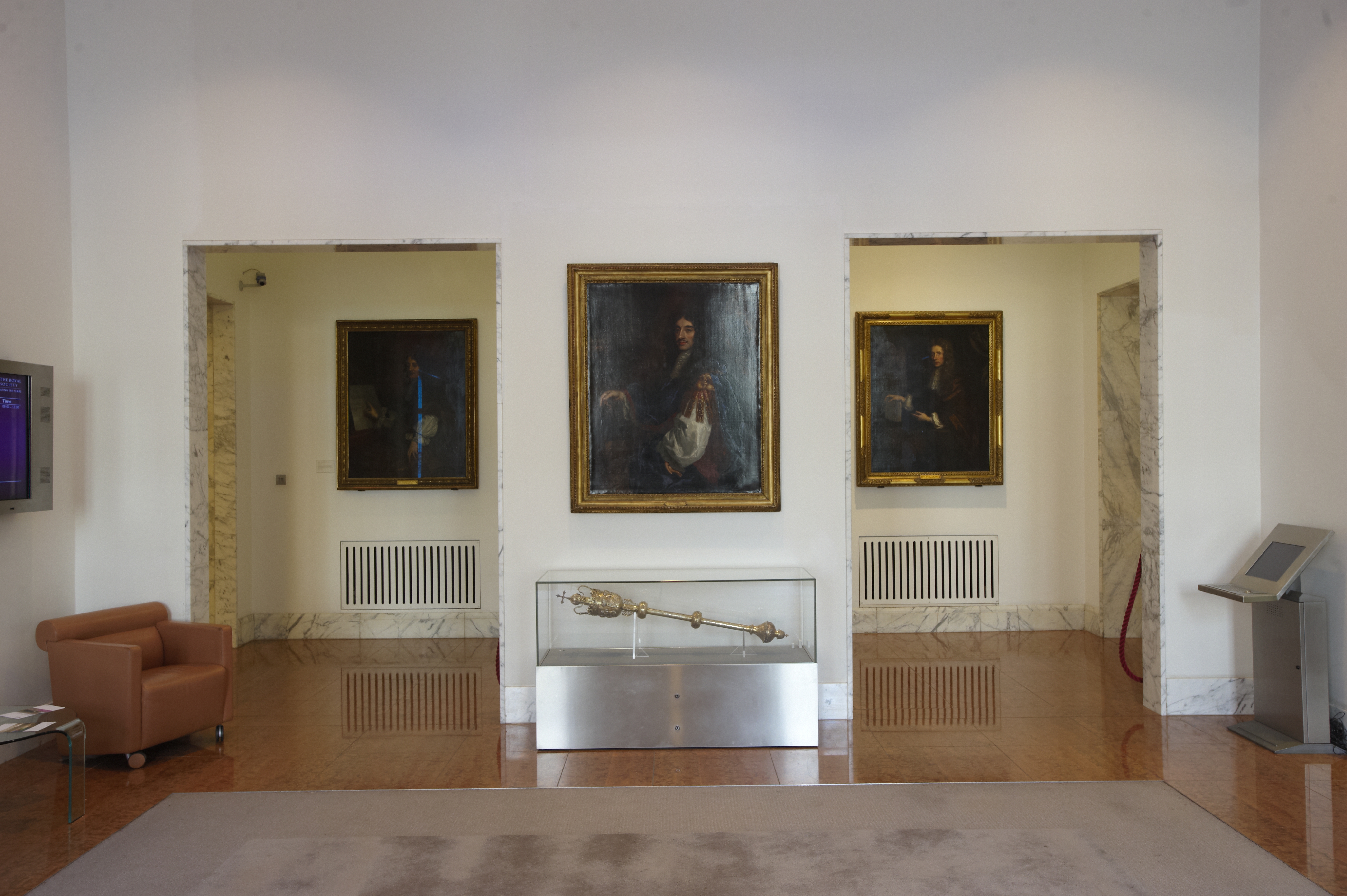
Royal approval came fast. At the second meeting Moray announced that King Charles II approved of the gatherings, and a royal charter signed on July 15, 1662, created the Royal Society of London, with Brouncker as its first president. A second charter in 1663 named the king as founder. Every monarch since has been its patron, and a mace granted by Charles II still stands in its entrance hall.
Gentlemen, not scientists
The early society was more club than laboratory. Fellows were lawyers, merchants, physicians, aristocrats and landowners, all of them men. The Royal Society's Wikipedia history notes that two-thirds of the fellows in 1663 were not scientists at all; wealthy members were needed to keep the lights on, and many skipped the one-shilling weekly subscription.
The rivalries were fierce. Robert Hooke, its star experimenter, wrote that people who knew Henry Oldenburg, the first secretary, "understood well enough how little he himself knew of philosophic matter." Isaac Newton, president from 1703 to 1727, went further. In his fight with Gottfried Leibniz over who invented calculus, he set up an "impartial" committee and then published a report he had written himself in its name.
The output was real all the same. Oldenburg launched Philosophical Transactions in 1665, now the longest-running scientific journal in the world, and Hooke published Micrographia the same year. The motto, Nullius in verba, roughly "take nobody's word for it," set the tone: claims had to survive experiment.
A long wait for women
Women were shut out of the fellowship for 285 years. A postal ballot in wartime went 336 to 37 in favour of change, and on March 22, 1945, Kathleen Lonsdale and Marjory Stephenson became the first female fellows.
The society's later stars include the young Newton, whose letter to Hooke Badiyaa traced in the story of the 'shoulders of giants' line. Its old question, what counts as science, still splits experts, as a survey of 92 researchers and 991 Americans showed.
The society has been based at 6 to 9 Carlton House Terrace in London since 1967, and its Copley Medal, first given to Stephen Gray in 1731, is still awarded every year.
Sources
- History of the Royal Society, The Royal Society, 2026
- Royal Society, Wikipedia, 2026
- Invisible College, Wikipedia, 2026
Image: Royal Society uploader, CC BY-SA 4.0 via Wikimedia Commons
This article was produced with AI assistance and reviewed by our Editorial Desk. How we work.