The water gun that became America's top-selling toy started with an accident in a bathroom. In 1985, Lonnie Johnson, an engineer who had worked for the US Air Force and NASA's Jet Propulsion Laboratory, was experimenting with a new kind of refrigeration system in his bathroom when he shot a powerful stream of water across the room. That blast gave him the idea for a pressurized water gun, according to the Super Soaker's Wikipedia history.
A few months later a basement prototype existed. Its tank was an empty two-liter soda bottle, plumbed with PVC pipe and sealed with rubber O-rings, all held in a Plexiglas body.
The kid they called "the Professor"
Johnson was born in Mobile, Alabama, on October 6, 1949. Neighborhood children nicknamed him "the Professor." He pulled apart his sister's doll to see how its eyes closed, built a go-kart from a junkyard lawnmower engine, and once tried cooking rocket fuel in a saucepan on the kitchen stove. The explosion nearly burned down the family home, his Wikipedia biography records.
In 1968 he was the only Black student at a regional science fair at the University of Alabama, where his compressed-air robot, Linex, took first prize. He went on to Tuskegee University for a degree in mechanical engineering in 1973 and a master's in nuclear engineering in 1975.
The day job was serious hardware. His National Inventors Hall of Fame profile says he worked as a systems engineer at JPL on the Galileo mission to Jupiter, was the first flight test engineer Strategic Air Command assigned to the B-2 stealth bomber, and later returned to JPL for the Mars Observer and Saturn Cassini projects.
From Power Drencher to $1 billion
Johnson wanted to make the toy himself but could not cover the costs. The break came at the American International Toy Fair in New York in 1989, where he met a vice president of the toy maker Larami, then pitched an improved prototype at the company's Philadelphia headquarters.
The first version reached stores in 1990 under a clunkier name, the Power Drencher. Renamed the Super Soaker in 1991, it took off. The Hall of Fame says it generated more than $200 million in sales within two years of the 1989 licence and became the No. 1 selling toy in America. Lifetime sales have passed $1 billion, and his patents also underpin the Nerf N-Strike foam blaster line.
The money did not always flow smoothly. In 2013 Johnson took Hasbro, which had bought Larami in 1995, to arbitration over unpaid royalties and was awarded nearly $73 million.
His own explanation of where ideas come from is plain: "It's an old saying: Need is the mother of invention. And I think that's true."
Still chasing heat
The National Toy Hall of Fame took in the Super Soaker in 2015, and Johnson entered the National Inventors Hall of Fame in 2022 for U.S. Patent No. 4,591,071. Royalties funded his own firm, Johnson Research and Development, which now works on rechargeable batteries and a converter that turns waste heat into electricity, the same territory as that heat-pump experiment in his bathroom.
He joins a long line of Black American inventors Badiyaa has profiled, from Granville Woods, the Ohio inventor called the Black Edison, to Marie Van Brittan Brown and her 1969 home security patent and Elijah McCoy's train engine oiler.
The tally so far: more than 100 US patents, according to the Hall of Fame, from a man who began by nearly blowing up the family kitchen.
Sources
- Lonnie Johnson (inventor), Wikipedia, 2026
- Super Soaker, Wikipedia, 2026
- Lonnie Johnson, Super Soaker, U.S. Patent No. 4,591,071, National Inventors Hall of Fame, 2022
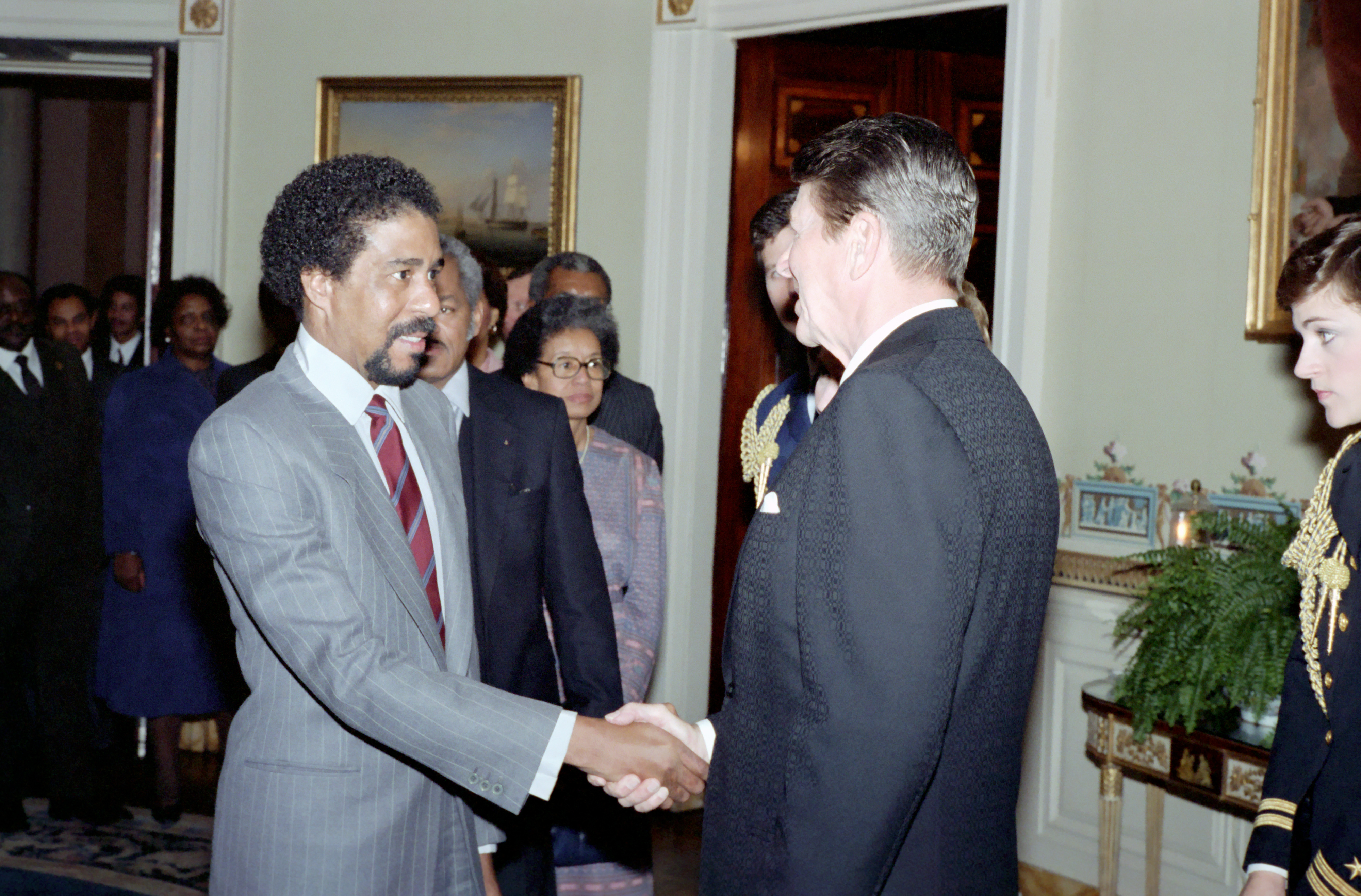
Image: Office of Naval Research, Public domain via Wikimedia Commons
This article was produced with AI assistance and reviewed by our Editorial Desk. How we work.