India’s priciest film project ever is now in cinemas, and audiences in different countries are not even seeing the same cut. Ramayana: Part 1, Nitesh Tiwari’s Hindi-language retelling of the ancient epic, runs 195 minutes in India, 166 minutes in the US and 208 minutes in the UK and Ireland.
The film opened worldwide on November 5, 2026, a week after a premiere at the Academy Museum of Motion Pictures in Los Angeles on October 27. Outside India it carries a different name: Ramayana: Rise of a Legend.
A two-film plan, now stretched to 2028
Part 1 covers the first three of the epic’s books, following Prince Rama from his childhood in Ayodhya through his marriage to Sita, his 14-year exile and Ravana’s abduction of Sita. A short scene during the credits introduces Hanuman.
The second half will take longer than planned. Producer Namit Malhotra confirmed this month that Ramayana: Part 2 has moved from Diwali 2027 to Diwali 2028, saying the team needed more time given the film’s scale. The new window is printed in Part 1’s end credits.
The combined budget for both films is estimated at ₹4,000 crore, about US$430 million. If that figure holds, the duology would be the most expensive Indian production ever and the costliest film made in a language other than English.
Who plays whom
- Ranbir Kapoor as Rama, plus a cameo as Parashurama
- Yash as Ravana; he also co-produces through his company Monster Mind Creations
- Sai Pallavi as Sita
- Ravi Dubey as Lakshmana, in his film debut
- Sunny Deol as Hanuman, in a cameo
- Arun Govil as King Dasharatha
Govil’s casting carries a nod to TV history: he played Rama in Ramanand Sagar’s Ramayan, the 1987-88 television serial that the producers cite as the last widely known screen version of the story. Lara Dutta, Kajal Aggarwal, Rakul Preet Singh, Vivek Oberoi and Kunal Kapoor round out the ensemble, and Anupam Kher voices the vulture Jatayu.
One casting wrinkle drew attention before release. Yash, a Kannada star, originally spoke his own Hindi lines in the first trailer. By the second trailer, actor Sharad Kelkar had taken over Ravana’s Hindi voice, while Yash still dubbed himself in the Kannada version. Ami Trivedi supplies Sai Pallavi’s Hindi voice.
Zimmer’s first Indian score
Hans Zimmer and A. R. Rahman wrote the music together, the first time Zimmer has worked on an Indian film. Rahman layered Sanskrit verses over Zimmer’s early themes, and poet Kumar Vishwas contributed lyrics.
The road to the screen was long. Producers first announced a three-film adaptation in May 2017. It was later reworked into two films under Tiwari alone. Shooting began on April 2, 2024 at Film City in Mumbai under the working title God Power and wrapped by July 1, 2025. Visual effects company DNEG, which also co-produced, handled the effects work during roughly 600 days of post-production.
How critics responded
Reviews have split. About 77% of 52 critics’ reviews counted by the main review aggregator are positive, while a weighted score from nine critics sits at 58 out of 100. Praise has gone to the scale and some of the performances; complaints focus on uneven characters and effects work.
Global audiences have also been weighing it against other big-screen spectacles this month, including Godzilla Minus Zero’s record North American opening. For Indian viewers who skip theaters, the film will later stream on JioHotstar on a pay-per-view basis. More film coverage is on our Entertainment page. Next up for the saga is Diwali 2028.
Further reading
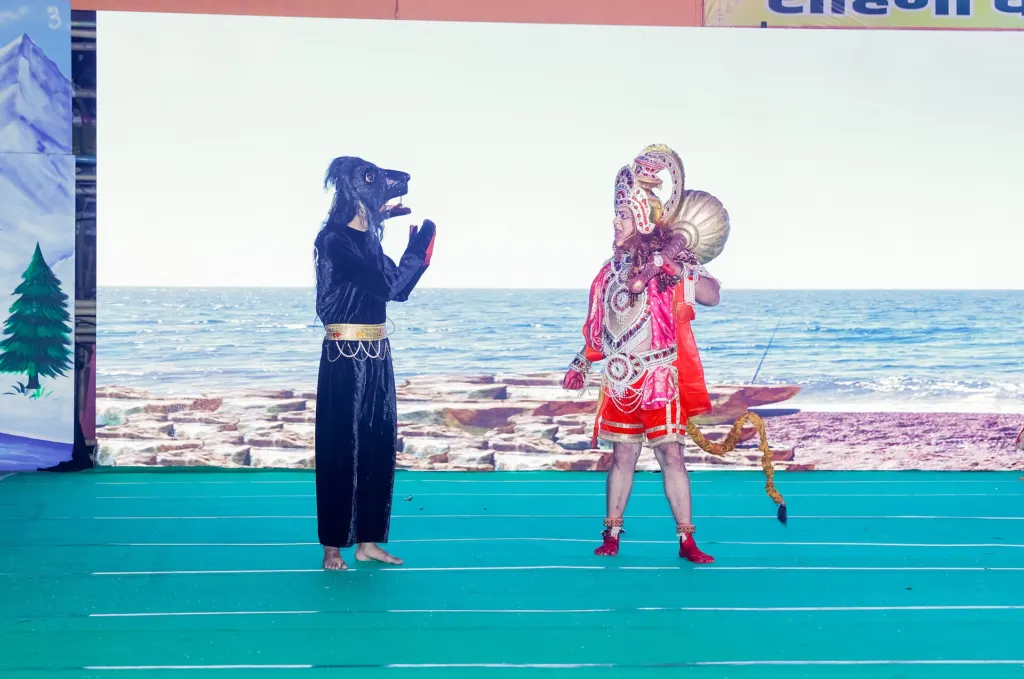
Illustrative image. Image: Spinachkid, CC BY 4.0 via Wikimedia Commons
This article was produced with AI assistance and reviewed by our Editorial Desk. How we work.