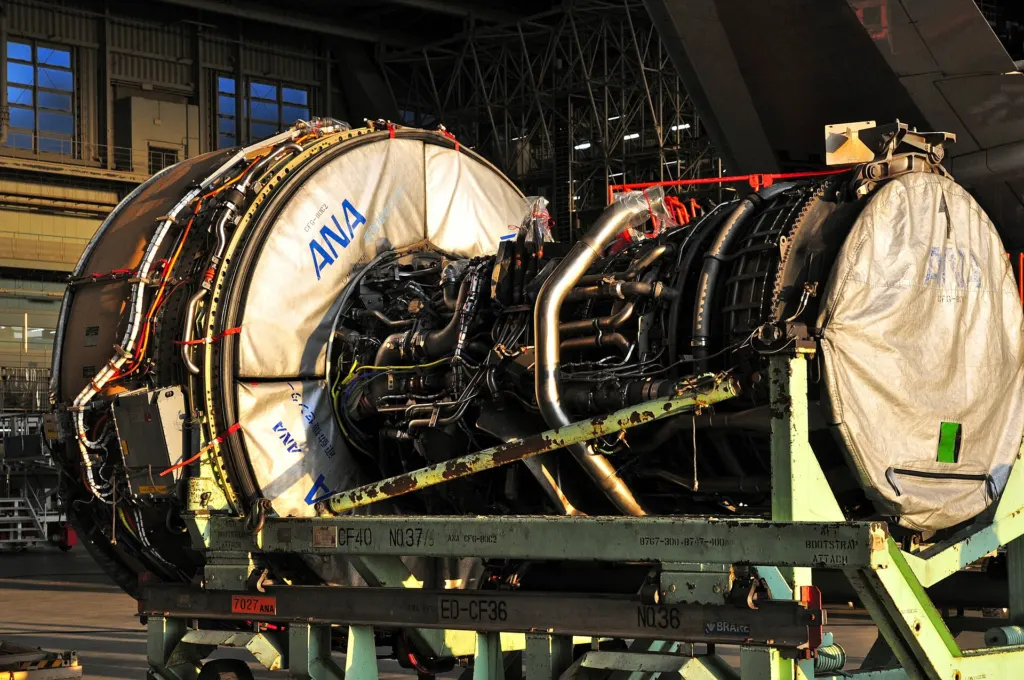
The engine core that once pushed a Boeing 747 across oceans is now being bolted into power plants for artificial intelligence. Missouri-based ProEnergy builds its PE6000 gas turbine around an overhauled core from the General Electric CF6-80C2 jet engine, and in April it agreed to deliver 13 of them to Crusoe for AI data centers.
Each of those 13 generator sets can produce 50 megawatts, the company said in its April 16, 2026 announcement from Sedalia, Missouri. Crusoe, which describes itself as a vertically integrated AI infrastructure provider, will install them to power upcoming hyperscale data center projects.
From the wing to the power plant
ProEnergy first unveiled the PE6000 on November 21, 2023, as a 48-megawatt turbine. Its release said every unit starts with a ProEnergy-overhauled engine core from the CF6-80C2, an engine “found in aircraft including the Boeing 747,” paired with ground-based “aeroderivative” parts.
The idea came out of a project with a large European utility. That first hybrid engine logged more than 180 starts and 8,000 hours of running, and its results led ProEnergy to spend seven years and $115 million on the PE6000 program, covering research, manufacturing and infrastructure.
By that 2023 launch the company had built two PE6000 units. One was running at a WattBridge generating site in Houston, with more than 100 starts and 750 hours logged, and six more were lined up for validation at WattBridge facilities.
Why an airliner engine works on the ground
The trick is older than the AI boom. General Electric has long sold the core of the CF6 as industrial machinery: its LM6000 family, developed from the CF6-80C2, delivers 40 to 56 megawatts for utilities, factories and oil and gas sites and has also driven fast ferries. By 2018 GE had delivered about 4,400 CF6-80C2 engines and 3,000 LM6000 industrial and marine derivatives.
Jet engine cores suit this job because they start fast. ProEnergy pitched the PE6000 as “dispatchable” power, meaning output that can be switched on quickly to fill gaps during severe weather, when solar output fades in the evening, or on days with little renewable production. The CF6-80C2 itself is a big machine, weighing roughly 9,500 to 9,900 pounds in airline form.
What 13 turbines add up to
The arithmetic on the Crusoe order is simple: 13 units at 50 megawatts each comes to 650 megawatts of generating capacity. ProEnergy’s own yardstick from 2023 was that one 48-megawatt PE6000 could firm up supply for more than 40,000 American homes, based on US Energy Information Administration data. Applied to 13 units, that ratio points to more than half a million homes’ worth of capacity, now aimed at computer halls instead.
“The acquisition of these 13 PE6000 units is a strategic move to rapidly provide the energy capacity our hyperscale projects require,” said John Adams, Crusoe’s senior vice president for power infrastructure. ProEnergy chief executive Jeff Canon said the firm’s founding idea was “giving flight engines new life and becoming an OEM for aeroderivative turbines.”
Power is already the sore point of the AI build-out. Badiyaa covered the local fight in our story on a Utah AI data center that SNL spoofed, and the industry’s appetite for computing in our report on Sergey Brin describing Google’s “RSI treadmill”.
ProEnergy says each Crusoe unit will be test-fitted and quality-checked at its Sedalia plant before shipping, so it arrives on site ready to install. The company has not published a delivery date.
Further reading
Image: Noriko SHINAGAWA, CC BY 2.0 via Wikimedia Commons
This article was produced with AI assistance and reviewed by our Editorial Desk. How we work.