A shrimp about 2 inches long can fire a bubble from its claw that collapses so violently it flashes with light, and for an instant the inside of that bubble may run at least as hot as 5,000 kelvin. That is in the neighborhood of the solar surface, which runs about 5,772 kelvin.
Meet the pistol shrimp, also called the snapping shrimp, a family of crustaceans that hunts with what is essentially a water gun.
A claw built like a hammer and trigger
According to the reference entry on the snapping shrimp family Alpheidae, many species carry one hugely oversized claw, sometimes bigger than half the animal's body. A joint lets the top part, the hammer, cock back to a right angle. Sticky pads hold it there while tension builds. When it lets go, a plunger slams into a socket on the other half of the claw and drives out a jet of water.
The family is big and spread across the world's coasts, with well over 330 species in the genus Alpheus alone. Most dig burrows on coral reefs, seagrass flats and oyster reefs. They grow to roughly 1.2 to 2 inches.
The noise is a bubble, not the claw
For decades, people assumed the famous crack came from the two halves of the claw smacking together. Physicists at the University of Twente in the Netherlands, working with a zoologist from the Technical University of Munich, filmed the claw at high speed while recording with an underwater microphone.
Their 2000 paper, “How Snapping Shrimp Snap: Through Cavitating Bubbles,” published in Science, found the water jet leaves the claw fast enough to tear the water apart and form a cavitation bubble. The sound came when that bubble collapsed, not when the claw closed. That shockwave is what stuns or kills the shrimp's prey.
The numbers are wild for an animal that fits on a fingertip. The Alpheidae entry gives a bubble speed of about 25 meters per second, roughly 56 mph, a pressure of up to 80 kilopascals measured 4 centimeters from the claw, and a peak sound level of about 218 decibels relative to one micropascal underwater. The whole click is over in less than a millisecond.
Shrimpoluminescence: the flash of light
A year later the same Twente team went back with light detectors. In a 2001 Nature paper by Detlef Lohse, Barbara Schmitz and Michel Versluis, they reported a short, intense flash of light as the bubble collapses. That flash implies pressures and temperatures inside the bubble of at least 5,000 kelvin, or roughly 8,500°F.
The team “dubbed this phenomenon ‘shrimpoluminescence’,” which they described as the first known case of an animal making light this way. It is a cousin of sonoluminescence, first spotted at the University of Cologne in 1934, the glow lab physicists coax out of bubbles shaken by ultrasound. The flash is far too faint for the naked eye and is probably just a byproduct of the shockwave, with no known purpose. Mantis shrimp, it later turned out, can do something similar with their punches.
Loud enough to bother the Navy
A single snap is tiny. A colony of thousands is not. Snapping shrimp are counted among the major natural sources of noise in the ocean, and a busy reef can produce enough crackle to interfere with sonar and underwater communication.
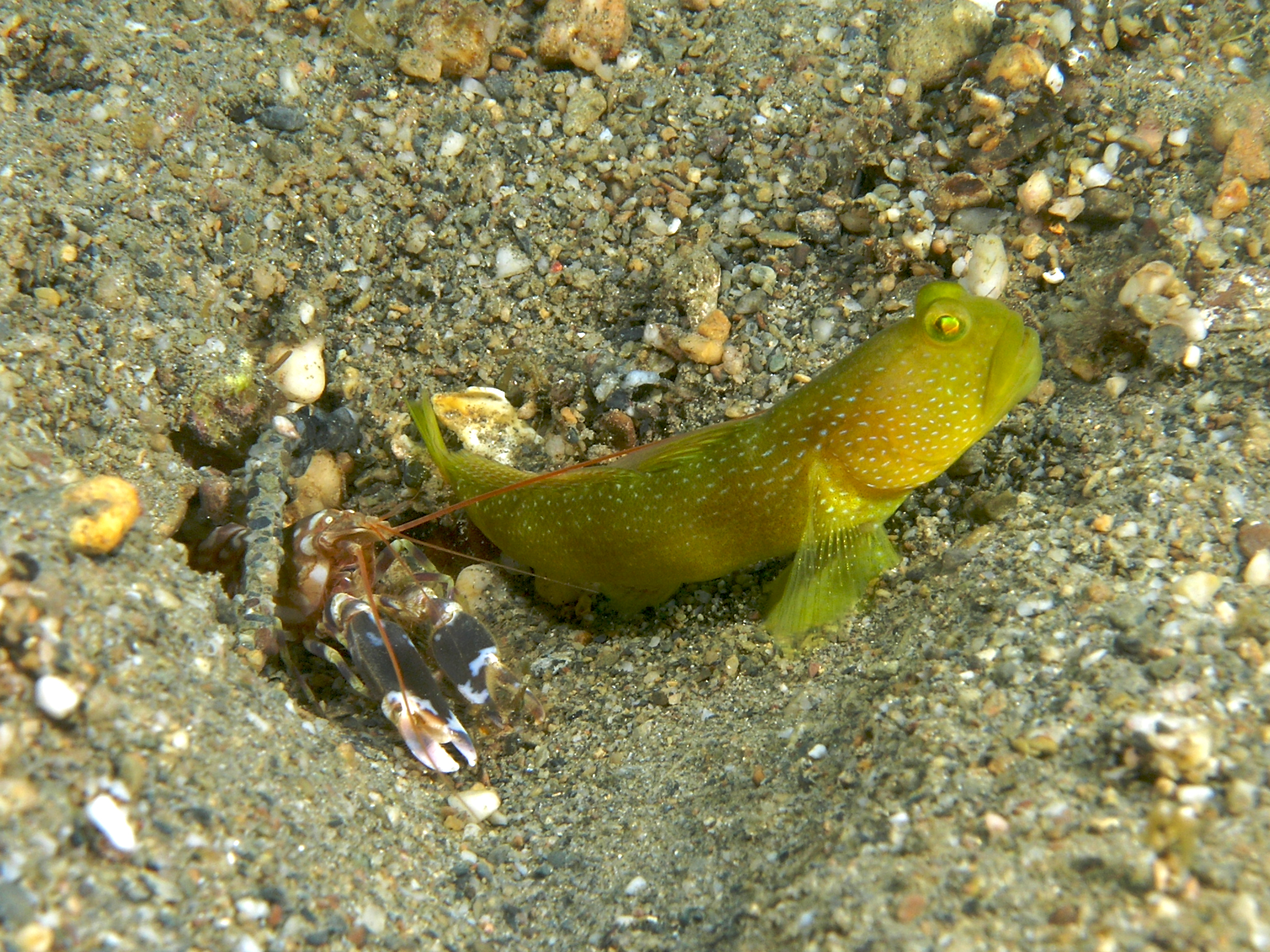
Off the hunt, pistol shrimp have surprisingly cozy lives. Some share burrows with goby fish: the shrimp digs and maintains the home, while the goby, which sees far better, keeps watch and flicks its tail to warn of danger. Others, in the genus Synalpheus, live in sponges in colonies of more than 300 run by a single queen, one of the few known examples of insect-style social life in the sea.
The pistol shrimp has some rivals for the title of most overpowered small creature. Badiyaa has covered how the peacock mantis shrimp punches at 51 mph and how hagfish slime swells 10,000 times to clog a predator's gills.
Sources
- “How Snapping Shrimp Snap: Through Cavitating Bubbles”, Science (Versluis, Schmitz, von der Heydt and Lohse, University of Twente), 2000
- “Snapping shrimp make flashing bubbles”, Nature (Lohse, Schmitz and Versluis, University of Twente), 2001
- “Alpheidae”, Wikipedia, 2026
- “Sonoluminescence”, Wikipedia, 2026
Image: Nick Hobgood, CC BY-SA 3.0 via Wikimedia Commons
This article was produced with AI assistance and reviewed by our Editorial Desk. How we work.