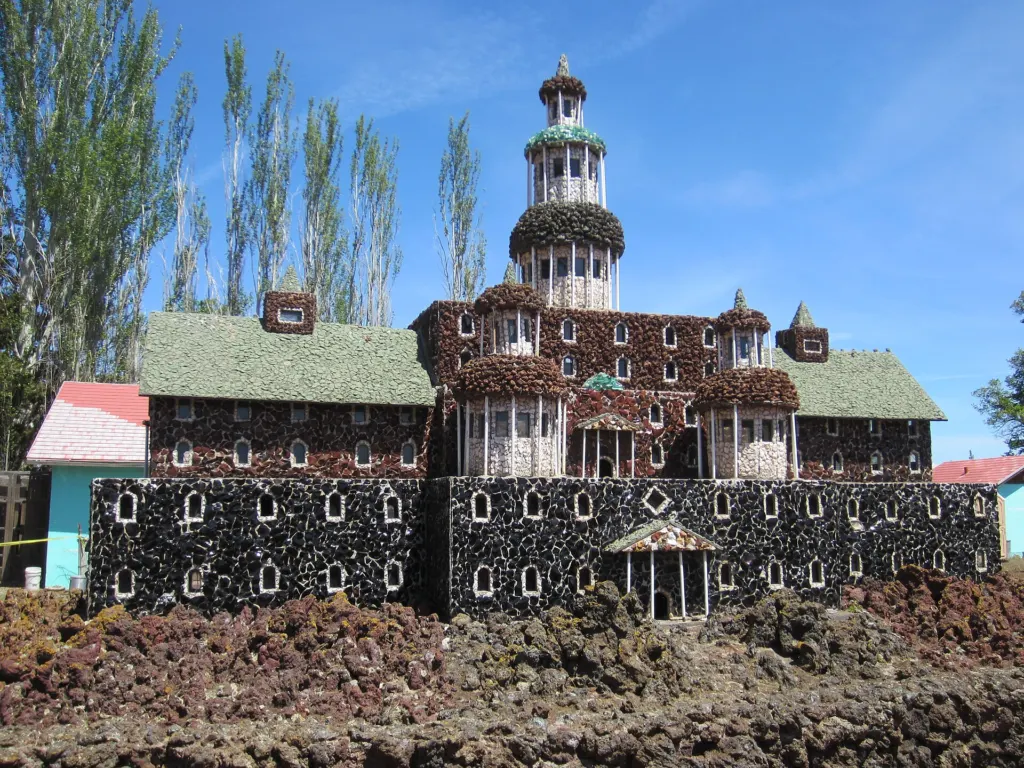
Rasmus Petersen was 52 in 1935 when he began stacking the stones he had cleared from his fields near Redmond, Oregon, into little castles. Ninety-one years on, the four-acre garden he left behind is open again after a decade of decline, a closure and a change of owner, and an old account of his winter hobby is trending online this week.
The practical answer first, for anyone tempted to drive there. Petersen Rock Garden is at 7930 SW 77th Street, about 10 miles north of Bend and 7 miles south of Redmond, roughly 3 miles off U.S. Route 97. It opens Friday through Monday from 10 a.m. to 4 p.m., and from November 1 it closes at 3 p.m. instead. Entry runs on a suggested donation of $10.
A farmer’s winter project
Petersen was a Danish immigrant who arrived in Junction City, Oregon, in 1905 and a year later took up 80 acres of homestead land outside Redmond, filed under the federal Desert Land Act, according to the garden’s own history. By the 1920s he was farming 256 acres of hay, grain and livestock, and in the Depression he switched to potatoes.
The rock work started as something to fill the winters. Central Oregon’s volcanic country gave him plenty of material: agate, jasper, obsidian, lava, malachite, petrified wood and thundereggs, the rounded nodules that split open to show banded or crystal centers. All of it came from within about 85 miles (137 km) of his house. Out of it he built miniature castles, churches, bridges, ponds and fountains, then American landmarks: a stone Independence Hall, a U.S. Capitol and a 7-foot (2.1 m) Statue of Liberty with a light bulb for a torch.
A plaque under that statue is the only inscription on the grounds. It reads: “Enjoy yourself. It is later than you think.”
He gave up farming in 1940 to work on the garden full time and kept at it until he died in 1952, 17 years after the first stones went down.
From roadside hit to locked gate
Visitors arrived almost at once. The current operators put the count at more than 7,000 by 1938 and about 120,000 a year by the early 1950s, a jump of roughly 17 times (120,000 divided by 7,000) in little more than a decade. Other estimates of the peak run closer to 150,000 a year, helped by traffic on the old highway between Bend and Redmond.
After Petersen’s death his widow, Nyleta, ran the site until 1987; her daughter Adele Hegardt and son-in-law Harry followed, and from 2010 Adele’s daughter Susan Caward took over. Upkeep became the problem. In 2011 the Historic Preservation League of Oregon, now Restore Oregon, put the garden on its list of Oregon’s Most Endangered Places. A year later a contractor accidentally damaged one of the stone bridges, which led a Portland company to laser-scan the site so pieces could be rebuilt to match.
The garden joined the National Register of Historic Places on October 30, 2013. It still closed indefinitely in September 2016, when Caward cited repair bills and a cancelled insurance policy, and it went up for sale in June 2022.
What changed in 2026
The buyer, Marci Wayman, turned the property into a nonprofit run with volunteers. After about a year of restoration it reopened with a ribbon-cutting on April 4, 2026, attended by hundreds of people. A $20,000 community grant from a local home improvement firm paid for the museum’s facelift, including a new floor, fresh paint and a rearranged rock collection, and the 1927 farmhouse and the 1940s museum building have new roofs.
Inside, the fluorescent room still glows: its small castles are built from manganese, tungsten, uranium and zinc minerals that light up under ultraviolet lamps. Outside, about 40 peacocks wander the paths and are fed corn, sunflower seeds and wild bird seed.
Before you go
- Check the day. The most common slip is trusting an old listing. Some travel guides still show Thursday-to-Monday hours, but the garden’s own site lists Friday through Monday only.
- Watch the clock in winter. From November 1 the day runs 10 a.m. to 3 p.m.
- Bring cash or a card for the $10 donation, plus extra if you want a souvenir; the museum shop sells rocks, crystals and fossils.
- Plan an hour or more. The tour is self-guided across 4 acres (1.6 hectares), and the garden is family-friendly.
The operators say they are short of museum volunteers and need more before they can open every day. The next fixed change on their calendar is November 1, when closing time moves from 4 p.m. to 3 p.m. The garden’s full history and listing record is online for anyone who wants the long version.
Further reading
Image: Another Believer, CC BY-SA 3.0 via Wikimedia Commons
This article was produced with AI assistance and reviewed by our Editorial Desk. How we work.