Some of the fuel that carried Allied fighters deep over Europe in World War II rode in tanks made of paper. Short of metal, British factories built drop tanks from kraft paper soaked in glue, and by the time American experts declared the idea unworkable, US Eighth Air Force fighters had already used more than 15,000 of them without a single failure.
What a drop tank does
A drop tank is an extra fuel tank hung outside an aircraft, under the wings or belly. Pilots burn its fuel first, then switch to the internal tanks and, in the classic wartime version, let the empty shell fall away. Shedding it removes the drag and weight that would otherwise slow the fighter in a dogfight.
That trick mattered enormously in the war. American planners in the so-called Bomber Mafia had expected heavy bombers to defend themselves and resisted drop tanks, but airmen including Benjamin S. Kelsey and Oliver P. Echols quietly pushed to add them to fighters. Extra fuel turned short-range fighters into escorts that could stay with daylight bombers all the way to their targets.
How you build a fuel tank out of paper
The British design was a careful piece of craft. Each tank came in three parts, a nose cone, a tail cone and a body, each shaped over wooden forms. The middle section was made by wrapping layers of glue-soaked paper around a cylinder, and the end caps were laid up by hand from petal-shaped pieces called gores.
- Wooden baffles went inside to stop fuel sloshing around.
- The interior got a coat of fuel-resistant lacquer before the three pieces were pressed together.
- Each cured tank was pressure tested to 6 psi (41 kPa).
- Tanks that passed received two coats of cellulose dope and two of aluminum paint, which is why paper tanks looked silver while metal ones were gray.
The material was tough against heat and cold and kept water out. Its weakness was the fuel itself, which slowly dissolved the glue. Some tanks started leaking within a few hours of filling, so crews loaded them just before takeoff and used them only for the outbound leg, usually in cool northern European weather.
The numbers
The US version came from Col. Bob Shafer and Col. Cass Hough, who developed a 110-gallon (420-liter) paper tank and got it into series production in London. The most common American metal tank for single-engine fighters in northern Europe held 75 gallons (280 liters). Put side by side, the paper tank carried 50% more fuel than that standard metal one, since 420 divided by 280 is 1.5.
The Royal Air Force made and used some 13,000 paper tanks, most of them during the war, saving a significant amount of metal. Experts at Wright Field in Ohio still insisted that paper tanks were “absolutely unfeasible and will not do the job for which they are intended”, a verdict nobody took seriously given the 15,000 already flown.
Why so few survive
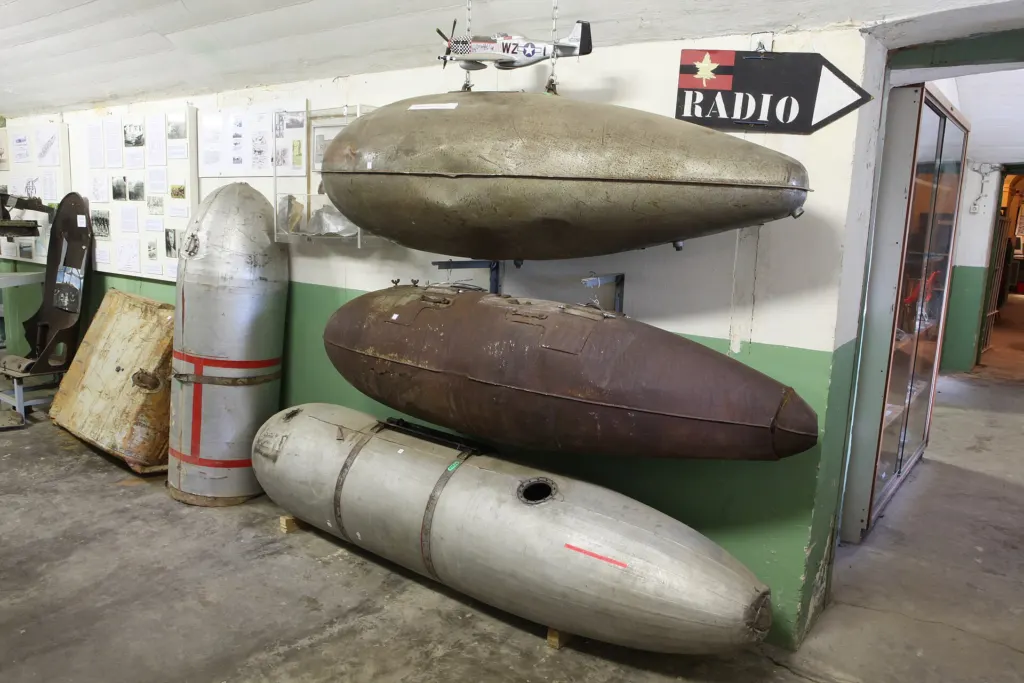
Hardly any paper tanks exist today. They were built to be thrown away, were worth little and were fragile by nature. One survivor sits beside a metal tank at the Luchtoorlogsmuseum, an aviation museum in the Netherlands.
Empty tanks tumbling from the sky also caused alarm on the ground, even though the light paper shells were unlikely to do much harm. German authorities went as far as printing leaflets telling people that drop tanks were not bombs.
Badiyaa has covered other aviation oddities, from the Air Canada 767 that ran out of fuel over a pounds-for-kilograms mix-up to Eugene Ely’s 1910 takeoff from USS Birmingham. The drop tank had a second life after 1945, too: California hot rodders turned surplus P-38 Lightning belly tanks into land-speed racers called lakesters, which still compete on the Bonneville Salt Flats.
Further reading
Image: happy days photos and art, CC BY 2.0 via Wikimedia Commons
This article was produced with AI assistance and reviewed by our Editorial Desk. How we work.