In 1985 a small Dutch team released a home-computer copy of Pac-Man whose hero swore out loud every time he died. When the game crossed the North Sea, the curse had to go. British players got the same maze, the same four ghosts and the same yellow muncher under a politer name: Oh No!
The original title, printed on the Dutch cassette, was a two-word exclamation that starts with “Oh” and ends in a common four-letter English expletive. The UK edition was renamed because that title was considered too obscene for a video game, and the digitized voice inside was re-recorded to match.
A faithful clone with one big difference
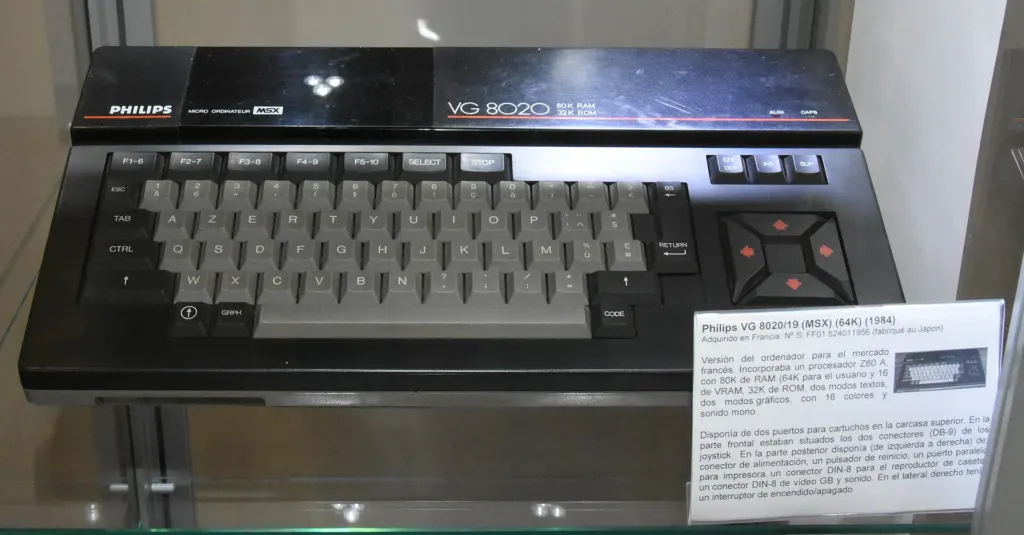
The game ran on MSX, a shared home-computer standard launched in Japan in 1983. It sold best in Japan but also caught on in continental Europe, especially in the Netherlands and Spain, and Dutch electronics giant Philips built MSX machines of its own. It was made by a group called The ByteBusters and published by Aackosoft as part of its Classics range, a line of budget copies of arcade hits.
The maze and art matched Pac-Man almost exactly, down to the level design and the short “coffee break” cartoons that play between stages. Steve Course wrote the code. What set it apart was speech, which was rare on cheap home computers at the time. Ronald van der Putten of The ByteBusters wrote the speech routine and supplied the voice himself.
The ghosts even got new names. Instead of Blinky, Pinky, Inky and Clyde, the title screen introduced them as Joey, Paul, Willy and Frankie.
What changed for British players
The renaming was more than a sticker on the box. The two versions differ in a few specific ways:
- The death line: in the Dutch original, the hero shouts the title every single time he loses a life. In Oh No!, the phrase is heard only once, when the last life is gone and the game ends.
- The introductions: the original rattles off all four ghost names in one sentence. The UK version says “This is Joey, this is Paul, this is Willy, and this is Frankie,” repeating the same recorded “This is” four times.
- The price: Oh No! sold for £2.99 in Britain in 1986.
That last point mattered to reviewers. One British MSX magazine gave the game two stars out of three and called it “an easy game to play,” adding that “Pac-man fans will love this game as it is based very much along the same lines.” It singled out the talking as “a really novel and fun feature.”
A second, even blunter rename
Aackosoft went bankrupt in 1988. Its catalog was then reissued by Premium III Software Distribution, and this time the title was cut down to just the expletive on its own. Its box borrowed the cover painting of a 1985 horror paperback, The Howling III: Echoes, and may never have had the rights to it. The same year the game also appeared on a 30 MSX Hits compilation that added compatibility with the newer MSX2 machines.
Prices tell their own story. In the Netherlands the original cost 29.50 guilders in 1985 and was cut to 14.95 guilders in 1987. Divide one by the other and the game lost about 49 percent of its price in two years, typical of how fast budget software was discounted in that era.
Dutch reviewers were mostly kind. One magazine scored it 4.5 out of five but complained that “the speech, which gets boring quickly, has been added at the expense of the original wokka-wokka sounds.” Another simply told readers, “You already know how to play it: it’s Pac-Man.”
For more on how one game can end up in many different versions, see our guide to The Secret of Monkey Island’s many releases, and browse more retro stories in our Gaming section.
The original MSX cassette needed a machine with at least 32K of memory, so unlike most of Aackosoft’s Classics range, it would not run on the cheapest 16K MSX computers of 1985.
Further reading
Image: AUIC Oficial, CC BY-SA 2.0 via Wikimedia Commons
This article was produced with AI assistance and reviewed by our Editorial Desk. How we work.