Nelson Mandela's famous line about education was not delivered in a grand hall or a world summit. The earliest sourced version sits in a speech to students at Madison Park High School in Boston on June 23, 1990, four months after he walked out of prison.
And the words he used that day are not quite the ones printed on classroom posters.
What the poster says
The version shared millions of times reads: "Education is the most powerful weapon which you can use to change the world." It turns up in graduation speeches, school mottos and United Nations remarks, almost always credited to Mandela with no date or place attached.
What the record shows
The sourced entry in Wikiquote's collection of Nelson Mandela quotations dates the line to that Boston visit. Mandela was talking about young people leaving school early, a worry he said he shared in South Africa and in the United States. His closing advice, as recorded, was to "try as much as possible to remain in school, because education is the most powerful weapon which we can use."
Two differences jump out. He said "we," not "you," putting himself alongside the students. And there is no "to change the world" at the end. In the recorded remarks, the weapon is aimed at something closer to home: staying in school.
The fuller phrasing grew later. Wikiquote's citation for the Boston remarks rests on two 2013 retrospectives published in Boston after Mandela's death, and Badiyaa found no dated, sourced first use of the "change the world" ending in the open records checked. Until one turns up, the honest attribution is the Boston version.
Why he was in Boston
Mandela had been released from Victor Verster Prison on February 11, 1990, after 27 years behind bars. Within months he was on a world tour pressing governments to keep sanctions on apartheid South Africa. In the United States, according to Wikipedia's biography of Mandela, his stops took in eight cities, a meeting with President George H. W. Bush and a speech to a joint session of Congress, and African American crowds gave him an especially warm welcome.
Madison Park sits in Roxbury, at the heart of Boston's Black community, on what is now Malcolm X Boulevard. The school's Wikipedia entry describes it as the only technical vocational high school in the city, part of Boston Public Schools, with about 1,100 students today.
Four years after that speech, Mandela became South Africa's first Black president, serving from 1994 to 1999. He died in Johannesburg on December 5, 2013, at 95.
A pattern with Mandela quotes
He is one of the most quoted people of the last century, and one of the most misquoted. Badiyaa has already traced the "Our deepest fear" passage, which is Marianne Williamson's, not Mandela's, and the widespread false memory that Mandela died in prison in the 1980s.
The education line is a gentler case. Mandela really did say something very close to it, to a room of Boston teenagers in June 1990. The world just edited his "we" into a "you" and gave it a bigger target. The sourced Boston wording, with its "we," is the version to cite.
Sources
- Nelson Mandela, Wikiquote, 2026
- Nelson Mandela, Wikipedia, 2026
- Madison Park Technical Vocational High School, Wikipedia, 2026
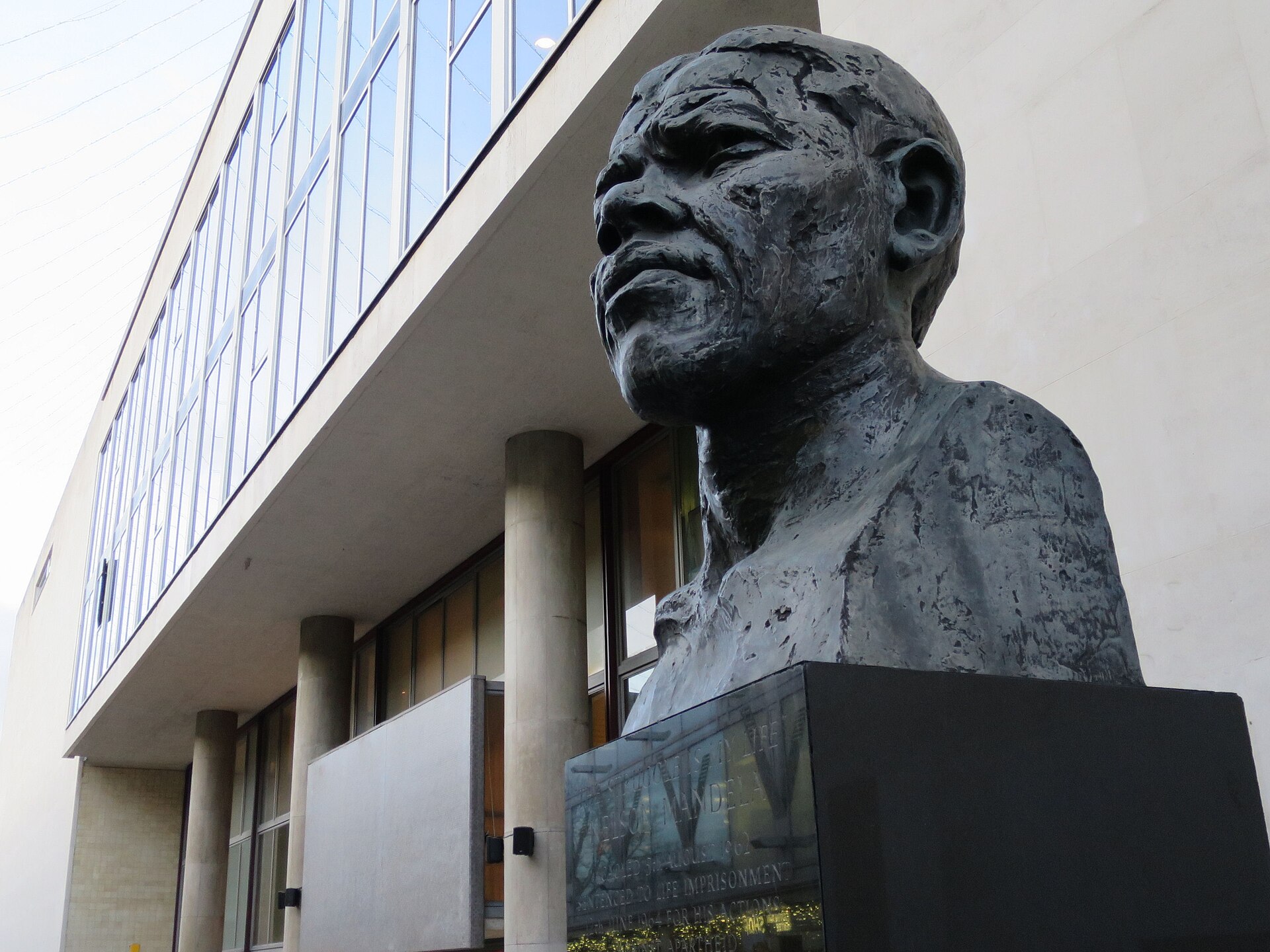
Image: Alan Stanton, CC BY-SA 2.0 via Wikimedia Commons
This article was produced with AI assistance and reviewed by our Editorial Desk. How we work.