Strap on a typical automatic watch and something inside it beats 28,800 times an hour, eight times a second, with no battery and no chip. That number comes from Bartosz Ciechanowski's interactive Mechanical Watch explainer, a sprawling 3D walkthrough on his own site that lets readers spin a movement around, slice it open and slow the parts down to watch every tooth do its job.
The page first went up on May 4, 2022, and it still gets passed around for a simple reason: it makes a machine the size of a coin feel huge. Taken apart piece by piece, the watch goes like this.
A coiled spring does all the work
Everything starts with the mainspring, a spiral strip of metal wound tight inside a drum called the barrel. Left alone, it would unwind in a blur. Ciechanowski demonstrates the problem by sticking a hand straight on the barrel: it whips around a few times and dies.
His math explains the fix. To run about 40 hours, the second hand must turn roughly 2,400 times, while the barrel turns only close to 7 times on a full wind. A single gear pair would need a ratio near 343 to 1, with teeth so tiny they would be absurdly fragile. So watches use a chain of four wheels, each big gear driving a small pinion, stepping the speed up in stages.
The escapement and the beating heart
Gears alone would still let the spring dump its energy in seconds. The brake is the escapement: an escape wheel with oddly hooked teeth and a rocking pallet fork tipped with synthetic ruby. The fork lets the wheel slip one tooth at a time, which is the tick you hear.
What sets the pace is the balance wheel, a weighted ring on a hair-thin spring that swings back and forth like a tiny pendulum. Each swing knocks the fork, the fork frees the wheel, and the wheel gives the balance a small push back, like shoving a kid on a swing. In the movement on Ciechanowski's page the balance completes four full swings a second.
That rate is common but not universal. Wikipedia's mechanical watch entry lists 18,000, 21,600, 28,800 and 36,000 beats per hour as the usual speeds, and notes that most movements run between 36 and 72 hours on a full wind.
Rubies, clicks and the self-winding trick
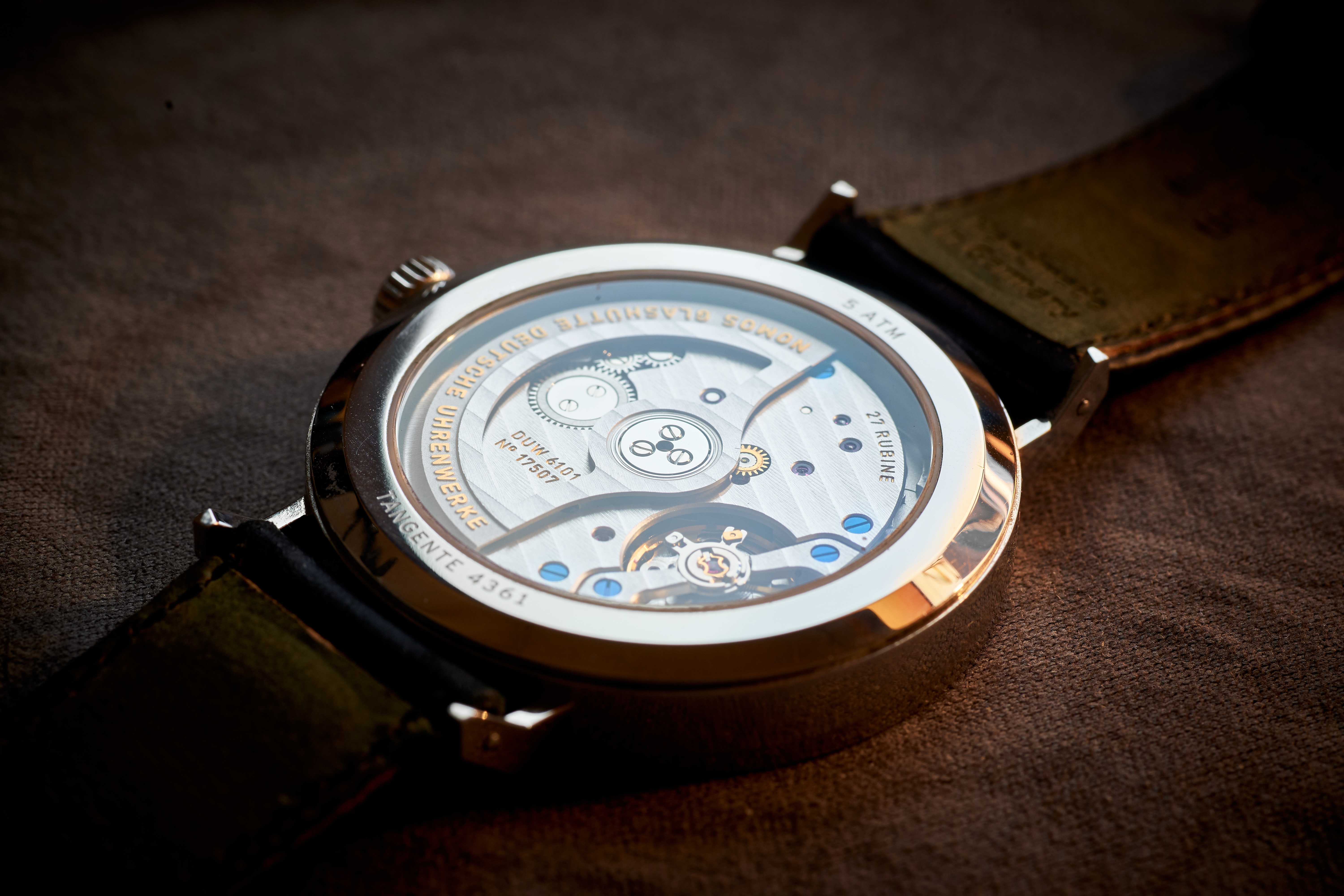
The jewels in a watch are not bling. Synthetic ruby is hard and slick against steel, so it serves as bearings where shafts spin. The same Wikipedia article recounts a 1960s "jewel craze" when brands advertised 41, 53, 75 or even 100 jewels; the Waltham 100-jewel watch was an ordinary 17-jewel movement with 83 decorative rubies around the rotor. A 1974 ISO standard put an end to counting the useless ones.
A small pawl called the click stops the spring from unwinding backward, and it is the source of the ratcheting sound when you wind the crown. Automatic watches add a free-swinging weight. As your wrist moves, gravity turns it, and a pair of one-way gears means swings in either direction wind the spring.
The explainer closes by shrinking the whole thing back to real size next to the outline of a credit card. In his closing words, Ciechanowski writes that "Mechanical watches are not as accurate as digital ones," yet "these devices show a true mastery of engineering."
Badiyaa has looked at other clockwork wonders, including the Silver Swan automaton built in London in 1773, and at Elijah McCoy's 1872 engine oiler patent, another small part that kept big machines running.
The one-line version: spring stores it, gears multiply it, the escapement rations it, and the balance wheel counts it out at eight beats a second.
Sources
- Mechanical Watch, Bartosz Ciechanowski (author's own site), 2022
- Mechanical watch, Wikipedia, 2026
Image: Anil Öztas, CC BY-SA 4.0 via Wikimedia Commons
This article was produced with AI assistance and reviewed by our Editorial Desk. How we work.