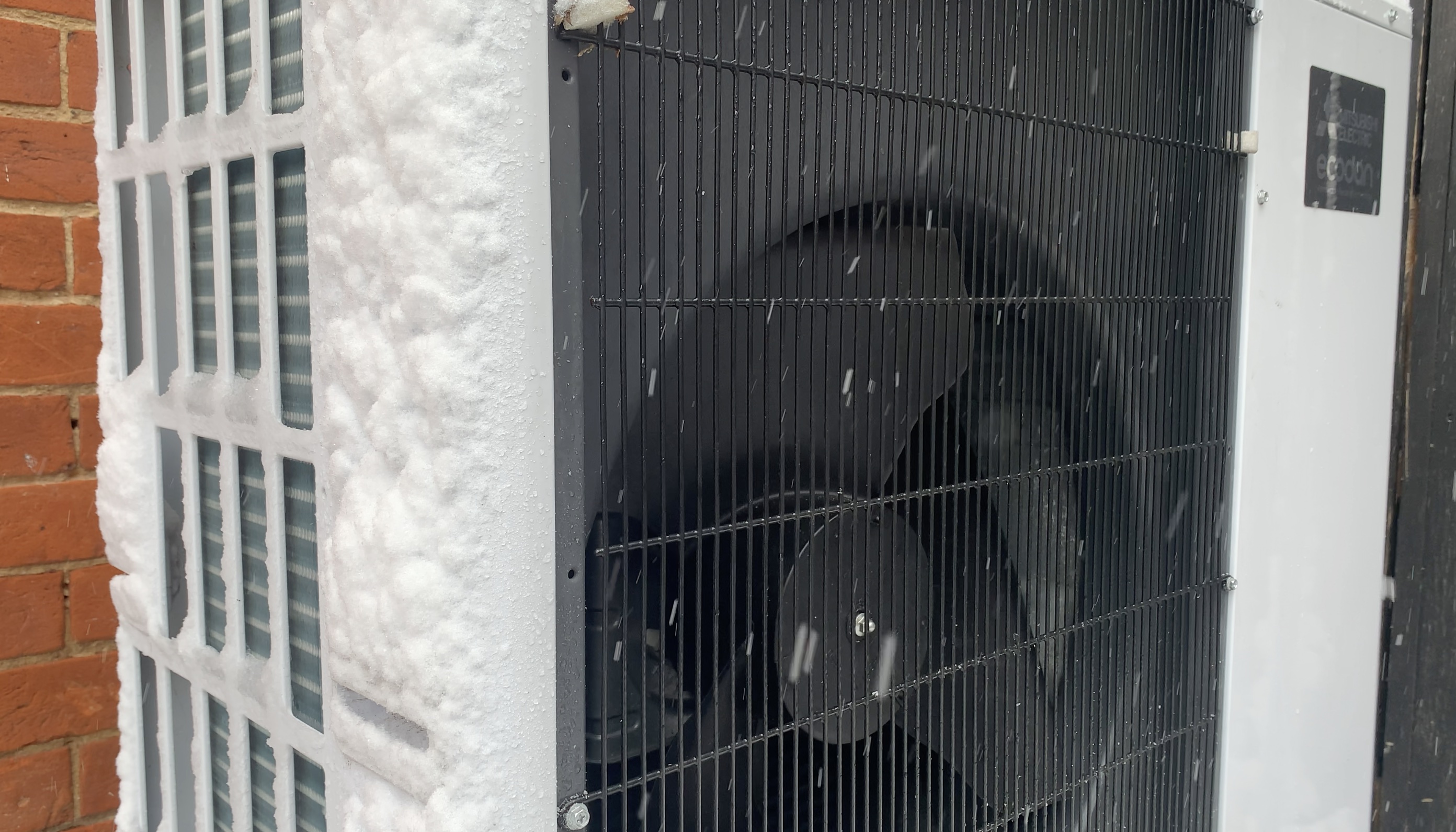
A heat pump warms a home in winter without burning anything. Instead of making heat, it moves heat that is already outdoors, even in cold air, and pumps it inside. In summer the same machine runs the other way and works as an air conditioner.
That difference is the whole idea. Because heat pumps move heat rather than converting it from fuel, an air-source model can put up to three times as much heat into a house as the electricity it consumes, according to ENERGY STAR's guide to air-source heat pumps, the efficiency program run by the US Environmental Protection Agency and Department of Energy.
The cycle, step by step
Every common heat pump runs a loop of refrigerant, a fluid that boils at very low temperatures, through four main parts. In heating mode, the cycle goes like this:
- Outdoor coil (evaporator): cold liquid refrigerant passes through the outdoor unit. Even freezing air is warmer than the refrigerant, so the refrigerant absorbs heat and turns into a gas.
- Compressor: the gas is squeezed, which raises its pressure and its temperature well above room temperature.
- Indoor coil (condenser): the hot gas gives up its heat to the air or water inside the house and condenses back into a liquid.
- Expansion valve: the liquid's pressure drops sharply, which chills it below the outdoor temperature so the loop can start again.
A reversing valve swaps the jobs of the two coils, so in summer the indoor coil collects heat and the outdoor coil dumps it, Wikipedia's heat pump article explains. Outdoor coils can ice up in damp, cold weather, so units run a short defrost cycle to melt it.
Why it beats a plain electric heater
Engineers measure this with the coefficient of performance, or COP: units of heat delivered per unit of electricity. An electric resistance heater has a COP of 1.0. A well-designed heat pump typically reaches 3 to 5 when it is 10 °C (50 °F) outside and 20 °C (68 °F) inside. The catch is that efficiency falls as the outdoor air gets colder, because the pump has a bigger temperature gap to bridge.
Newer equipment handles that better. ENERGY STAR tests certified cold-climate air-source heat pumps down to 5 °F (minus 15 °C), and says they keep working below that, though pairing them with a backup heat source is the most efficient approach in deeper cold.
Ducted, ductless and ground source
A ducted air-source heat pump plugs into the same forced-air ducts a furnace uses, and ENERGY STAR suggests thinking of it as a central air conditioner that also runs in reverse. Mini-split, or ductless, systems mount an indoor unit on a wall or ceiling, paired with an outdoor unit. Ground-source models swap outdoor air for the steady temperature of the earth, which makes them the most efficient type, with COPs typically around 3 to 6.
An idea from 1852
The physics is old. Lord Kelvin described the theory behind heat pumps in 1852, and Peter von Rittinger built the first one between 1855 and 1857. A heat pump installed in Zurich's city hall in 1937 and 1938 heated the building for 63 years, until 2001. By 2022, more heat pumps were sold in the US than natural gas furnaces, the heat pump entry records.
Running one well
ENERGY STAR's tips for owners are simple: pick a comfortable temperature and leave it there, since heat pumps do not save energy by being turned down at night; set the system to heat or cool rather than auto; and clean the dust filters when they look dirty.
For more practical home explainers, see Badiyaa's Lifestyle section, including our look at what a stovetop simmer pot actually does.
Sources
- Air-Source Heat Pumps, ENERGY STAR (US Environmental Protection Agency and Department of Energy), 2026
- Heat pump, Wikipedia, 2026
Image: PeterEastern, CC BY-SA 4.0 via Wikimedia Commons
This article was produced with AI assistance and reviewed by our Editorial Desk. How we work.