Gordon Parks was 28 when he walked into a Seattle pawnshop and paid $12.50 for a Voigtländer Brillant camera. He had no lessons and no connections. Within three decades that cheap camera had carried him to Life magazine, to Vogue's fashion shoots and to the director's chair on Shaft, the 1971 hit that put a cool, leather-coated Black private eye at the center of a Hollywood film.
Parks was born in Fort Scott, Kansas, on November 30, 1912, the youngest of 15 children of a farming family, according to his Wikipedia biography. His mother died when he was 14. Sent to live with a sister in St. Paul, Minnesota, he was put out on the street at 15 and survived by playing piano, busing tables, waiting on trains and playing semi-pro basketball.
A camera as a weapon
Fashion portraits for a St. Paul clothing store caught the eye of Marva Louis, the wife of boxing champion Joe Louis, who urged Parks to move to Chicago. A Julius Rosenwald Fellowship in 1942 paid him $200 a month and led him to the Farm Security Administration in Washington, D.C.
There he made his most famous image, American Gothic, Washington, D.C., a portrait of Ella Watson, a Black member of the building's cleaning crew, posed stiffly before an American flag with a broom in her hand. His boss, Roy Stryker, called the picture an indictment of America and warned it could get every one of his photographers fired.
In 1948 Life hired him as a staff photographer and writer on the strength of his photo story about a teenage gang chief in Harlem. He stayed until 1972, photographing Muhammad Ali, Malcolm X and Barbra Streisand along with poverty and segregation. Vogue, meanwhile, kept booking him for evening gowns, and he became known for shooting models in motion instead of frozen poses.
Fifteen minutes that opened Hollywood
In 1969 Parks adapted his own semi-autobiographical novel, The Learning Tree, for Warner Bros.-Seven Arts. He wrote the script, produced it, composed the score and directed it in his hometown, making it the first film by a Black director for a major American studio. The film's Wikipedia entry quotes him on how the deal happened: "We had a meeting that lasted 15 minutes and he gave me the job of directing The Learning Tree. All of those years of prejudice and bigotry were broken down in 15 minutes."
Two years later came Shaft. The script had the detective as white; Parks cast Richard Roundtree instead. The film's record lists a budget of $500,000 and a gross of $13 million, and the movie is credited with helping rescue a struggling MGM. Both films now sit in the Library of Congress's National Film Registry. Parks even returned for a cameo in the 2000 Shaft, where Samuel L. Jackson greets him as "Mr. P."
The private life of a public man
Parks married three times. His third wife, Genevieve Young, started out as his book editor on The Learning Tree; the pair fell for each other while both were divorcing, and married in 1973. Until his death in 2006 he was in a long-term relationship with Gloria Vanderbilt, the heiress and designer. Not bad for a man who once slept in a Chicago flophouse.
He also helped found Essence magazine in 1970, wrote 15 books and composed a ballet about Martin Luther King Jr. For more Black pioneers on our History pages, read how Dorothy Dandridge became the first Black woman nominated for the best actress Oscar and how Zora Neale Hurston wrote Their Eyes Were Watching God in seven weeks. Photography fans can also see how Ansel Adams split every picture into 11 tones.
Sources
- Gordon Parks, Wikipedia, 2026
- The Learning Tree, Wikipedia, 2026
- Shaft (1971 film), Wikipedia, 2026
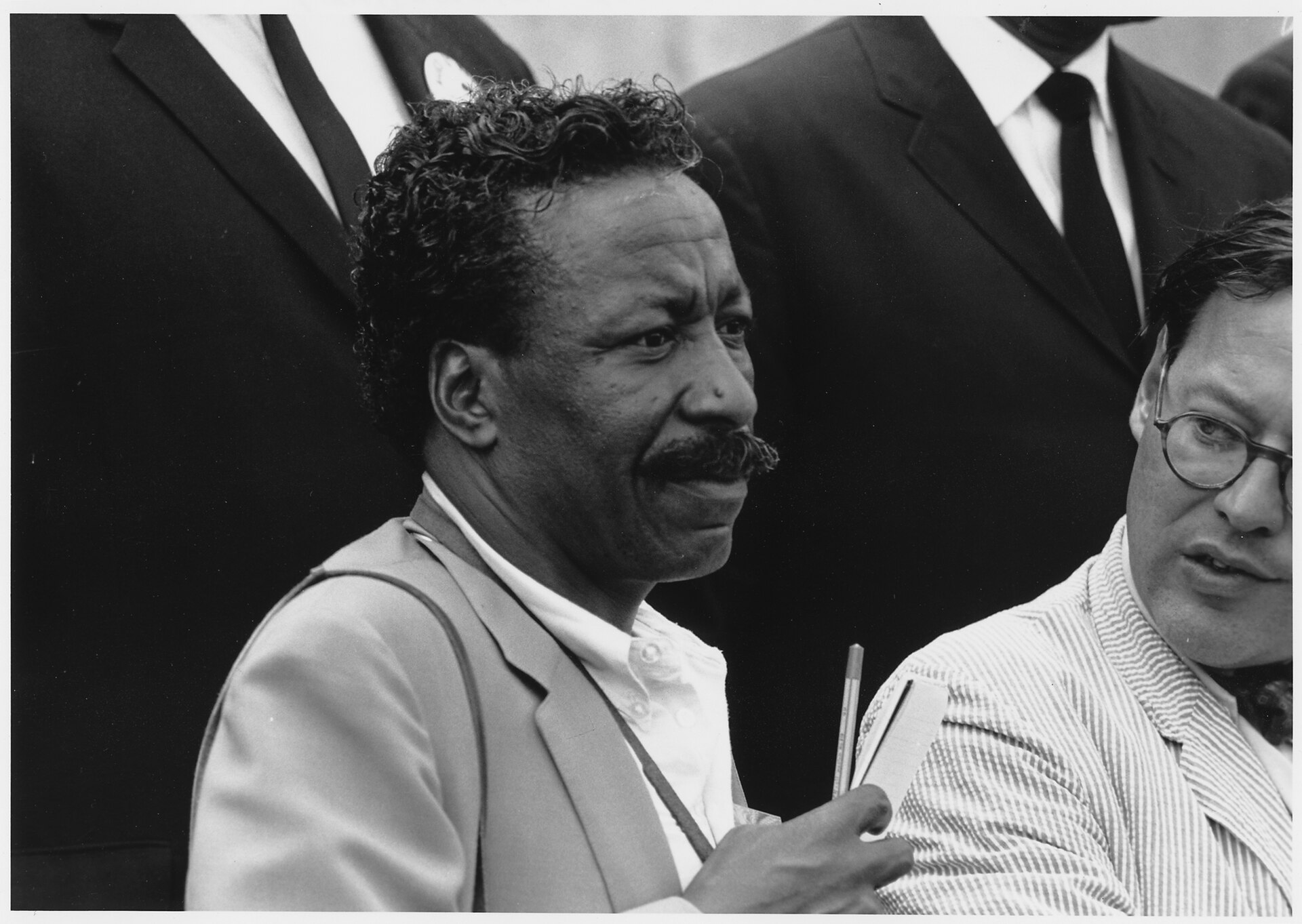
Image: Rowland Scherman (US National Archives), Public domain via Wikimedia Commons
This article was produced with AI assistance and reviewed by our Editorial Desk. How we work.