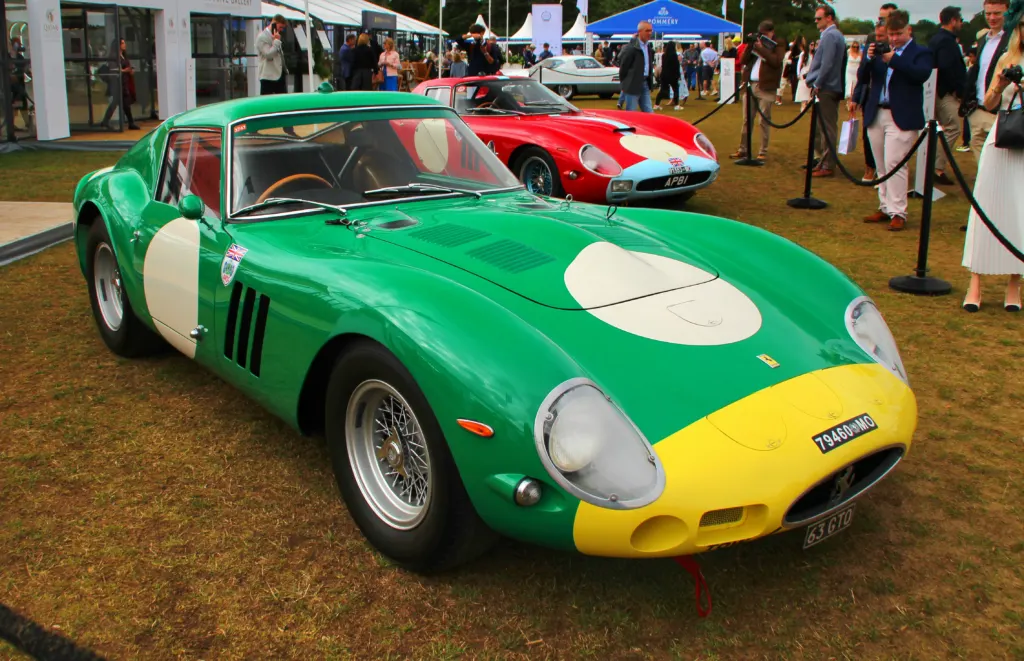
In 1962 a buyer in the United States could drive home a brand-new Ferrari 250 GTO for about $18,000. In June 2018 one of the same cars, a 1963 example with chassis number 4153GT, changed hands in a private sale for $70 million. That deal still stands as the record for the most expensive Ferrari ever sold.
Ferrari made just 36 of them between 1962 and 1964. Buyers were reportedly vetted by Enzo Ferrari himself and by his North American dealer, Luigi Chinetti.
Price per kilogram
The GTO is a light car. Its curb weight sits between 880 and 950 kilograms, or roughly 1,940 to 2,094 pounds. Spread $70 million across that and every kilogram of the record car was worth somewhere between $74,000 and $80,000. Put another way, the 2018 price was close to 3,900 times the $18,000 sticker from 1962.
What the money buys
The name stands for Gran Turismo Omologato, Italian for Grand Touring Homologated. Ferrari built it to race in the FIA’s Group 3 GT class against the Shelby Cobra, the Jaguar E-Type and Aston Martin’s DP214.
Under the long aluminum nose sits a 3.0-liter Colombo V12 fed by six Weber carburetors, good for about 300 PS at 7,500 rpm, through a five-speed manual gearbox. Chief engineer Giotto Bizzarrini shaped the body with help from wind tunnel tests at the University of Pisa, and Scaglietti built the bodies. The most famous paint color is the bright red Rosso Cina.
Inside, it is bare. There is no speedometer, the seats are trimmed in cloth, and there is no carpet or headliner. The exposed metal gear gate became a Ferrari signature for decades.
The shuffle myth
Racing rules in 1962 demanded at least 100 cars for a GT homologation, and Ferrari built 36. A popular story says Enzo Ferrari moved the same cars between locations so FIA inspectors would think they were counting 100. The real answer is duller. The GTO was approved as an evolution of the earlier 250 GT SWB, which had been homologated in 1960, so no trick was needed. Aston Martin and Jaguar used similar paperwork for their own racers.
From used race car to trophy asset
The value curve is wild. By the late 1960s a GTO was just an old race car, and many traded for four-figure sums. Pink Floyd drummer Nick Mason paid £35,000 for chassis 3757GT around November 1977, and he still owns it. Prices crashed in the early 1990s to lows of $2.7 million in 1994 and $2.5 million in 1996, before climbing again.
Here is how a few key sales stack up:
- 1962: about $18,000 to $18,500 new.
- 1977: £35,000 (about $71,000) for Nick Mason’s car.
- 2018 (June): $70 million privately for 4153GT, the Ferrari record.
- 2018 (August): $48.4 million at auction in Monterey for 3413GT, then the highest auction price for any car.
- 2023: $51.7 million in New York for 3765LM.
The GTO no longer holds the overall title. Badiyaa has covered the Mercedes-Benz 300 SLR Uhlenhaut Coupé, still the most expensive car ever sold, and the story of how Ferdinand Porsche built the first hybrid car in 1900. More records live in our offbeat section.
The latest GTO to sell was the white 3729GT, known as Bianco Speciale, which went for $38.5 million at a Florida auction in January 2026.
Further reading
Image: Calreyn88, CC BY-SA 4.0 via Wikimedia Commons
This article was produced with AI assistance and reviewed by our Editorial Desk. How we work.