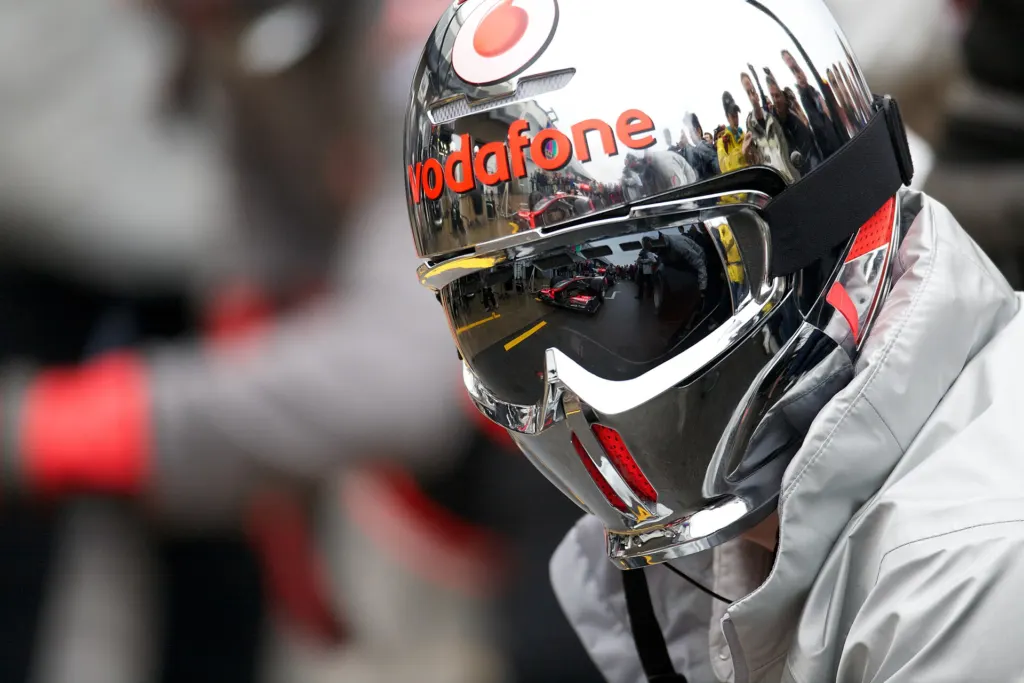
A clip of a racing crew swapping tires in a blur is making the rounds on Reddit this week, and it raises a fair question: how did changing wheels get this quick? In Formula One the answer is now under two seconds. McLaren holds the world record, a 1.80-second stop on Lando Norris’s car at the 2023 Qatar Grand Prix, the fastest pit stop in any racing series.
Fifty years ago, four seconds was a headline. Bobby Unser’s crew set what was then called a world record with a four-second stop at the 1976 Indianapolis 500.
What happens in those 1.8 seconds
Formula 1’s own technical guide breaks a solid 2.2-second stop into tenths. The car’s nose hits the front jack a fraction before it halts, and the jack is fully up at 0.3 seconds. The rear jack follows at about 0.4 seconds.
Each corner has its own small team: a gunner with a wheel gun, a crew member pulling the old wheel off and another pushing the new one on. The old wheels are off at roughly 0.6 seconds, the new ones are on by 1.2, and the guns have tightened the nuts and come away at about 1.9. Both jacks drop at around 2.1 seconds.
Around them, wing-adjusters tweak the front flap and two stabilizers hold the car steady. The release call is still made by a person, usually the chief mechanic, who works a set of traffic lights. The old lollipop sign is gone.
When it goes right, you barely see anything. The guide describes a good stop as two sounds: the guns loosening all four nuts together, then firing again to tighten them.
Why refueling made stops slower
Mid-race refueling was allowed in F1 until 1983 and again from 1994 to 2009. In that era a stop involved about 20 mechanics and lasted six to twelve seconds, because the tires had to wait for the fuel. Once refueling was banned in 2010, the stop became a pure tire change, and the times began to fall.
A quick record timeline, from the event histories:
- 1976: Bobby Unser’s 4-second stop at Indianapolis.
- Before 2013: McLaren’s 2.31 seconds is the F1 benchmark.
- 2013 Malaysian Grand Prix: that mark falls six times in one race; Red Bull’s 2.05 for Mark Webber is quickest.
- 2019 Brazilian Grand Prix: Red Bull services Max Verstappen in 1.82 seconds.
- 2023 Qatar Grand Prix: McLaren’s 1.80 for Norris.
Some quick math puts that in perspective. Going from Unser’s 4 seconds to 1.80 cuts the stop by 55%. The gain from 2013’s 2.05 to today’s record is only a quarter of a second, which shows how close crews are to the physical limit. In NASCAR, where crews also refuel, the record listed for 2025 is 8.02 seconds for Denny Hamlin’s Joe Gibbs Racing car.
Consistency beats records
Teams care less about one record than about never having a bad stop. “It’s no-good breaking a world record if the next pit stop is five seconds!” McLaren operations director Charlie Hooper said in the official F1 guide. His crew ran fewer practice stops than usual in the Qatar heat the weekend it set the 1.80.
Crews are not specialists. They are the team’s mechanics and technicians, rotated through positions across a long season, and a typical practice session runs only eight to ten stops to avoid tiring them out. The driver matters too: if the car misses its marks by a few centimeters, the whole choreography slows.
For more on the sport’s past, see how Sebastian Vettel became F1’s youngest world champion in 2010, and the 25 drivers in our list of Formula One’s one-race Grand Prix winners.
At the 2024 season finale in Abu Dhabi, a 2.07-second stop for Norris was the fastest of the day and helped McLaren hold the lead that sealed its first constructors’ title since 1998.
Further reading
Image: Mark McArdle, CC BY-SA 2.0 via Wikimedia Commons
This article was produced with AI assistance and reviewed by our Editorial Desk. How we work.