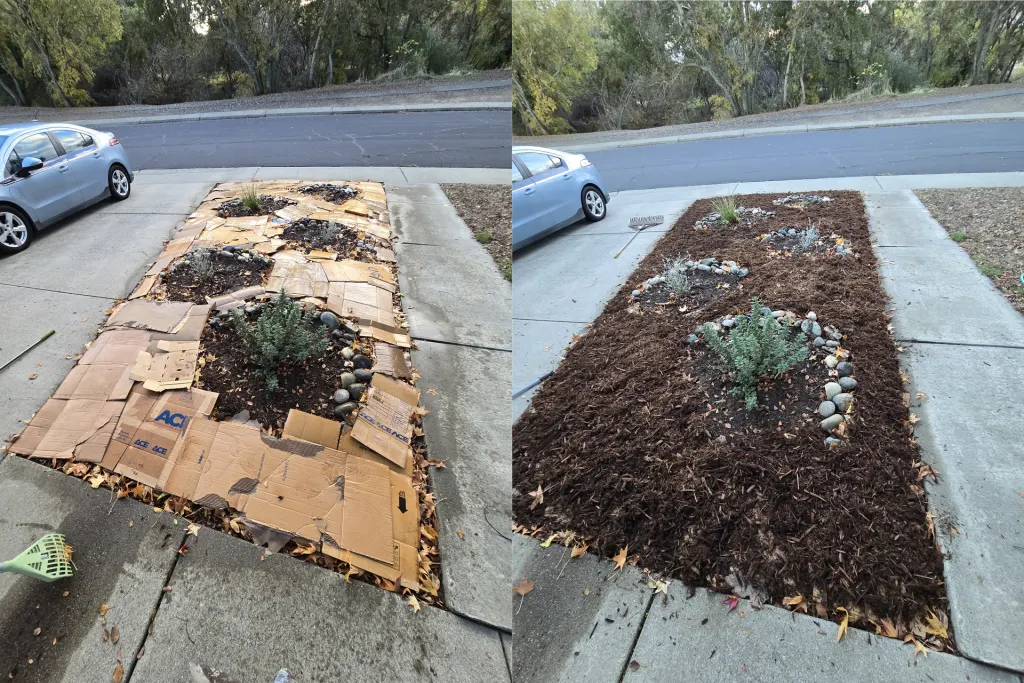
Cardboard laid over a bed in October and buried under 4 to 6 inches (10 to 15 cm) of mulch should be ready to plant through by April. That is the short answer from three US university extension services, which put the wait at four to six months. By spring the grass and weeds underneath have died for lack of light, the cardboard has softened or largely broken down, and the top layer has started turning into organic matter.
The method is called sheet mulching. Oregon State University Extension describes it as a light barrier: plain cardboard, newspaper or heavy paper stops photosynthesis in whatever is beneath, and a covering of bark, wood chips, leaves or other compostable material holds it down and starts to rot. Its guide calls fall an excellent time to start, because the layers break down slowly over winter. Stack alternating layers of greens and browns on top and it becomes lasagna composting, which needs about six months or more.
The method, step by step
Extension guides agree on the order of work. Mow the area as short as possible. Cut an edge around the bed 4 to 6 inches deep so the cardboard can be tucked in. Lay plain corrugated cardboard with every piece of tape and every staple removed, overlapping sheets by 8 to 10 inches so no turf shows through. Soak it, then cover it with 4 to 6 inches of mulch, more for vegetables and annuals, which need richer soil. University of Vermont Extension adds a warning about what goes on top: since this is the base you will plant into, skip any material treated with herbicides, pesticides or dyes.
A worked example shows how much material that means. Oregon State suggests a bed 3 feet wide so the middle can be reached from both sides. A 3-by-10-foot bed covers 30 square feet (2.8 square meters). At 4 inches deep that takes 10 cubic feet of mulch, and at 6 inches 15 cubic feet; with 27 cubic feet in a cubic yard, that is roughly 0.4 to 0.6 cubic yards (0.28 to 0.42 cubic meters), about a pickup-bed load or less.
The common mistakes, and the evidence
The most common error is using the wrong cardboard. Oregon State says shiny, glossy or printed board is harder to compost, and that tape and staples should come off first. Its second warning runs against instinct: piling the cardboard too thick slows decomposition, and a heavy layer limits the water and air reaching the soil, which can harm the roots of plants already growing there. The opposite fault, too little mulch on top, leaves the cardboard exposed and liable to shift; Vermont’s figure is 4 to 6 inches.
The hard evidence is thinner than the enthusiasm online. The best-documented trial is small: a 2010 farmer-led project in Massachusetts, funded by the federal Sustainable Agriculture Research and Education program, compared 12 plots under four treatments. Plots with 1/4 inch of cardboard under 12 inches of hay held moisture most consistently from July to October and had at least twice as many earthworms at the surface as any other treatment. The same report says porcupines destroyed the crops, and the farmers called their worm counts less than rigorous, so treat it as an encouraging field observation, not proof.
Some weeds do not cooperate either. Oregon State advises digging out blackberry, bindweed, morning glory and quackgrass first, because the layers may not smother them, and the method may not suit every soil and rainfall pattern.
What the Penn State Extension video shows
The clip from Penn State Extension’s own channel is a five-minute, 40-second walk-through of a lawn becoming a bed in three steps: lay it out, dig the edge, mulch it. Its strengths are practical. It shows a garden hose used to trace a curved outline, marking paint sprayed upside down, and the cut edge with turf spread back inside. It also gives a clean alternative to cardboard: newspaper 10 sheets thick, with no glossy inserts.
Its best advice comes near the end. “You want the plant’s roots to be in the soil itself not just the mulch,” the narrator says, which is why spring planting means scooping the mulch aside rather than setting plants into it.
The gaps are worth knowing. The video says the method works in many climates but is filmed for the northeastern US, where it calls fall “the perfect time”; Oregon State is more cautious and tells readers to check with their local extension office. It also skips the deep-rooted weeds that cardboard may not kill, and it says nothing about the air-and-water problem that comes with very thick layers. Watched alongside the written guides, it covers the method well.
For a bed laid this week, four months lands in mid-February and six in mid-April, the point at which the extension guides say to start scooping back the mulch and planting.
Further reading
- Wikipedia: Sheet mulching
- Oregon State University Extension: Sheet mulching and lasagna composting with cardboard
- University of Vermont Extension: Sheet mulching for lawn-to-garden conversion
- Penn State Extension: Sheet Mulching, Lawn to Garden Bed in 3 Steps
Image: Killamator, CC BY-SA 4.0 via Wikimedia Commons
This article was produced with AI assistance and reviewed by our Editorial Desk. How we work.