Audrey Hepburn made exactly one film with Cary Grant, and more than 25 years later she still spoke of him with unusual warmth. In a 1989 interview with Australian film presenter Bill Collins, she said Grant worked her out the moment they met: he saw what she was tense about and went out of his way to help, because she still felt green in front of the camera. Acting opposite him was easy, she added, since he carried the scene and all she had to do was respond.
The film was Charade, the Paris-set comic thriller that Stanley Donen produced and directed for Universal. Its release at the end of 1963 put two stars from different Hollywood generations on the same poster for the first and only time, after almost a decade of near misses.
Three refusals before a yes
Grant had been the first choice for the male leads in Roman Holiday (1953), Sabrina (1954) and Love in the Afternoon (1957), and he passed each time. The sticking point was age. Grant was born in Bristol, England, in January 1904; Hepburn was born in Brussels in May 1929. He did not want audiences watching a man of his years woo someone half his age, so the parts went to Gregory Peck, Humphrey Bogart and Gary Cooper.
Charade nearly went the same way. Writers Peter Stone and Marc Behm could not sell their original script, then called The Unsuspecting Wife, until Stone reworked it as a novel, it ran as a magazine serial and Donen bought the film rights. Grant first said no, then agreed once Donen offered to make Hepburn’s character the one doing the chasing, then pulled out for a Howard Hawks project, and finally rang Donen after reading the Hawks script to ask whether Charade was still available. The shooting script also gave Grant’s character lines that joke about his own age.
Charade by the numbers
Cameras started rolling in Paris on October 22, 1962. About half the picture was shot on real locations, among them the Palais-Royal colonnade and the Comédie-Française, with interiors at the Studios de Boulogne. The ski-resort scenes in which the two characters meet were filmed in Megève, in the French Alps, in January 1963. Grant turned 59 during the shoot. Hepburn was 33.
Universal allowed one charity preview at the Palace Theatre in Washington, D.C., on September 24, 1963, ahead of the official opening at Radio City Music Hall in New York on December 5, roughly two weeks after President John F. Kennedy was killed. Prints that went out that Christmas swapped a Hepburn line about being “assassinated” for “eliminated”. The film broke the house record at Radio City, was the top-grossing title in the US for five straight weekends in January 1964 and ended up the fourth-highest earner of that year. Against a reported budget of $3 million, its box office of $13.4 million works out to about 4.5 times what it cost to make.
Hepburn won the BAFTA for best British actress for the role, both stars were nominated at the Golden Globes, and the title song by Henry Mancini and Johnny Mercer earned an Oscar nomination. In 2022 the Library of Congress added Charade to the National Film Registry.
Two careers, side by side
The age gap that worried Grant is easier to see when the two careers are lined up against each other:
- Debut: Grant’s first feature was This Is the Night in 1932, when he was 28. Hepburn played a flight attendant in the Dutch travel film Dutch in Seven Lessons in 1948, the year she turned 19.
- Breakout: Grant became a top-billed star with The Awful Truth in 1937. Hepburn won the Academy Award for best actress for Roman Holiday in 1953, her first starring role.
- Charade: for him it came 31 years into a screen career; for her, 10 years after Roman Holiday.
- Stepping back: Grant quit film acting in 1966, at 62, after two more pictures. Hepburn worked only occasionally after Wait Until Dark in 1967 and made her final screen appearance in Steven Spielberg’s Always in 1989.
- Later honors: Grant received an honorary Academy Award in 1970 and a Kennedy Center Honor in 1981. Hepburn became a UNICEF Goodwill Ambassador in 1989 and received the US Presidential Medal of Freedom in December 1992.
- Deaths: Grant died of a stroke in Davenport, Iowa, on November 29, 1986, aged 82. Hepburn died at her home in Tolochenaz, Switzerland, on January 20, 1993, aged 63.
The admiration ran both ways. After Charade, Grant said the only Christmas present he wanted was another film with Hepburn, a reunion that never happened. His top acting compliment went elsewhere, though: he named Grace Kelly, his co-star in To Catch a Thief (1955), as possibly the finest actress he ever worked with.
One quirk keeps Charade easy to see. Its 1963 on-screen notice left out the word “copyright”, its abbreviation and the © symbol, which US law then required, so the film entered the American public domain the day it was released. All 113 minutes are free to watch and download from the Internet Archive, although Mancini’s music remains under copyright outside the film.
Further reading
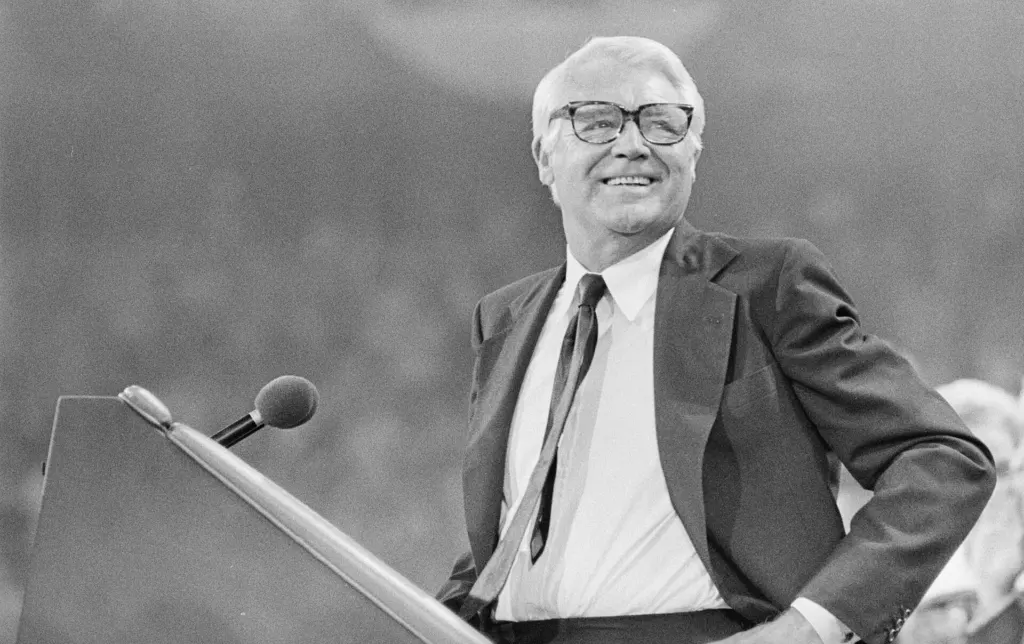
Image: Thomas J. O’Halloran, Public domain via Wikimedia Commons
This article was produced with AI assistance and reviewed by our Editorial Desk. How we work.