Alibaba’s Qwen team has put the weights of a 2.4-trillion-parameter language model on Hugging Face for anyone to download, the first time it has opened up a model from its top-tier Max line. The model, Qwen3.8-2.4T-A95B, is the open base for the company’s flagship Qwen3.8-Max service, and its sheer size means very few people outside large companies and labs can actually run it.
The Qwen team calls Qwen3.8 “the most capable generation in the Qwen open-model family to date” and says it was built for coding, research, professional work and long agentic tasks that take many steps to finish.
Why 2.4 trillion does not mean 2.4 trillion at once
The headline number is total parameters, the adjustable values a model learns in training. Qwen3.8 is a mixture-of-experts design: its 92 layers contain 512 small specialist networks called experts, and for each piece of text only 10 of them, plus one shared expert, switch on. That is why the model card describes it as 2.4 trillion in total with 95 billion activated.
In practice that means each word the model produces uses only about 4 percent of its parameters (95 billion out of 2,400 billion) and about 2 percent of its experts (11 out of 512). The design lets a very large model answer at something closer to the speed and cost of a much smaller one, which is the main reason Max-class labs use it.
The idea is not new, but the scale is. Google’s GLaM language model reached 1.2 trillion parameters with each layer picking 2 of 64 experts; Qwen3.8 doubles that total and spreads it across eight times as many experts.
What it takes to run
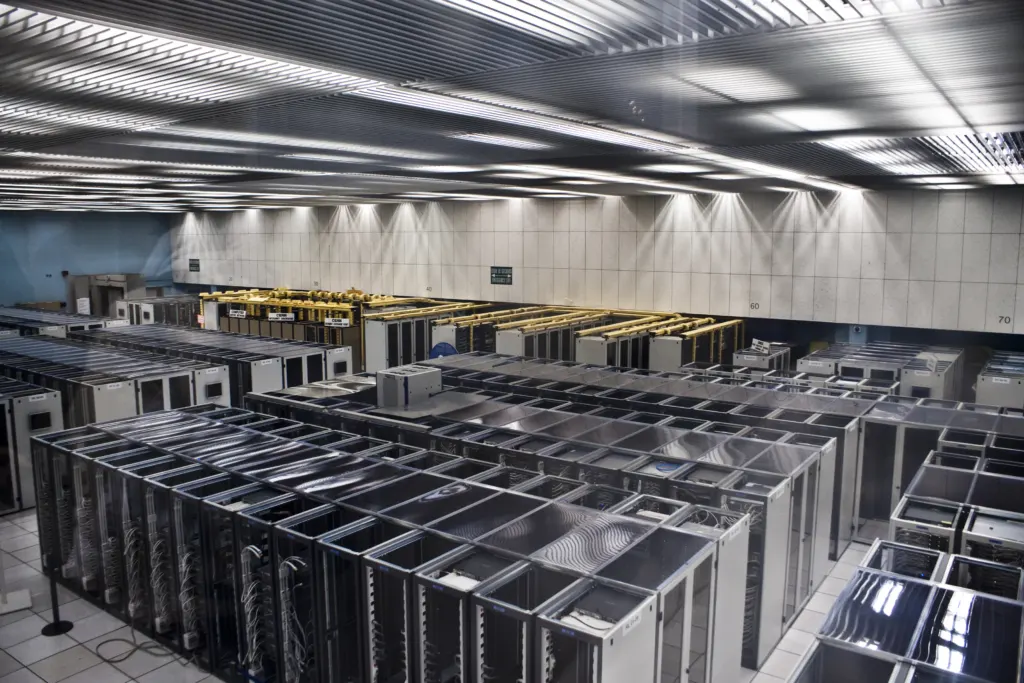
Activating fewer parameters does not shrink what has to be stored. The main release is in BF16, a format that uses two bytes per parameter, so the weights alone come to roughly 4.8 terabytes. A separate FP8 version, at one byte per parameter, still needs about 2.4 terabytes. That is before any memory for the conversation itself, and the model reads 262,144 tokens of context natively and can be stretched to about 1.01 million, almost four times as much.
For comparison, the same family’s Qwen3.8-27B model has about 28 billion parameters, small enough for a single high-end workstation. The 2.4T version is aimed at data centers, and Alibaba points users who do not want to manage hardware to its paid Qwen Cloud service instead. Recommended serving software includes the open-source engines vLLM and SGLang.
The open model is also narrower than the paid one. It handles text only and always “thinks” before answering, with its reasoning wrapped in tags at the start of every reply. The Max service adds image input, a non-thinking mode, a 1-million-token context by default and built-in tools.
How it scores
On the Qwen team’s own published tests, Qwen3.8-Max scores 92.6 on the GPQA Diamond science quiz and 67.7 on SWE-bench Pro, a test of fixing real software bugs, up from 60.6 for the previous Qwen3.7-Max. The team’s table shows it ahead of rival frontier models on some tasks and behind on others; these figures come from Alibaba, not outside testers.
The release fits a wider pattern of companies opening, closing and reshaping access to AI. Banks are already setting rules on outside AI tools, as when JPMorgan Chase blocked outside AI agents from logging in to customer accounts, and more AI coverage is on our tech page.
Interest is real but specialized. The main 2.4T model page logged 29,059 downloads in the past month, against more than 6.9 million for the 27-billion-parameter sibling.
Further reading
Image: Danielinblue, CC BY-SA 4.0 via Wikimedia Commons
This article was produced with AI assistance and reviewed by our Editorial Desk. How we work.