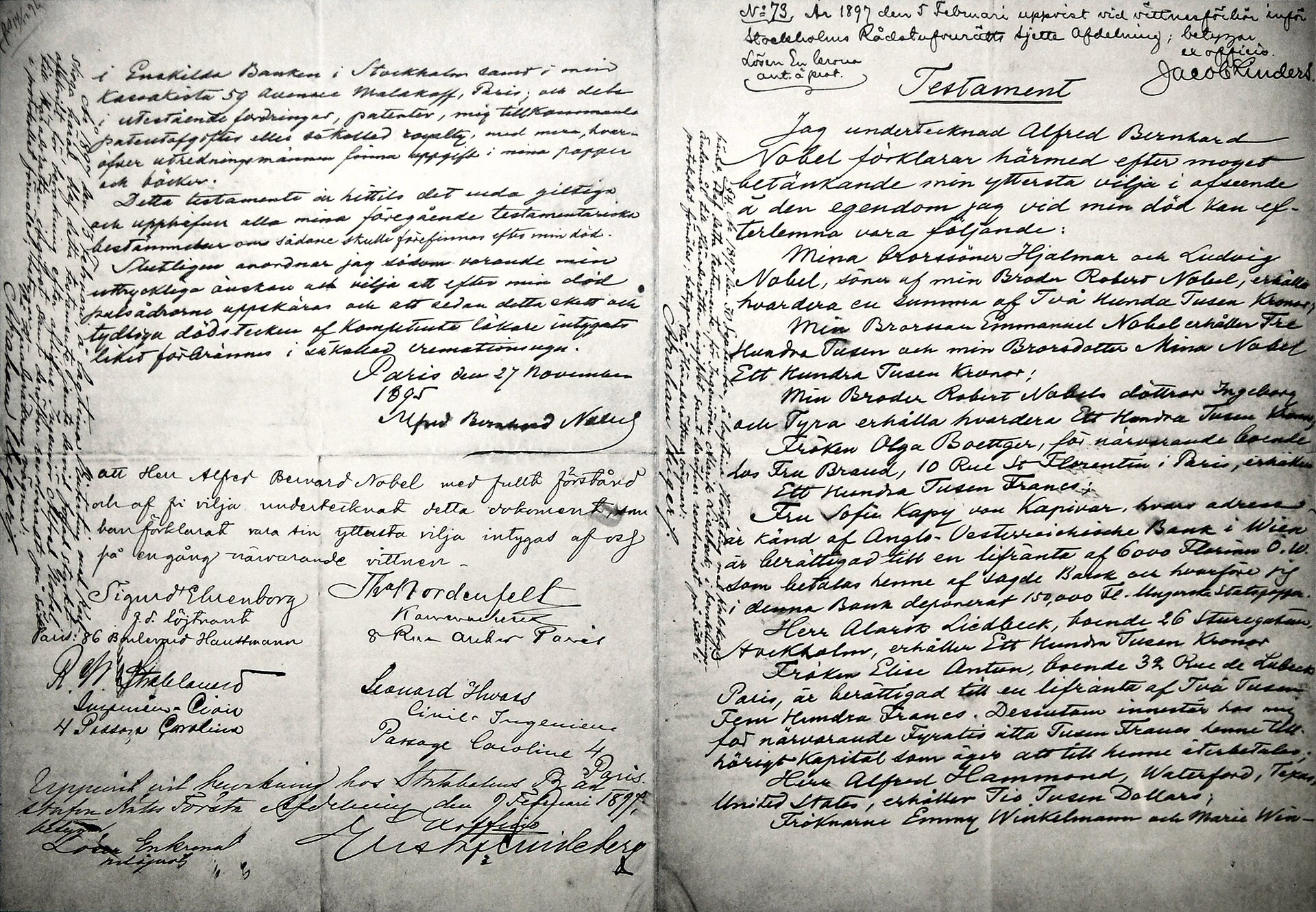
On November 27, 1895, Alfred Nobel sat down at the Swedish-Norwegian Club in Paris and signed a will that left most of his wealth to a set of prizes nobody had asked for. His family did not know, and the academies he named to hand out the prizes had not been consulted.
The full English text, published by the Nobel Foundation in its translation of the will, opens with a long list of personal bequests to nephews, nieces, servants and friends across Europe, and one to a Mr Alfred Hammond of Waterford, Texas, who was left ten thousand dollars. Only after all of that does it get to the part that made Nobel's name.
The paragraph that created the prizes
The will tells his executors to turn the rest of his assets into safe securities and build a fund, "the interest on which is to be distributed annually as prizes to those who, during the preceding year, have conferred the greatest benefit to humankind." That interest was to be split into five equal parts: physics, chemistry, physiology or medicine, literature, and peace.
Nobel also chose who would judge. Physics and chemistry went to the Swedish Academy of Sciences, medicine to the Karolinska Institute, literature to "the Academy in Stockholm," and peace to a five-person committee picked by Norway's parliament, the Storting. He then added the line that still defines the prizes: "It is my express wish that when awarding the prizes, no consideration be given to nationality, but that the prize be awarded to the worthiest person, whether or not they are Scandinavian."
How much money that meant
According to Nobel's Wikipedia biography, after taxes and the personal gifts, 94% of his total assets, 31,225,000 Swedish kronor, went to the prizes. The Nobel Foundation, set up on June 29, 1900, to manage that money, had 6.6 billion kronor in investment capital at the end of 2024, about $700 million. Divide 6.6 billion by 31.2 million and the fund is roughly 211 times the size of the original gift in kronor, before adjusting for inflation.
It took time to get there. Norway's parliament approved the will on April 26, 1897, the Karolinska Institute, the Swedish Academy and the Royal Swedish Academy of Sciences agreed that June, and the first prizes were handed out on December 10, 1901.
The man who did most of the work was his young assistant. Ragnar Sohlman's Wikipedia entry notes he was named executor with Rudolf Lilljequist and paid one hundred thousand crowns for his trouble, a large sum when the first prizes in 1901 were worth 150,782 crowns each. Because the will gave no detailed rules and was challenged by Nobel's relatives, the job took him several years. He later ran the Nobel Foundation from 1929 to 1946.
The obituary story, checked
The popular explanation for the will is that a French paper mistook his brother Ludvig's 1888 death for his and called him "the merchant of death." Historians have not been able to verify that version. Wikipedia's account says the wording is unconfirmed; the obituary that can be found, printed and then retracted in April 1888, called him a man who could "only with the utmost difficulty be considered a benefactor of mankind."
The will is also more personal than most people expect. Its final instruction asks that after his death his arteries be cut and that, once doctors had confirmed death, his body be cremated.
Nobel died in Sanremo, Italy, on December 10, 1896, just over a year after signing. That date became prize day. For two early winners, see Badiyaa's stories on Wilhelm Röntgen, who found X-rays weeks before the will was signed, and Charles Richet's 1913 prize.
That date still governs the calendar. As the Nobel Prize's Wikipedia entry explains, every prize except peace is presented in Stockholm on December 10, with the Peace Prize presented in Oslo, usually the same day. Each full prize now carries 12 million kronor. The 2026 ceremonies fall exactly 130 years after Nobel's death.
Sources
- Full text of Alfred Nobel's will, The Nobel Foundation (NobelPrize.org), 2018
- Alfred Nobel, Wikipedia, 2026
- Nobel Foundation, Wikipedia, 2026
- Nobel Prize, Wikipedia, 2026
- Ragnar Sohlman, Wikipedia, 2026
Image: Prolineserver (photograph); Alfred Nobel (document), Public domain via Wikimedia Commons
This article was produced with AI assistance and reviewed by our Editorial Desk. How we work.