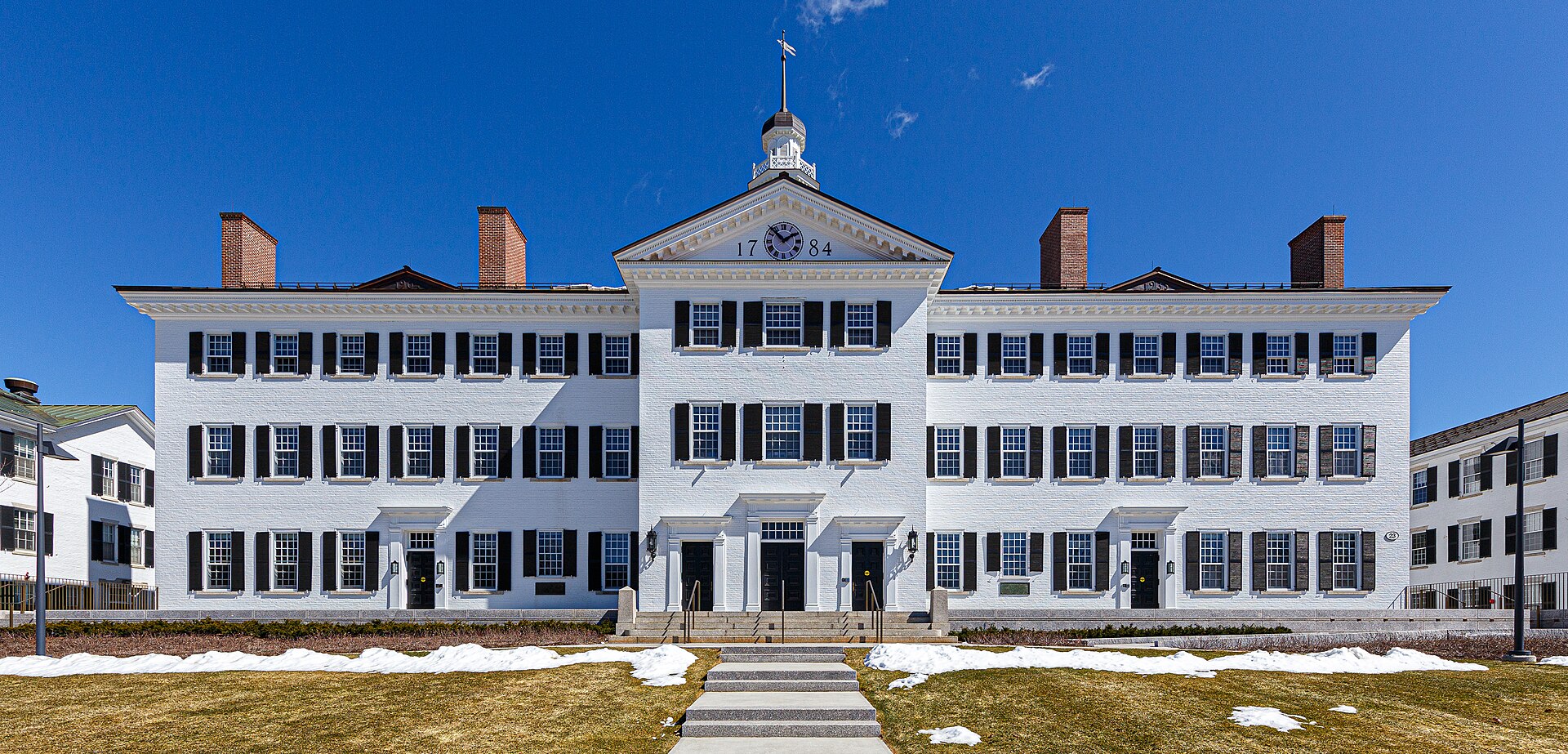
Dartmouth's medical school began with a single teacher standing in front of a handful of students in Hanover, New Hampshire, on November 22, 1797. That teacher, Nathan Smith, delivered the first lecture of what the college then called its "Medical Department," the date the school itself uses as its founding in the Geisel School of Medicine's own list of Dartmouth medical milestones.
It made Dartmouth the fourth medical school in the United States, after the University of Pennsylvania in 1765, King's College (now Columbia) in 1767 and Harvard in 1782, according to the Geisel School of Medicine's Wikipedia entry.
One doctor, every subject
Smith had seen how few trained physicians worked in the rural Upper Valley along the Connecticut River. In August 1796 he asked Dartmouth's trustees to back a medical school. The college was short of money but said yes.
For years Smith was the entire faculty. His Wikipedia biography says he taught anatomy, chemistry, surgery and clinical medicine himself, and in effect also served as dean and treasurer. A second faculty member did not arrive until 1810, which means Smith ran the school alone for about 13 years. He favored hands-on experience over theory and largely avoided the bleeding and purging common in his era.
Smith's own path was unusual for a frontier doctor. Born in Rehoboth, Massachusetts, he started studying medicine at 24 after watching an operation, earned a Bachelor of Medicine from Harvard in 1790 as only its third medical graduate, and later spent a year at the University of Edinburgh.
A school that kept moving firsts
The school's milestone list reads like a short history of American medicine:
- 1811: Dartmouth opens the first US building used only for medical teaching.
- 1812: the school begins granting the Doctor of Medicine degree.
- 1838: poet-physician Oliver Wendell Holmes joins the faculty and brings the stethoscope into the curriculum.
- 1839: Samuel Ford McGill becomes the first Black student to graduate from a US medical school.
- 1896: the first clinical X-ray in America is used to diagnose a broken arm.
- 1955: the nation's first multispecialty intensive care unit opens at Mary Hitchcock Memorial Hospital.
A founder who kept founding
Smith left Hanover in 1816, but he was far from finished. He went on to help start the medical schools at Yale, Bowdoin College in Maine and the University of Vermont. Notes a student took at his lectures in 1814 and 1815 survive at the National Library of Medicine; the library's finding aid for the Nathan Smith lecture notes lists topics from the nervous system to "ancient compounds" in early chemistry.
The school did not have an easy 20th century. A national survey of medical education in 1908 judged its rural setting too remote for clinical training, and from 1914 to 1974 it graduated no new MDs, sending students elsewhere to finish. A "refounding" begun in 1956 rebuilt the faculty, and admission of MD candidates resumed in 1970. In 2012 it took its current name in honor of Audrey and Theodor Geisel.
Counting from Smith's first lecture, the school marks 229 years today. Badiyaa has told other stories from medicine's past, including how Angélique du Coudray built a life-size birthing mannequin to train French midwives and how London's Old Operating Theatre sat hidden in a church attic for 95 years.
Each fall the school admits a class of about 92 MD students, chosen from roughly 7,000 applicants.
Sources
- Dartmouth Medical Milestones, Geisel School of Medicine at Dartmouth, 2026
- Geisel School of Medicine, Wikipedia, 2026
- Nathan Smith (physician, born 1762), Wikipedia, 2026
- Lectures on the theory and practice of physic (MS C 300), National Library of Medicine, 2003
Image: Kenneth C. Zirkel, CC BY 4.0 via Wikimedia Commons
This article was produced with AI assistance and reviewed by our Editorial Desk. How we work.