The $2 million Utah swimming pool circulating on social feeds this week is not a new build. It first reached a national audience in August 2014, on the Animal Planet series The Pool Master, and nothing published since suggests the owners have added to it or spoken about it in public. The figures that made it famous are still the ones being shared, so we checked them.
The pool sits behind a home in Springville, a city of 35,268 people at the 2020 census in Utah County, on the west side of the Wasatch Range and about 3 miles east of Utah Lake. The homeowners were never named on air. Animal Planet said the project was made for an owner who loves mountains and scuba diving, and the stated goal was simple: practice dives at home rather than travel to open water.
What $2 million bought
The water area is 140 feet long and 60 feet wide and holds roughly 360,000 gallons. Above it rises an artificial mountain 90 feet tall, crossed by two bridges that climb to the top, with a concealed slide dropping 60 feet through the rock into the water. There are five waterfalls, a 300-foot lazy river, a diving rock and a grotto with passages hidden inside the mountain.
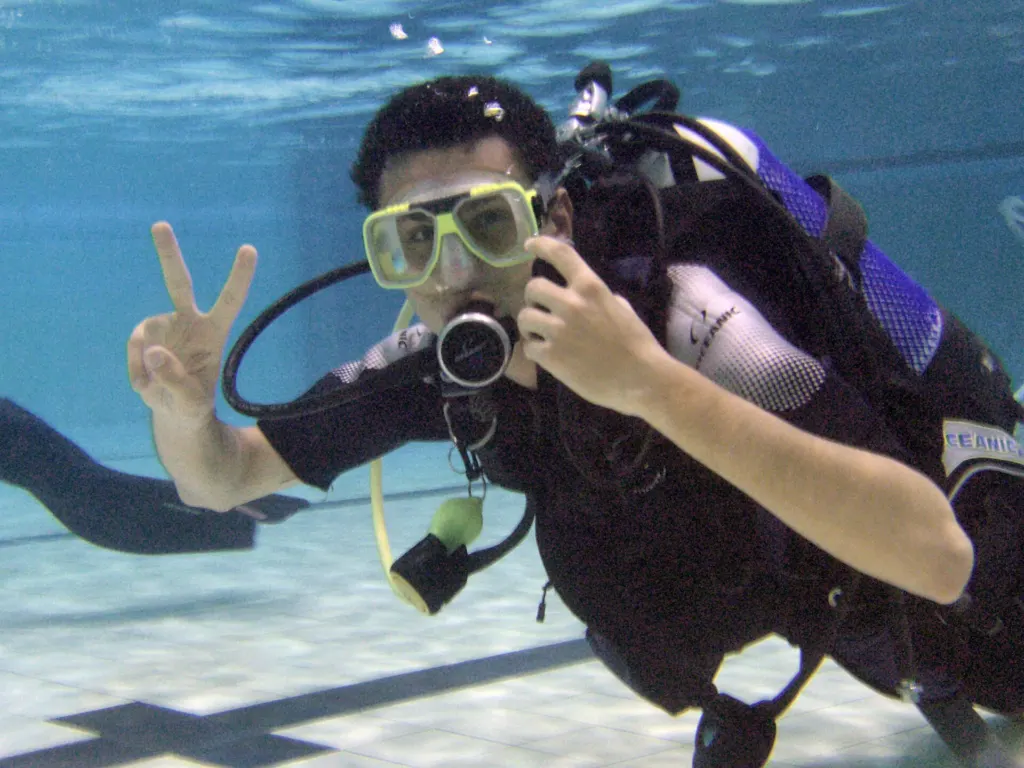
The rockwork also hides a working kitchen (granite counters, stainless steel cabinets, an eight-burner grill and a fridge) and a restroom. Divers enter from a separate point inside the mountain and swim through a tunnel 54 feet long and 5 feet wide to reach the deepest water, 26 feet (about 8 meters) down. That section is meant for certified divers only.
Anthony Archer-Wills, the British pool and water-garden designer who hosted the series, did not design this one. In the segment he was admiring a pool built by another designer, who has not been identified in anything we could check.
The numbers, worked out
- Against an Olympic pool: a competition pool of 50 by 25 meters at its 2-meter minimum depth holds about 660,000 US gallons. Dividing 360,000 by 660,000 gives 0.55, so the Utah pool holds a little over half an Olympic pool’s water.
- Depth: the Olympic minimum is 6 feet 7 inches, or about 6.58 feet. At 26 feet, the dive section is nearly four times that (26 divided by 6.58 is 3.95).
- Weight: 360,000 gallons is about 1.4 million liters. Federal data put water at 70°F at 0.998 grams per milliliter, so 1.4 million liters works out to roughly 1,397 metric tons, or about 3.1 million pounds of water.
- Household water: each American uses an average of 82 gallons a day at home. Since 360,000 divided by 82 is about 4,390 days, a single fill equals roughly 12 years of one person’s home water use.
That last figure is the one an owner actually pays for. According to the EPA’s WaterSense program, outdoor use already makes up more than 30 percent of an average household’s water, and up to 60 percent in arid regions, before any pool is filled. Density figures come from the US Geological Survey.
One common mistake in the viral posts is calling any huge private pool “Olympic-size.” The reference entry on the standard notes that style guides warn against that phrase, because almost no private pool comes close to the real volume. At about 55 percent, this one does not either.
What a deep backyard pool needs
For any home pool, the Consumer Product Safety Commission’s Pool Safely campaign lists the basics: barriers, covers and alarms; drain covers that meet federal rules; an adult watching whenever children are in or near the water; and someone in the household trained in CPR. The drain requirement comes from the Virginia Graeme Baker Pool & Spa Safety Act, named for a seven-year-old girl who drowned when suction from a hot tub drain held her under.
A 26-foot dive section goes beyond that checklist, which is why the deep water in Springville is limited to certified divers. When the segment aired, the online video of the pool had passed two million views by August 18, 2014. Twelve years later the same 360,000 gallons are circulating again, still with the 2014 price of $2 million attached.
Further reading
Image: Tim Sheerman-Chase, CC BY 2.0 via Wikimedia Commons
This article was produced with AI assistance and reviewed by our Editorial Desk. How we work.