The US State Department on Wednesday, October 21, ordered non-emergency American government employees and their family members to leave Saudi Arabia, pointing to attacks by Yemen’s Iran-backed Houthi movement on Saudi airports and other infrastructure.
The department said the order covers staff at the US Embassy in Riyadh and its consulates. The US Mission to Saudi Arabia has three posts: the embassy in Riyadh and consulates general in Jeddah and Dhahran. The department said the order applies to Saudi Arabia alone, although US embassies elsewhere in the Gulf will see temporary staffing changes.
What the department said
State Department spokesman Tommy Pigott announced the “ordered departure” in a social media post. “Iranian-supported Houthis have increasingly engaged in hostilities against Saudi Arabia, including attacks on civilian airports and other critical infrastructure resulting in civilian casualties and severe travel disruptions,” he wrote, adding: “The safety and security of Department personnel and their families remain our highest priority.”
A department spokesperson said in a separate statement that “the hostilities have the potential to escalate rapidly, including beyond that immediate area,” and that the department would support employees and families “as they return to the U.S.”
Pigott called “inaccurate” an earlier report that Washington was preparing departures from embassies across the Gulf. Separately, a diplomatic source in the region was reported as saying that some families of embassy staff were also being withdrawn from the United Arab Emirates, Jordan, Qatar and Bahrain; Pigott said Wednesday’s order was for Saudi Arabia only. Asked about the reports on Wednesday, President Donald Trump said: “I don’t know that they are. You are telling me something – I wouldn’t know that.”
The alert and the advisory
The order applies to government employees and their families, not to private US citizens; for them, the mission said in its October 21 security alert that regular and emergency consular services remain available. The alert set out several restrictions and warnings:
- US government staff now need special authorization from the Chief of Mission to use any airport in the kingdom, after missile and drone attacks on airports.
- Staff may not travel within 20 miles of the Yemen border and need special permission to visit Jizan, Asir and Najran provinces and the cities of Qatif, Yanbu and Taif.
- The mission listed King Khalid International Airport in Riyadh as suspended, with Jeddah’s and Dammam’s main airports open but facing delays.
- All land crossings, including the King Fahd Causeway to Bahrain, were open, and the mission pointed travelers to rail, bus and private car as alternatives to flying.
- Saudi Arabia’s Interior Ministry warns that filming or sharing images of missile and drone interceptions or impact sites carries legal liability, and the mission said US citizens have been detained for such photos.
The State Department’s travel advisory banner on the mission’s website on Thursday showed Saudi Arabia at Level 3, “Reconsider travel,” citing “risk of drone and missile targeting of American interests by Iran and the Iranian-supported Houthis, armed conflict, terrorism, exit bans, and local laws regarding social media activity.”
The attacks behind the order
The mission reported attacks on King Khalid International Airport on October 10 and told Americans to stay away from it. The airport had been shut since that attack. On Wednesday a small number of Saudi carriers flew in and out again, two days after Saudi aviation authorities told airlines they could resume with prior permission, while some major European airlines have canceled Riyadh flights through mid-November. The Houthis have acknowledged attacking the airport and claimed, without offering evidence, that Saudi Arabia used it to supply military equipment to Yemeni government forces.
Also on Wednesday, Saudi Arabia’s Energy Ministry said falling debris from a drone shot down near the Shaybah oil field, close to the border with the UAE, killed two people, a Filipino and a Nepali, and injured two others. The ministry did not say who launched the drone.
The fighting traces back to Yemen’s civil war, in which a Saudi-led coalition has backed the internationally recognized government since 2015. A four-year truce collapsed in June, and attacks on Saudi territory picked up again from mid-July. The United States has sent military advisers to help Saudi forces track incoming missiles and drones.
Second Saudi departure order of 2026
This is the second time this year the department has ordered staff and families out of the kingdom. Mission alerts issued in July and August stated that on March 8, 2026, the department ordered non-emergency employees and family members to leave Saudi Arabia “due to safety risks,” soon after the US and Israel began strikes on Iran in late February. The embassy in Riyadh was badly damaged early in that war and ran on a skeleton staff for months before some diplomats returned. Put together, the timeline runs from a March 8 order through months of reduced staffing to a fresh order on October 21, less than two weeks after the Riyadh airport attack.
US citizens in Saudi Arabia can reach the State Department’s consular call center at 1-888-407-4747 from the US and Canada, or +1-202-501-4444 from abroad.
Further reading
- US Mission to Saudi Arabia: Security Alert, October 21, 2026
- US Mission to Saudi Arabia: Security Alert, October 10, 2026
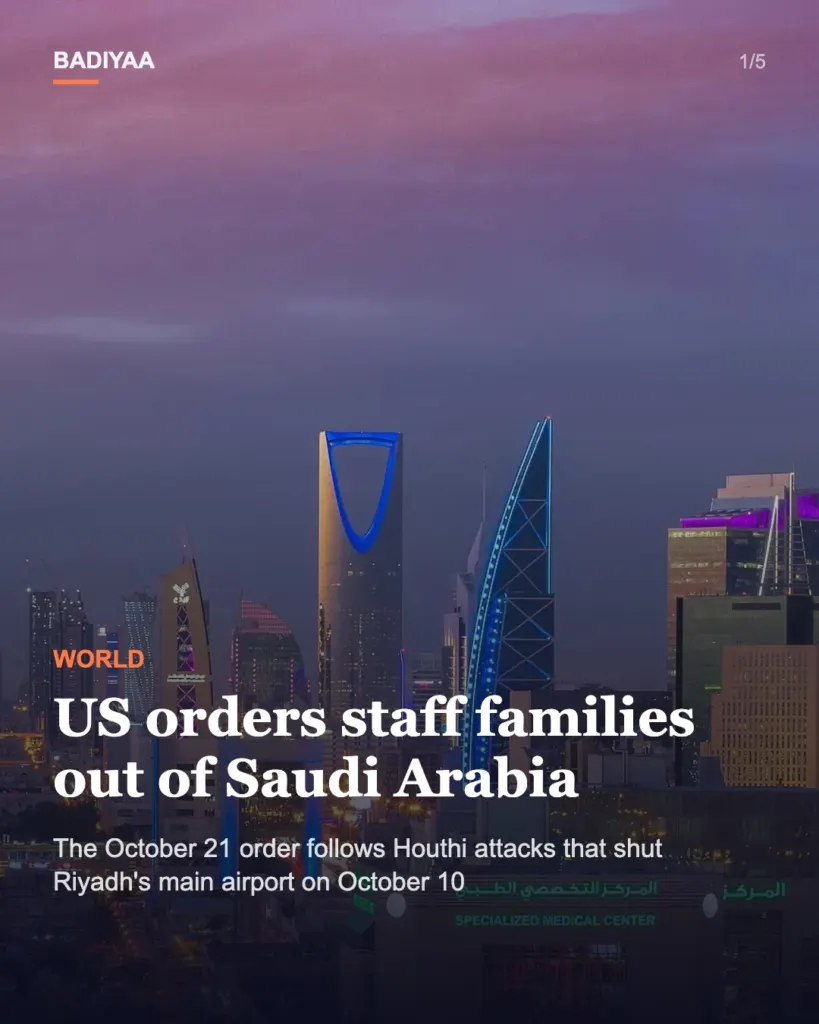
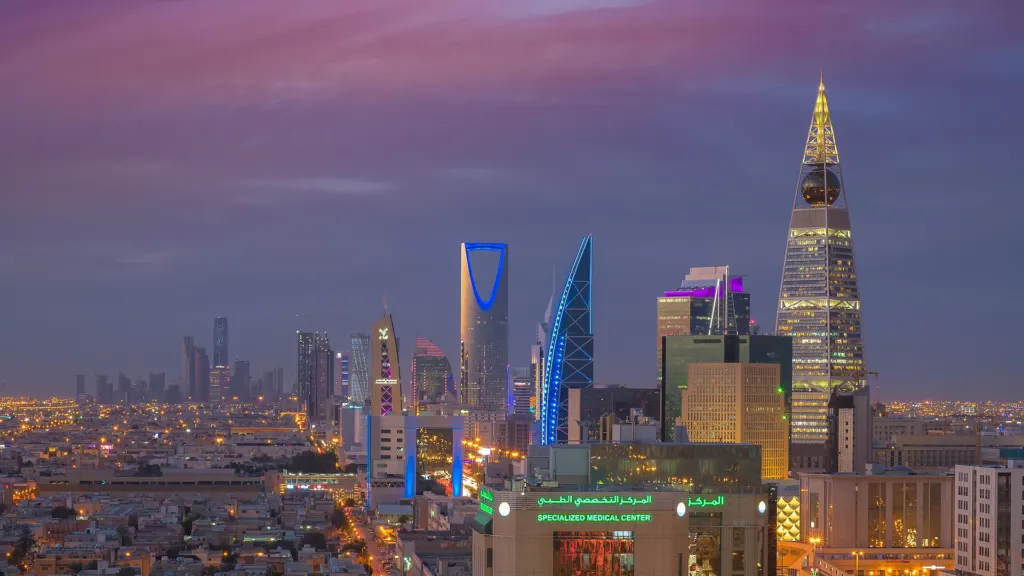
Image: B.alotaby, CC BY-SA 4.0 via Wikimedia Commons
This article was produced with AI assistance and reviewed by our Editorial Desk. How we work.
Spot an error? Help verify this story
The story in 5 slides