Teenage Engineering, the Stockholm company behind the OP-1 synthesizer and the Pocket Operators, has made a CD player. Called the EP/BC-1 and billed as a "professional CD player," it is the first product in a new EP/BC broadcast series, and it is now listed at the top of the company's online store with a launch offer.
That is a strange move in 2026, and a very on-brand one. Teenage Engineering has spent two decades building playful music gear, and its Wikipedia product list, which runs from the OP-1 in 2010 to the EP-40 Riddim sampler in November 2025, includes a portable record player but no CD player until now.
What the EP/BC-1 actually does
Teenage Engineering's homepage lists the feature set as a stack of terse labels rather than a spec sheet. Translated into plain English:
- It plays discs, with DJ-style controls. There is varispeed, time stretch, a jog control for fast-forward and rewind, and a tempo sync output.
- It reads data discs. The page lists "data disc read," which suggests it can handle more than standard audio CDs; the company has not published a list of supported file formats.
- It has old-school readouts. A digital display shows track, index, minutes and seconds, and there is a digital VU meter.
- It connects both ways. Outputs include line out, headphone out and digital USB 2.0, plus Bluetooth.
The more unusual part is how it fits Teenage Engineering's own gear. The homepage describes the player as mounted to the K.O.-AMP 35, the company's speaker amp, and says it can broadcast over Bluetooth Auracast to an unlimited number of K.O.-AMP 35 units. Auracast is the Bluetooth audio-sharing standard that lets one source stream to many receivers at once. The store also sells a "CD sound system kit" bundle and an EP/BC-1 long-sleeve T-shirt.
Why a broadcast CD player looks the way it does
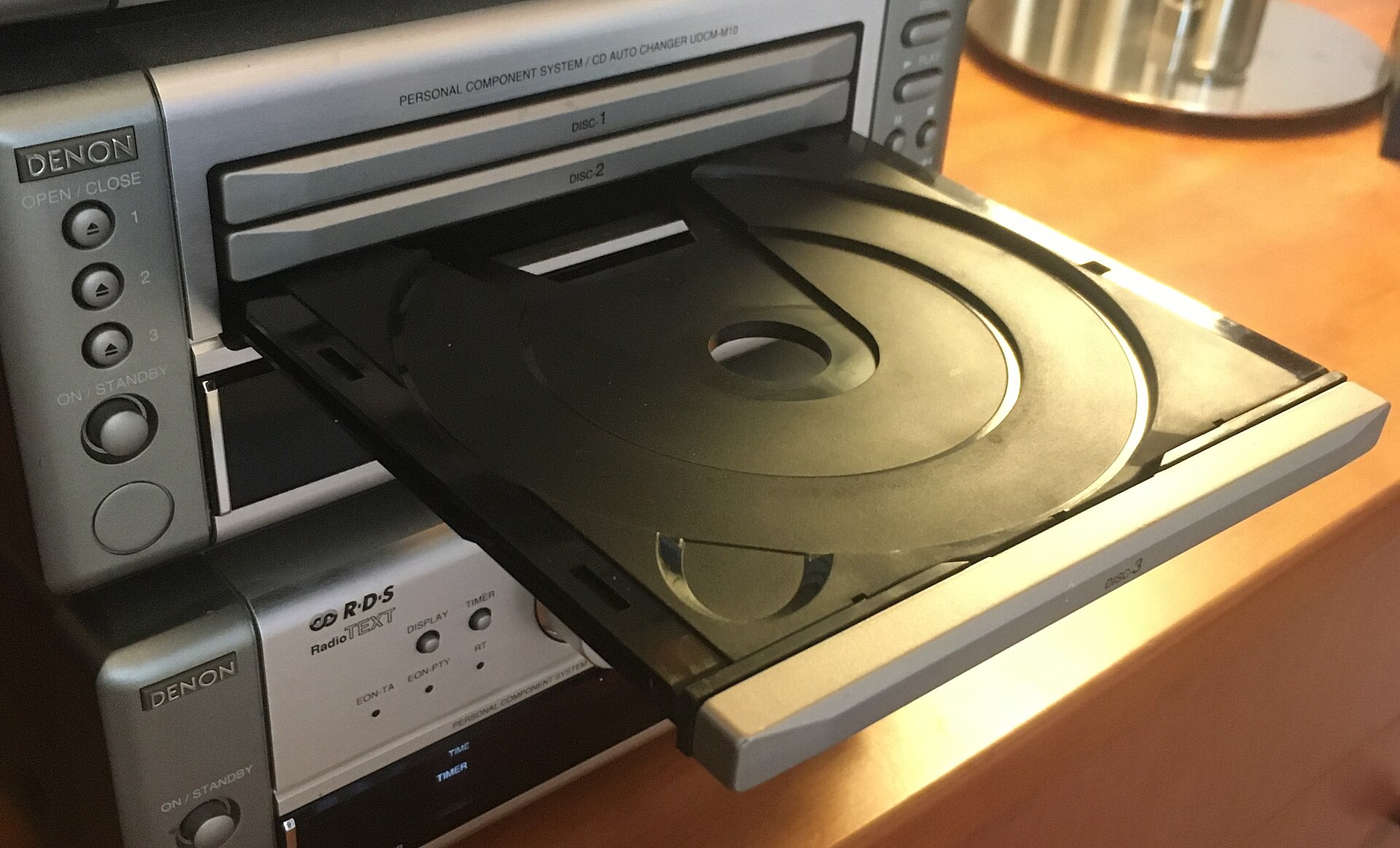
Teenage Engineering calls this a broadcast series, and that word carries some history. According to Wikipedia's history of the CD player, top-loading designs became common in players built for broadcast and live DJ use, such as Technics' SL-P50 of 1984 and SL-P1200, because they mimic the layout of a record turntable. Features like pitch control and cueing were the things that separated a DJ's CD player from a home unit.
The first consumer CD player, Sony's CDP-101, went on sale in Japan in 1982. More than 400,000 players sold in the United States between 1983 and 1984 even though early machines cost up to $1,000. The EP/BC-1 arrives 44 years after that first player, in a market where most music now streams.
What it means if you are thinking of buying one
Teenage Engineering has not printed a price on its homepage, and the store's product page shows only a launch offer label, so check the final price, shipping and which bundle you are getting before you commit. The bigger question is the ecosystem. The Auracast trick and the mounting design are built around the K.O.-AMP 35, so the EP/BC-1 makes the most sense for people already using Teenage Engineering's EP series or planning a K.O.-AMP setup. If you only want to rip or play an old CD collection, a basic drive costs far less.
For more on how audio formats came and went, see Badiyaa's look at the Selenophone, which printed sound on paper in 1930s Vienna, and our explainer on why dial-up modems had speakers.
Sources
- teenage engineering homepage: EP/BC-1 professional CD player, Teenage Engineering, 2026
- Teenage Engineering, Wikipedia, 2026
- CD player, Wikipedia, 2026
Image: Jberkel, CC BY-SA 4.0 via Wikimedia Commons
This article was produced with AI assistance and reviewed by our Editorial Desk. How we work.