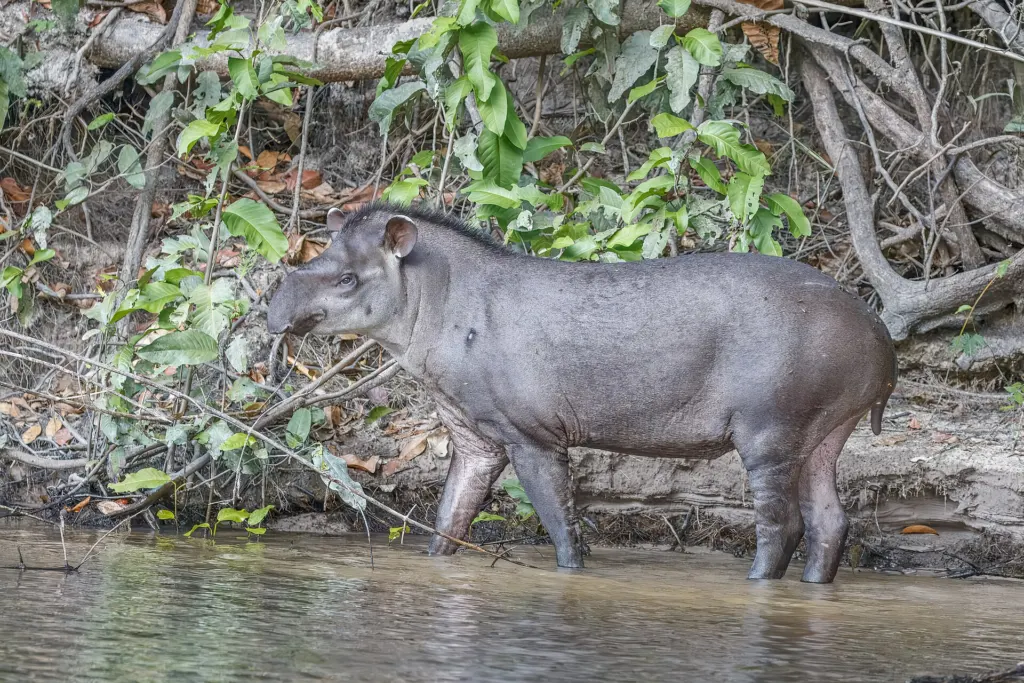
Tapirs are walking the forest floor near Rio de Janeiro again, more than a century after they vanished from the state. They came back to land that was cattle pasture until one family decided to stop ranching it.
The land is the Reserva Ecológica de Guapiaçu, known as REGUA, in Cachoeiras de Macacu, about 100 kilometers (62 miles) from the city of Rio. The reserve now lists 1,002,000 seedlings planted, 710 hectares (about 1,750 acres) restored and more than 10,600 hectares under protection. It is also home to 11 free-roaming South American tapirs, plus three calves born in the wild.
From a 1907 farm to a 25-year reserve
The Locke family had owned the farm since 1907. Nicholas and Raquel Locke turned it into a nonprofit in 2001; Nicholas, who still leads the reserve, had watched the Atlantic Forest around the farm being cut down. Land purchases began in 2003, and REGUA marked 25 years this year with a new institutional film.
The famous figure attached to this story online, 840,000 trees, is an older count. A partner conservation charity that has funded land purchases for the reserve has put the total at more than 700,000. The reserve’s own running total has since passed one million.
The planting itself was slow, physical work. Staff and volunteers collect seed from around 180 native tree species, raise roughly 60,000 saplings a year in a purpose-built nursery, and then weed out the dense tropical grasses that choke cleared lowland. REGUA also dammed and flooded old pasture to recreate wetlands, which drew in capybaras, broad-snouted caimans and herons.
The math behind one million seedlings
Spread across 25 years, 1,002,000 seedlings works out to about 40,080 a year (1,002,000 divided by 25). Divide that by 365 and the team has put roughly 110 young trees in the ground every single day since 2001, weekends and holidays included. Across the 710 restored hectares, that comes to about 1,411 seedlings per hectare (1,002,000 divided by 710), or roughly 570 per acre.
Why the tapirs needed a lift
Trees alone did not bring the tapirs home. The species had been missing from Rio de Janeiro state since 1914, and the nearest wild animals could not cross the highways and farmland between them and the valley. So in 2017 the reserve started a reintroduction with the Refauna project and a wildlife ecology lab at the Federal Institute of Rio de Janeiro. Three tapirs arrived first, tracked with radio collars and camera traps.
The South American tapir is the biggest land mammal on the continent, with adults weighing roughly 150 to 320 kilograms (330 to 710 pounds). Its importance to a young forest is what it leaves behind. Tapirs eat fruit and swallow seeds whole, then deposit them far away in their dung, which is why locals call them gardeners of the forest. For a reserve trying to turn rows of planted saplings into a self-seeding jungle, a big animal that plants trees for free is the missing piece.
Breeding is slow, which makes each wild birth count. A female carries a calf for about 13 months and typically has one young every two years, so three calves born free at REGUA represent years of patience. Those calves wear the striped, spotted coat that newborn tapirs carry before they turn plain brown.
What the reserve still has to prove
A population of 11 adults is small, and the animals still depend on the reserve’s rangers, who patrol against hunting. The species is listed as Vulnerable worldwide, mainly because of poaching and habitat loss. REGUA now owns and protects more than 12,000 hectares including partner land, and its nursery keeps producing about 60,000 saplings a year for the corridors those tapirs will need to spread beyond the valley.
Further reading
Image: Charles J. Sharp, CC BY-SA 4.0 via Wikimedia Commons
This article was produced with AI assistance and reviewed by our Editorial Desk. How we work.