The University of Notre Dame began 184 years ago today with a 28-year-old French priest, a handful of religious brothers, an oxcart and $310. On the bitterly cold afternoon of November 26, 1842, Rev. Edward Sorin reached a 524-acre patch of snow-covered Indiana land near South Bend that a bishop had handed him, with a catch: build a college in two years.
Sorin looked out at the frozen landscape and saw one big lake. There were actually two. He named the place anyway, in his native French: "L'Université de Notre Dame du Lac," Our Lady of the Lake, according to the university's own history page.
A college built on bread and nerve
The early days were rough. One novice recalled that when the brothers were hungry, Brother Vincent "would take a loaf, place it on the trunk of a fallen tree, and with an axe give it three or four heavy blows before he succeeded in cutting a piece."
Sorin was undaunted. "This college cannot fail to succeed," he wrote home to his superior in France. The Indiana legislature granted the university its charter on January 15, 1844, well inside the bishop's two-year window. Sorin had arrived in the United States in 1841 and knelt to kiss the ground in New York, notes his Wikipedia biography; he became an American citizen in 1850 and was soon the local postmaster too.
The fire, the gold and a famous speech that may be a myth
On April 23, 1879, young students spotted flames curling from the roof of the Main Building, which then held almost the entire university. In three hours it was gone. Nobody was killed.
What Sorin said next is Notre Dame legend. The university's history quotes him telling the community in the church: "I built it too small, and she had to burn it to the ground to make the point." He promised to rebuild "bigger and better than ever."
Here is the twist. Historians are not sure he ever said it. His Wikipedia biography calls that version apparently apocryphal, noting it does not appear in accounts from the time or in Sorin's own writings. An eyewitness, Timothy Howard, remembered a different closing line: "If it were ALL gone, I should not give up!"
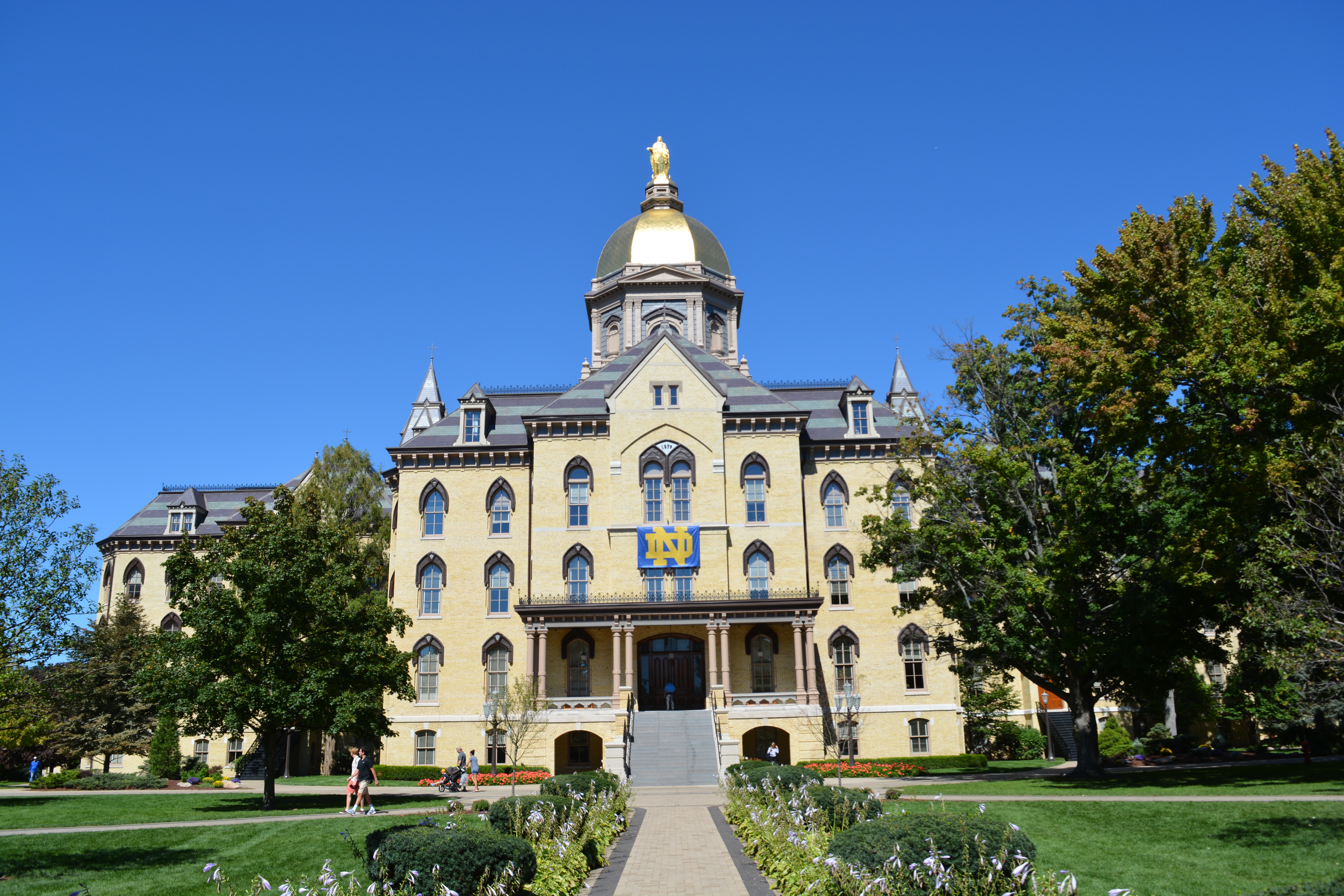
Either way, the builders moved fast. Three hundred laborers worked 16-hour days and laid 4.3 million bricks to have a new Main Building ready that autumn. When they reached the top, they built a bigger dome and, for the first time, covered it in gold. That is the Golden Dome on every Notre Dame postcard.
The students who took on the Klan
In May 1924 the Ku Klux Klan planned a week-long gathering in South Bend. Notre Dame students blocked Klansmen getting off their trains and tore away their robes and regalia, according to Wikipedia's history of the university. Thousands of students later massed downtown, and only the arrival of university president Rev. Matthew Walsh stopped further clashes. Football coach Knute Rockne told a campus rally to stay calm.
Three years later, Walsh approved the nickname Fighting Irish for the school's teams, preferring it to the insults rivals had been using, the university says.
From a log cabin to a research giant
The campus now covers 1,261 acres and enrolls about 13,000 students. Women were admitted as undergraduates for the first time in 1972. In 2023 Notre Dame became the first Catholic institution invited into the Association of American Universities, the club of top US research schools. Its endowment has grown to about $20 billion.
Notre Dame's teams are still making headlines, including Hannah Hidalgo's 500th career steal for Notre Dame. For more anniversaries, browse Badiyaa's History section.
Sources
- History, University of Notre Dame, 2026
- Edward Sorin, Wikipedia, 2026
- University of Notre Dame, Wikipedia, 2026
Image: Eccekevin, CC BY-SA 4.0 via Wikimedia Commons
This article was produced with AI assistance and reviewed by our Editorial Desk. How we work.