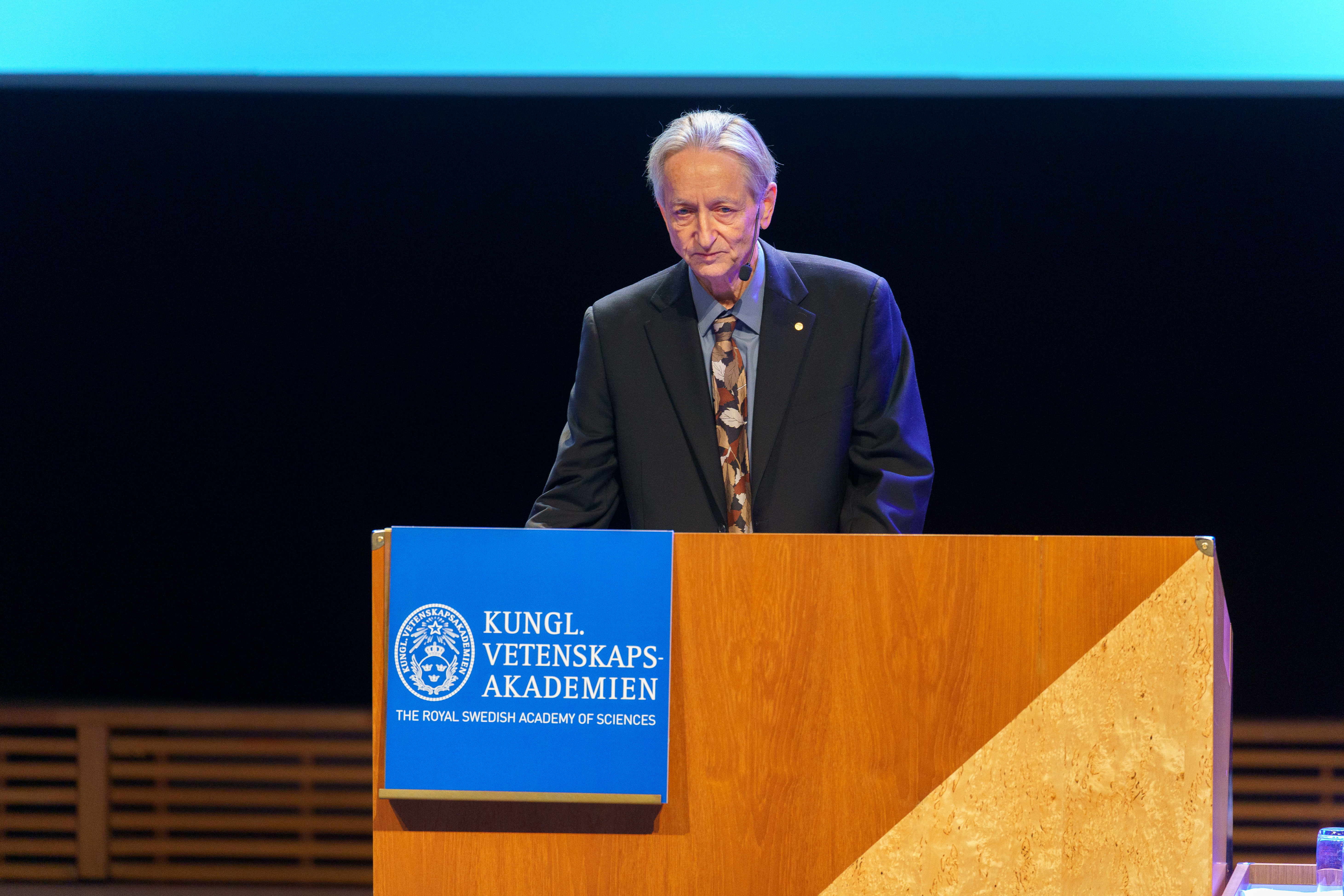
Geoffrey Hinton gave radiologists five years, ten at the outside. That was 2016. The outer limit lands this year, and the scan-reading job the "Godfather of AI" compared to a cartoon coyote has not gone over the cliff.
The line is one of the most quoted predictions in artificial intelligence. In the video of his 2016 remarks on radiology, Hinton told an audience that radiologists were already doomed, they just had not noticed yet. A 2018 paper in The British Journal of Radiology set down his words like this: "I think that if you work as a radiologist you are like Wile E. Coyote in the cartoon. You're already over the edge of the cliff, but you haven't yet looked down. There's no ground underneath. It's just completely obvious that in five years deep learning is going to do better than radiologists. It might be ten years".
Who said it, and why it stung
Hinton is not a pundit. He co-authored the 1986 paper that popularised backpropagation, helped build the AlexNet image network that won the ImageNet challenge in 2012, and shared the 2024 Nobel Prize in Physics with John Hopfield, according to his Wikipedia biography. When the man behind modern image recognition says a profession built on reading images is finished, medical students listen.
Radiologists pushed back fast. In that same 2018 paper, Stephen Chan of Harlem Hospital Center and Columbia University and Eliot L. Siegel of the VA Maryland Health Care System argued that "complex technological, regulatory, and medicolegal obstacles" would "definitely preclude replacement of the radiologist by these algorithms within the next two decades and beyond."
The 2026 scorecard
Ten years on, the machines have certainly arrived. The FDA's list of AI-enabled medical devices shows how lopsided the field is. Badiyaa counted the entries on the list's current page, which runs from October 11, 2024 to June 29, 2026: of 568 devices, 432 were reviewed by the agency's Radiology panel. That is about 76%, more than every other specialty combined, with cardiovascular devices a distant second at 48.
So the half of the prediction about AI pouring into radiology came true. The other half, that the people would be redundant, is where the cliff gag falls apart. The FDA authorizes these products as medical devices, and the clearance does not make them doctors.
Hinton's own softer pitch
By 2018, Hinton was selling a gentler idea to medicine. Writing in JAMA alongside former University of Toronto president David Naylor, he pitched deep learning as a helper. In the University of Toronto's account of that project, he describes several radiologists measuring the same irregular tumour differently over months. "Over time, it makes for a very inconsistent longitudinal set of measurements, which makes it very hard to notice things that are going on," Hinton said. "If you have a computer system doing this, you will at least get something that's consistent."
The cheeky reading is that the coyote learned to build a bridge. The fairer one is that Hinton was right about the technology and early on the timeline, a pattern that runs through many AI forecasts. Badiyaa has tracked how far chatbots still have to go, including a UCL study for UNESCO on AI chatbots abandoning correct facts under pushback, and the price war behind models such as Google's Gemini 4 Neon.
Hinton has since moved on to bigger fears. He left Google in May 2023 to speak freely about AI risks and has warned that AI could upend the wider job market. Radiology, the job he once wrote off first, is now the test case for whether AI replaces experts or simply ends up working for them.
Sources
- Geoff Hinton: On Radiology (video), Creative Destruction Lab, YouTube, 2016
- Stephen Chan and Eliot L. Siegel on whether machine learning will end radiology, The British Journal of Radiology, 2018
- Artificial Intelligence-Enabled Medical Devices list, US Food and Drug Administration, 2026
- U of T News feature on the Hinton and Naylor JAMA viewpoints, University of Toronto, 2018
- Geoffrey Hinton, Wikipedia, 2026
Image: Jay Dixit, CC BY-SA 4.0 via Wikimedia Commons
This article was produced with AI assistance and reviewed by our Editorial Desk. How we work.