There is no evidence Galileo Galilei ever said “Eppur si muove,” the defiant “And yet it moves” he supposedly muttered after the Roman Inquisition made him renounce the idea that the Earth circles the sun. The story first reached English print in 1757, 115 years after his death.
The phrase has been trending again among programmers and science fans online, so it is worth separating the record from the legend.
What the trial record shows
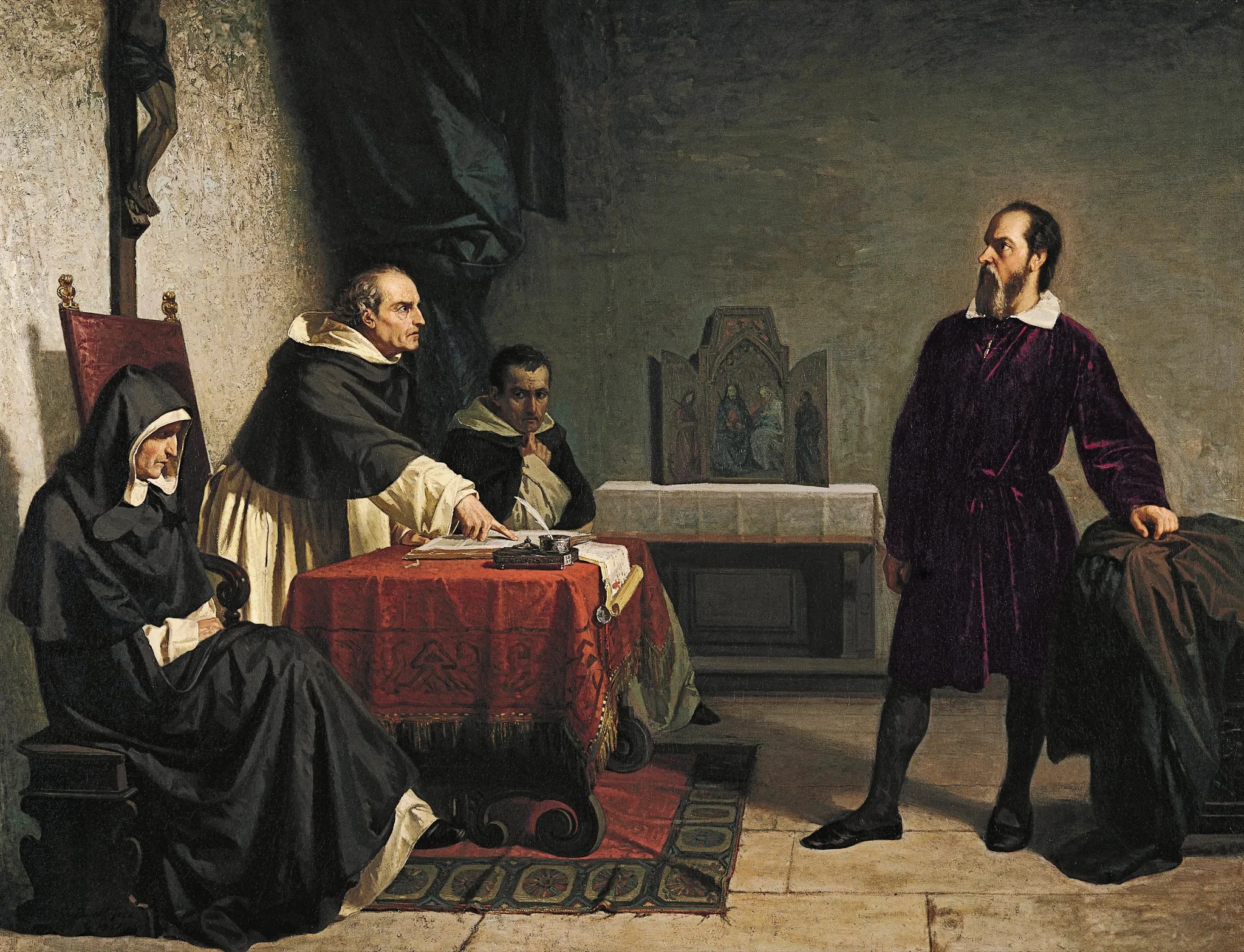
The Inquisition issued its sentence on June 22, 1633. According to Wikipedia’s account of the Galileo affair, he was found “vehemently suspect of heresy” for holding that the sun sits motionless at the center and the Earth moves, and he was required to “abjure, curse, and detest” those views. His Dialogue Concerning the Two Chief World Systems was banned, and his prison sentence was turned into house arrest the next day.
His own words that day survive. In the Museo Galileo’s English text of the 1633 abjuration, the 70-year-old kneels before the cardinals and declares: “I abjure with a sincere heart and unfeigned faith, I curse and detest the said errors and heresies.” The museum notes that a copy probably meant for Galileo himself is held in Florence’s National Central Library.
Nothing in the trial documents records him saying anything rebellious. As several historians have pointed out, muttering a contradiction in front of the tribunal that had just threatened him would have been reckless in the extreme.
The first witness who never mentioned it
The person best placed to record the moment was Vincenzo Viviani, who moved into Galileo’s home at Arcetri in 1639 as his assistant and stayed until the astronomer died in 1642. Viviani’s Wikipedia biography notes that he wrote his Historical Account of the Life of Galileo in 1654, the earliest biography. Wikipedia’s article on the phrase confirms that this account does not include “Eppur si muove,” and neither do the trial records.
Where the story really starts
The anecdote surfaces in English in The Italian Library, a 1757 book by the Italian writer Giuseppe Baretti. His version reads: “The moment he was set at liberty, he looked up to the sky and down to the ground, and, stamping with his foot, in a contemplative mood, said, Eppur si muove, that is, still it moves, meaning the Earth.”
That telling places the line after his release, not in the courtroom, and the story spread further after a 1761 French collection repeated it.
The painting that seemed to prove it
In 1911 a Belgian collector, Jules van Belle of Roeselare, bought a painting of Galileo in a cell with the words on the wall. It appeared to be dated 1643 or 1645, just after his death, and was credited to the Spanish painter Bartolomé Esteban Murillo. If genuine, it would push the legend back more than a century.
It did not hold up. The canvas turned out to be almost identical to an 1837 work by Eugene van Maldeghem, and many experts doubt it is by Murillo or even predates the 19th century. Its present location is unknown.
A quick Badiyaa timeline
- 1633: Galileo is sentenced in Rome and abjures heliocentrism
- 1642: he dies at Arcetri under house arrest
- 1654: Viviani writes the first biography, with no “Eppur si muove”
- 1757: Baretti prints the anecdote in English
- 1911: the disputed “Murillo” painting surfaces in Belgium
Counting from his death in 1642 to Baretti’s book in 1757 gives that 115-year gap, long enough for nobody who knew Galileo to be alive to confirm or deny it.
The science was vindicated far sooner than the man. The Church dropped its general ban on heliocentric books in 1758, and Galileo’s Dialogue left the Index of banned books with the 1835 edition. For more astronomy history, read how Urbain Le Verrier found Neptune with math in 1846, or where Voyager 1 is heading in the constellation Ophiuchus.
In 1992 Pope John Paul II closed a Vatican study commission with a speech praising Galileo’s intuition as “a brilliant physicist.”
Sources
- Galileo affair, Wikipedia, 2026
- The abjuration (1633), Museo Galileo, Institute and Museum of the History of Science, Florence, 2009
- Vincenzo Viviani, Wikipedia, 2026
- And yet it moves, Wikipedia, 2026
Image: Cristiano Banti, Public domain via Wikimedia Commons
This article was produced with AI assistance and reviewed by our Editorial Desk. How we work.