“Omies and palones of the jury, vada well at the eek of the poor ome who stands before you, his lallies trembling.” To most BBC radio listeners in the 1960s that line was a joke in gibberish. To gay men in Britain it was Polari, a private slang many of them had used for years to talk openly in front of people who could have them arrested.
Translated, it means: “Men and women of the jury, look well at the face of the poor man who stands before you, his legs trembling.” It comes from “Bona Law,” a Julian and Sandy sketch written by Barry Took and Marty Feldman for the comedy show Round the Horne, where Hugh Paddick and Kenneth Williams played two camp, Polari-speaking characters.
Where Polari came from
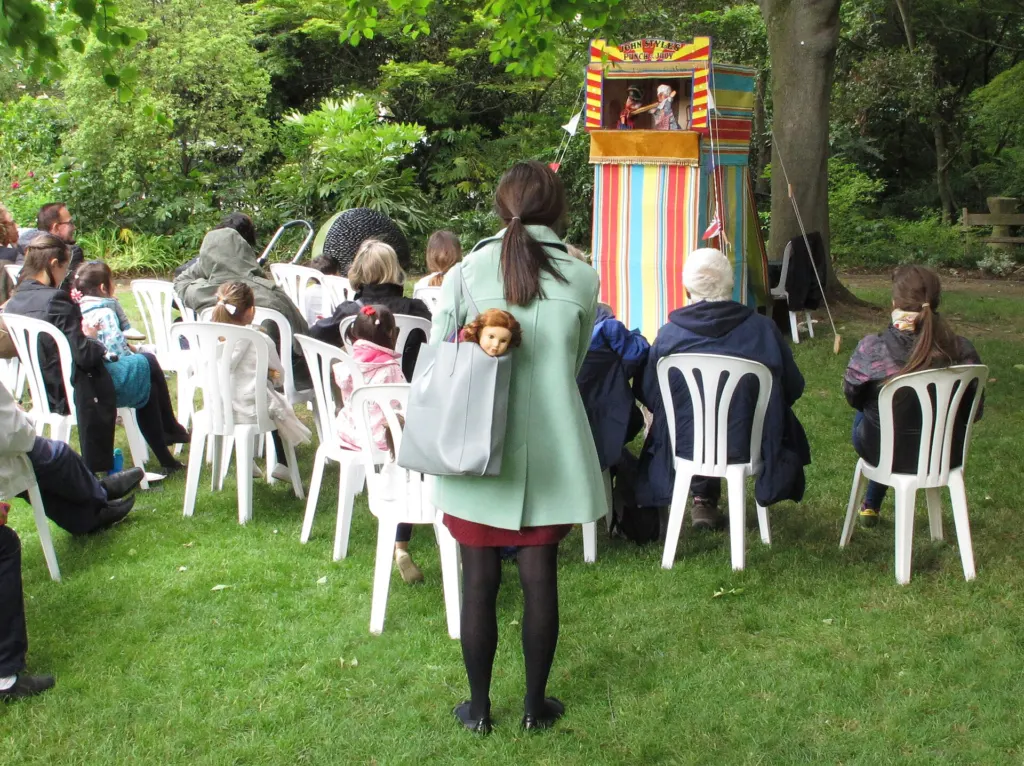
The name comes from the Italian parlare, “to talk.” According to the history of Polari, the slang can be traced to at least the 19th century and possibly the 16th. It was spoken in London fish markets, theaters, fairgrounds and circuses, by Punch and Judy puppeteers, professional wrestlers and merchant navy crews, where many gay men worked as stewards, waiters and entertainers.
Written evidence is thin before the 1890s, Oxford English Dictionary associate editor Peter Gilliver has noted. One early example, from an 1893 book, reads: “If the rozzers was to see him in bona clobber they’d take him for a gun.” In plain English: if the police saw him finely dressed, they would know he was a thief.
London even had two versions. An East End form leaned on Cockney rhyming slang, while a West End form drew on theater and classical language.
How the words were built
Polari had a small core of about 20 words and borrowed the rest from wherever its speakers had been. Its main ingredients:
- Italian and Mediterranean sailors’ slang: bona (good), vada (see), nanti (no, none) and palone (woman). Even the numbers follow Italian: una, dooey, tray for one, two, three.
- Backslang, or words said backward: riah for hair, and eek for face, a clipped form of ecaf.
- Cockney rhyming slang: an “irish” was a wig, from “Irish jig.”
- Yiddish and Romani: schmutter for clothes, from a Yiddish word for rag, and lavs for words.
In a short history of Polari for Lancaster University, linguist Paul Baker gives a typical put-down: “Vada the naff strides on the omee ajax,” meaning look at the awful trousers on the man nearby. Dropping a single word such as bona into conversation could also signal to another man that the speaker was gay.
Gay speakers also swapped pronouns and names from male to female, so “he” became “she” and Paul might become Pauline.
Why it faded
Polari began falling out of use among gay men by the late 1960s, for two reasons. Round the Horne put its vocabulary into living rooms across the country, which ruined it as a code. Then the Sexual Offences Act 1967 partly decriminalized sex between men in England and Wales, so a secret language mattered less. In the 1970s, gay liberation activists tended to see it as old-fashioned and tied to camp stereotypes. When Baker surveyed 800 gay men in 2000, about half had never heard of it.
The words that escaped
Some Polari words slipped into everyday British English and beyond, including naff, scarper, blag and barney. “Zhoosh,” meaning to smarten something up, spread widely in the mid-2000s through the American makeover show Queer Eye for the Straight Guy.
Polari is now treated as heritage. Baker has written three books on it, the latest being Fabulosa! in 2019. In 2015 artist Jez Dolan translated parts of the 1957 Wolfenden Report into Polari for a UK Parliament commission. Musicians kept it alive too: Morrissey’s 1990 single “Piccadilly Palare” and David Bowie’s 2016 song “Girl Loves Me” both use it.
Badiyaa has looked at other slices of London’s stage history, including the 1823 London play that gave Frankenstein his assistant Fritz. More hidden stories are in our History section.
The newest high-profile use is a whole album: British singer Olly Alexander released his debut album, titled Polari, on February 7, 2025.
Further reading
Illustrative image. Image: David Hawgood, CC BY-SA 2.0 via Wikimedia Commons
This article was produced with AI assistance and reviewed by our Editorial Desk. How we work.