NOAA’s Space Weather Prediction Center expected a minor, G1-level geomagnetic storm on Tuesday 13 October, the tail end of a week in which Earth took a run of hits from the Sun. Forecasts for the night of 12 to 13 October put the planetary Kp index at about 5, the threshold for G1. That is enough for aurora across Canada, Alaska, Iceland and Scandinavia, and possibly along the northern edge of the US and in northern Scotland if skies are clear.
A busy week on the Sun
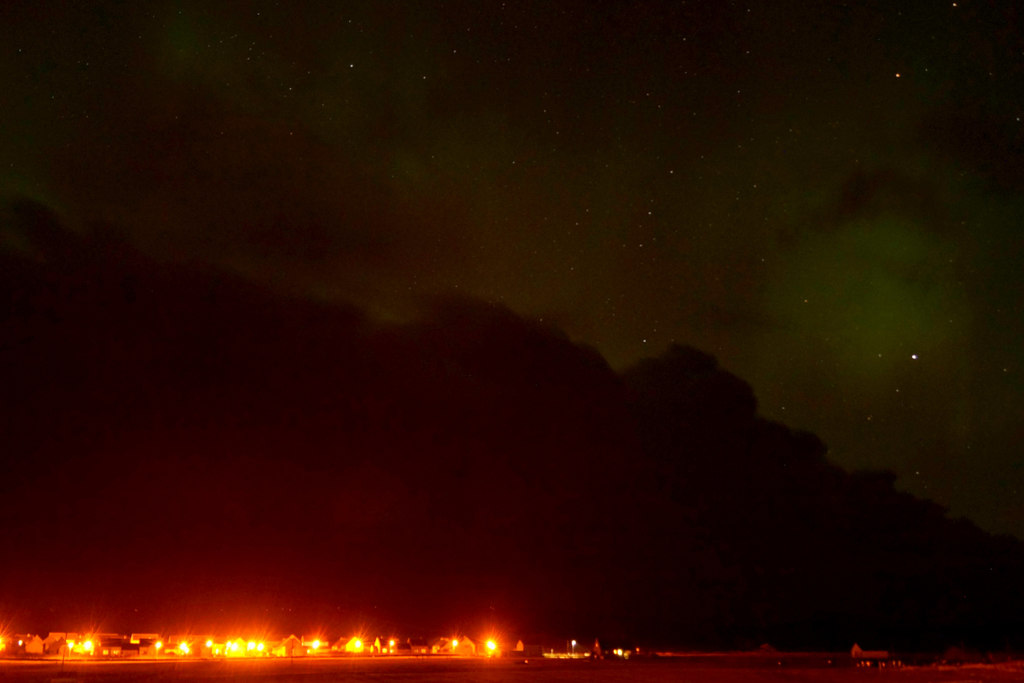
The context matters because the past few days overshot their forecasts. Earlier in the week the centre issued a G2 (moderate) watch for a coronal mass ejection, a cloud of magnetised plasma thrown off the Sun, due on 8 to 9 October. More eruptions followed, and by the weekend several CMEs were in transit. On Saturday 10 October the storm reached G3 (strong), one level above the watch. One explanation being examined is a “cannibal” CME, in which a faster cloud overtakes and merges with a slower one, compressing its magnetic field and raising its impact. Aurora was seen across the UK and northern Europe that night.
NOAA’s summary of 5 to 11 October lists geomagnetic storms from G1 to G3 over the week. The 13 October G1 is expected to be weaker than Saturday’s event.
How far south it reaches
The NOAA G-scale is tied to the Kp index, a 0 to 9 measure of how disturbed Earth’s magnetic field is over three-hour windows. As a rough guide from NOAA’s own scale descriptions, a G1 storm (Kp 5) can bring aurora to about 60 degrees geomagnetic latitude, which in the US means northern Michigan and Maine. A G2 (Kp 6) reaches roughly New York and Idaho; a G3 (Kp 7) can push to Illinois and Oregon. Because geomagnetic latitude is offset from geographic latitude, the UK sits further from the auroral zone than its map position suggests: Kp 5 usually favours northern Scotland, while northern England and Northern Ireland generally need Kp 6 or more.
These figures are averages. Kp forecasts are issued days ahead based on CME speed and direction, but the critical factor, the orientation of the CME’s magnetic field (known as Bz), is only measured about 15 to 60 minutes before arrival by spacecraft at the L1 point between Earth and the Sun. That is why the weekend storm outran its G2 watch, and why a forecast G1 can fizzle.
When to look, and how to photograph it
The best window is usually between 10pm and 2am local time, centred on magnetic midnight. Moon conditions favour viewers this week: new moon fell on 10 October, so the sky is dark through the evening. Face north, get away from street lighting, and give your eyes 20 minutes to adjust.
Phone cameras often record aurora that looks faint or grey to the eye, because the sensor collects light for several seconds. Use night mode and rest the phone on something solid. On a dedicated camera, start with a wide lens at its widest aperture, ISO 1600 to 3200 and an exposure of 5 to 15 seconds, then adjust. Focus manually on a bright star.
NOAA’s 30-minute aurora forecast and its live Kp readings are the best guide on the night; the centre’s 27-day outlook shows when this stretch of solar activity may come round again as the Sun rotates.
Further reading
- NOAA Space Weather Prediction Center
- NOAA SWPC: Aurora Dashboard (Experimental)
- NOAA/NWS: 27-day Space Weather Forecast
- Wikipedia: May 2024 solar storms
Image: Mike Pennington, CC BY-SA 2.0 via Wikimedia Commons
This article was produced with AI assistance and reviewed by our Editorial Desk. How we work.