Seventy skewers. Three Italian tourists. One barbecue stall in Shanghai’s Zhujiajiao water town, and more than an hour standing at its counter.
The clip began with the stall’s owner, who posted it on Douyin, the Chinese version of TikTok, on November 3. It has since jumped to Reddit, where it landed in a feel-good forum under a title about visitors who could not stop ordering beef and lamb.
An account of the visit from Qingpu, the Shanghai district that includes the town, says the three walked past and opened with 10 beef skewers. Then came another 10. Then another. By the time they stopped, the tally stood at 70.
The count, and a small dispute
Reddit viewers audited the footage themselves. One counted 65, in rounds of 5, 10, 10, 20 and 20. Another guessed 90. A viewer in the Chinese comment section claimed the trio came back 11 times. The Qingpu account’s figure is 70, and that is the number we are using, with the caveat that nobody has published a receipt.
Split evenly, 70 skewers works out to about 23 each (70 ÷ 3 = 23.3). The lower Reddit count gives about 22. Size matters here: several commenters said the pieces in the video looked like small, one-bite skewers, far from the loaded kebabs many Western readers picture.
No shared language needed
Neither side spoke the other’s language, so the whole transaction ran on gestures. Two hands held up meant 10 more. A raised thumb meant it was delicious. Before leaving, the visitors bought a bag of the stall’s chili powder to take away, which the Qingpu account reads as a plan to try the flavor back home.
The owner credits fresh ingredients and a chili and cumin mix he selects and balances himself. Foreign customers, he said, mostly ask for salt and chili alone.
Why Italians may have felt at home
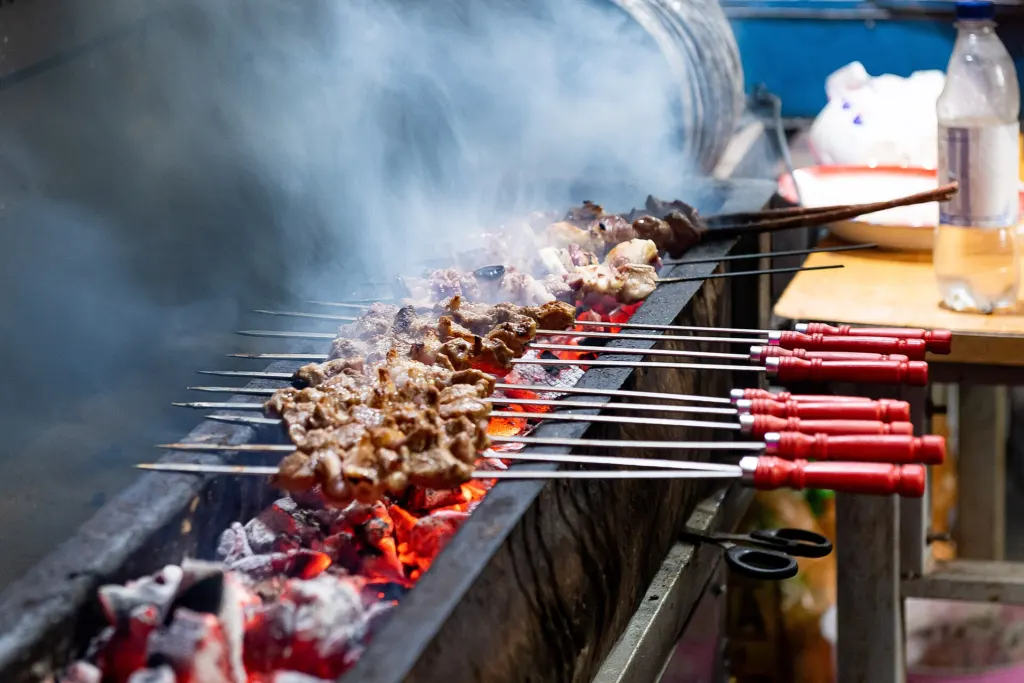
The most popular explanation on Reddit came from Italians. Their country has its own tradition of small grilled meat on sticks, and it looks strikingly close to what was on that grill.
Chuan, the Chinese skewer, started in Xinjiang in the country’s northwest and comes out of the Islamic cooking of the Uyghur people and other Chinese Muslims. Lamb remains the classic filling, usually dusted with cumin, red pepper flakes and salt.
Arrosticini come from Abruzzo, on the other side of the Eurasian landmass. They are chunks of mutton or lamb cooked on a long, gutter-shaped brazier called a furnacella, and they grew out of the region’s shepherding culture. Italy’s agriculture ministry lists them as a traditional food product. Put the two side by side and the main difference is the spice: Abruzzo keeps it simple, while Xinjiang reaches for the cumin jar.
That gives the clip a neat reading, though only a reading. Nothing published says where in Italy these three come from, and none of them has spoken publicly.
How much of this is real
The video came from the stall’s owner, and the fullest account of it was written to promote Zhujiajiao as a stop for overseas visitors. So the source has every reason to enjoy the story, and we cannot rule out that parts of the footage were arranged or tightly edited. Commenters who said they had eaten at similar stalls found the appetite entirely believable.
The stall, listed as Zilaihuo Barbecue, opens from 10 a.m. to 9 p.m.
Further reading
Illustrative image. Image: N509FZ, CC BY-SA 4.0 via Wikimedia Commons
This article was produced with AI assistance and reviewed by our Editorial Desk. How we work.