America's first automobile race was run in a Chicago snowstorm on Thanksgiving Day, November 28, 1895, and the winner, Frank Duryea, crossed the line after 10 hours and 23 minutes. Over the 54-mile course to Evanston and back, that is an average of about 5 mph.
Six cars started, out of more than 80 entries, according to Wikipedia's history of the 1895 Chicago race. Only two finished. A Chicago newspaper owner had put up $5,000 in prizes to promote the brand-new American car business, which was only two years old.
Snow, sleighs and a blacksmith's forge
Six inches of snow covered the course that morning and the temperature sat at 38°F. Duryea, of Springfield, Massachusetts, drove a gasoline motor wagon his brother Charles had designed. He left at 8:55 a.m. and finished at 7:18 p.m.
His running time was only 7 hours and 53 minutes. Badiyaa's subtraction shows he spent about two and a half hours stopped, mostly on two breakdowns that needed a forge. Because he had built the car himself, he could make repairs other drivers could not. For the final 12 miles a horse-drawn sleigh broke a trail through the snow for him.
The rest of the field had a rough day:
- Oscar Mueller's Benz finished second, 24 minutes slower on elapsed time, with twine wrapped around its solid rubber tires for grip. Mueller passed out from the cold, and umpire Charles Brady King drove it home.
- The Macy's Benz hit a streetcar, a sleigh and a horse-drawn cab, then its engine quit about 25 minutes behind the leader.
- The De La Vergne Benz retired early on the snowy roads.
- Two electric cars, the Sturges Electro Motocycle and the Morris and Salom Electrobat, ran out of power within 15 miles.
The winner who did not get the gold medal
The judges took a week to decide and found that every finisher had broken the rules by leaving the course. They gave the gold medal to the Electrobat, mainly on separate safety and design tests, partly because city rules made gasoline hard to buy in town. Duryea still took the $2,000 first cash prize for best performance and average speed, and Mueller received $1,500.
The race was postponed twice. A first attempt on November 2 turned into a two-car exhibition run in which Duryea swerved into a ditch to avoid a farmer's wagon. Police had also stopped early cars from driving on city streets until Chicago passed an ordinance allowing them.
What happened next
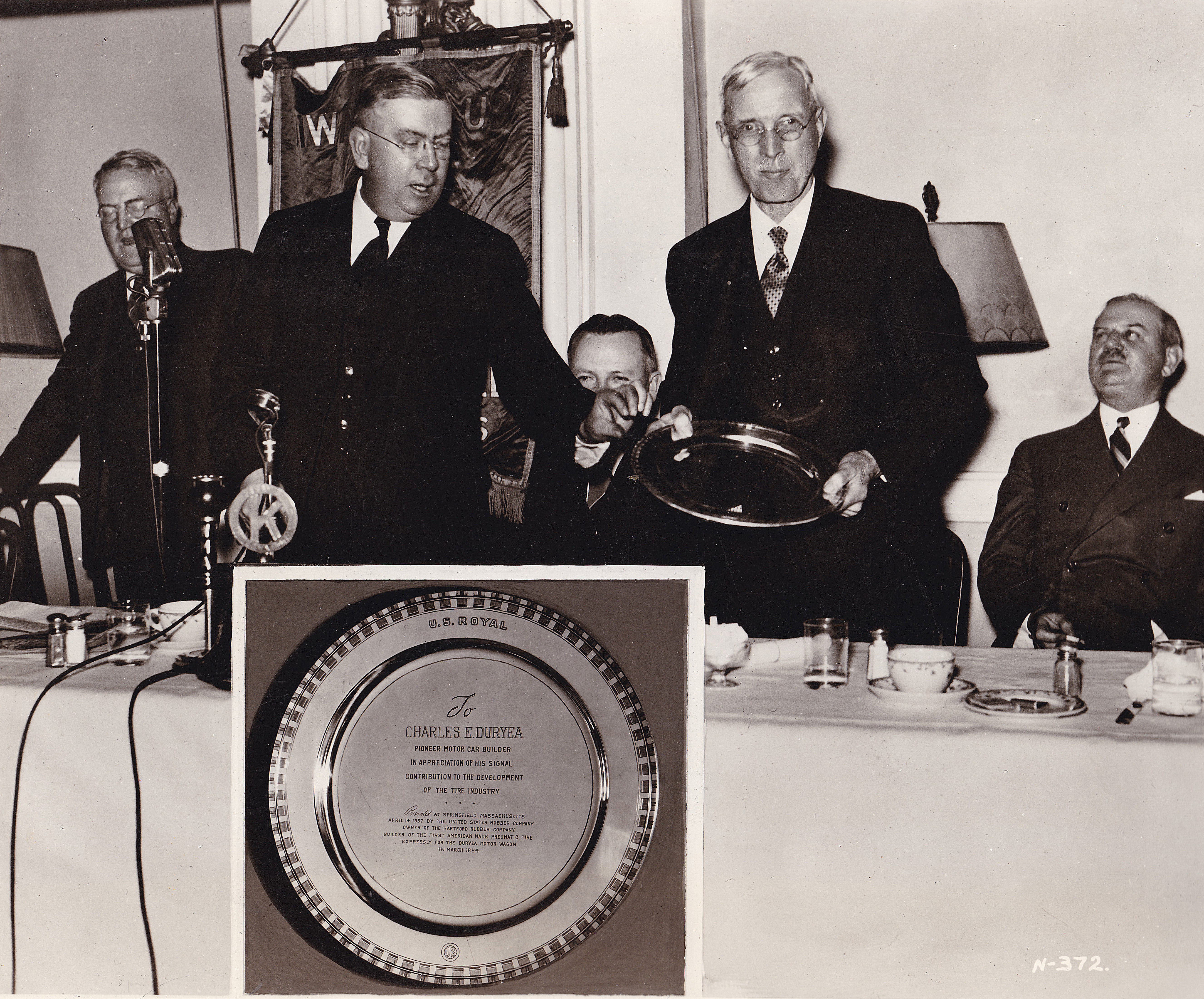
The publicity sped up American car-making. In 1896 the Duryea brothers built 13 cars by hand, making theirs the first gasoline automobile factory in the United States, as Frank Duryea's Wikipedia biography notes. He was inducted into the Automotive Hall of Fame in 1996 and lived until 1967, the last survivor of the industry's founders.
Thanksgiving has hosted other famous sporting days, including the 1929 game when Ernie Nevers scored all 40 Cardinals points against the Bears. For a race that still uses public roads, read our guide to the Isle of Man TT Mountain Course.
This year's Thanksgiving falls on Thursday, November 26, two days before the Chicago race's 131st anniversary on November 28.
Sources
- Chicago Times-Herald race, Wikipedia, 2026
- J. Frank Duryea, Wikipedia, 2026
Image: Springfield-Duryea Anniversary Committee, photographer unknown, Public domain via Wikimedia Commons
This article was produced with AI assistance and reviewed by our Editorial Desk. How we work.