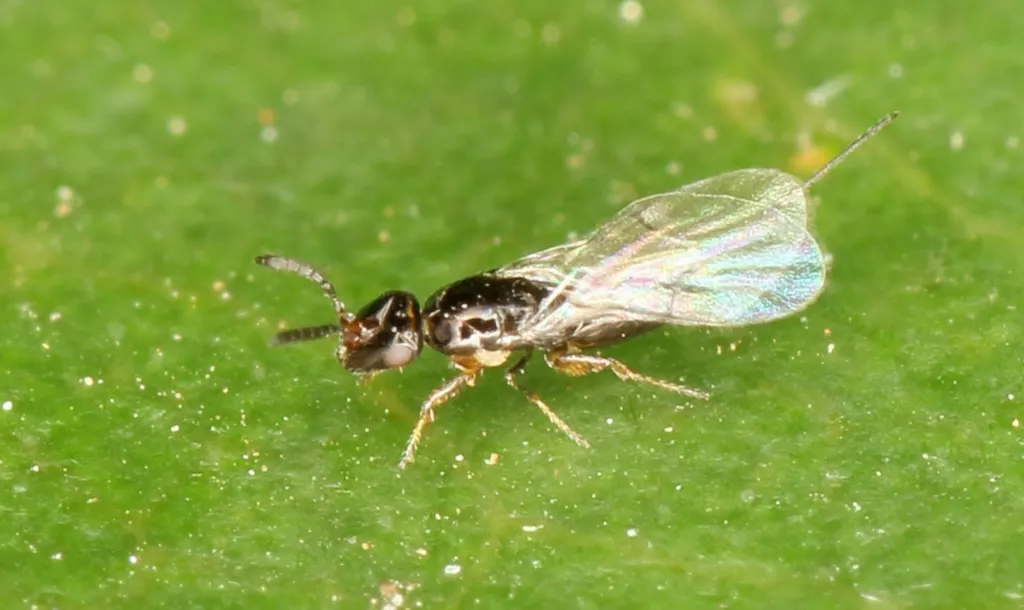
A female fig wasp squeezes into an unripe fig through a hole so tight it often tears off her wings and most of her antennae. She lays her eggs, leaves pollen behind and dies inside. The fig then breaks her body down with an enzyme called ficin. That partnership between more than 800 species of fig and their wasps is at least 70 million years old, and a post titled “The humble fig’s disturbing secret” pushed it back onto Reddit’s front pages this week.
The secret is real. The popular version of it, that every fig you eat is packed with dead insects, is not quite right.
A flower turned inside out
Start with the fruit itself. Botanically, a fig is a syconium: a hollow, fleshy pouch lined on the inside with hundreds of tiny flowers that bloom out of sight. There is only one way in, a narrow opening at the tip called the ostiole. No bee can reach those flowers. Only a wasp small enough, and specialized enough, can crawl through.
The common fig, Ficus carica, is served by one such insect, Blastophaga psenes. Across the genus, each group of figs tends to pair with its own pollinating wasps, and the two lineages have branched together over tens of millions of years. Researchers date the start of the partnership to between 70 and 90 million years ago.
The life and death of a fig wasp
The fig wasp life cycle, step by step:
- A mated female, carrying pollen from the fig where she was born, finds a young fig and forces her way through the ostiole. Short spines under her head grip the walls; her wings and antennae often snap off on the way.
- Inside, she lays eggs in some of the flowers and, in doing so, pollinates others. Then she dies.
- Her larvae grow inside the fig. Males hatch first, and their first act is to mate with females that have not yet emerged.
- The wingless males chew an exit tunnel and soon die, never having left the fig for long.
- The females crawl out, collecting pollen as they go, and fly to another tree of the same species to start again.
So a fig wasp’s whole world is two figs: the one she is born in and the one she dies in.
So are you eating wasps?
Mostly no. The fig does not simply entomb the dead female. It produces ficin, also known as ficain, which digests her body, and the plant takes up the nutrients as the fruit ripens. The crunchy bits in a ripe fig are seeds, each one a tiny single-seeded fruit, not insect parts.
There is a second reason. Many fig varieties sold in shops are parthenocarpic, meaning they set fruit without pollination at all, so no wasp ever has to enter. The common fig does not always need a wasp to fruit, though it can be pollinated by one to make seeds. In colder regions such as the British Isles the wasp is simply absent.
The trick of growing figs without pollination is ancient. Nine subfossil figs of a sterile, parthenocarpic type found at Gilgal I, a Neolithic village in the Jordan Valley, date to around 9400 to 9200 BC. That predates the domestication of wheat and barley, which makes the fig a strong candidate for humanity’s first cultivated plant.
Why it matters
The fig and its wasp cannot survive without each other. Many figs are keystone species, feeding and sheltering a wide range of other animals, so losing a single wasp species could mean losing a fig, and with it a slice of a forest food web. Conservationists now treat the pair as a unit, since protecting one protects the other.
Farmers have worked with the system for millennia. The Greek writer Aristotle noted wasps, which he called psenes, flying from wild figs into cultivated ones, and Greek growers tied wild figs to cultivated trees to keep fruit from dropping. The fig crossed the Atlantic much later: Spanish missionaries brought the first figs to California in 1769, and true Smyrna figs followed in 1880.
The other wasps in the fig
Not every wasp in a fig is a helpful one. Alongside the pollinators, a much more varied cast of non-pollinating fig wasps lays eggs in the fruit without giving anything back. Some have ovipositors so long they can drill eggs into the fig from outside. Others mimic the pollinators and crawl in through the same opening.
Limits of what we know
The fig-wasp tree of life is still being redrawn. The pollinating family, Agaonidae, was reorganized as recently as 2022, and the non-pollinators are spread across several families whose origins are less well understood. Matching each fig to its wasp is messy too, because figs hybridize often and some wasps share or switch hosts. And how fast climate change is hitting pollinator numbers is a live research question rather than a settled figure.
The next time you slice a fresh fig, the pattern of pale threads and seeds you see inside is the flower garden one wasp died to pollinate, and the fruit has already digested her.
Further reading
Image: Alandmanson, CC BY 4.0 via Wikimedia Commons
This article was produced with AI assistance and reviewed by our Editorial Desk. How we work.