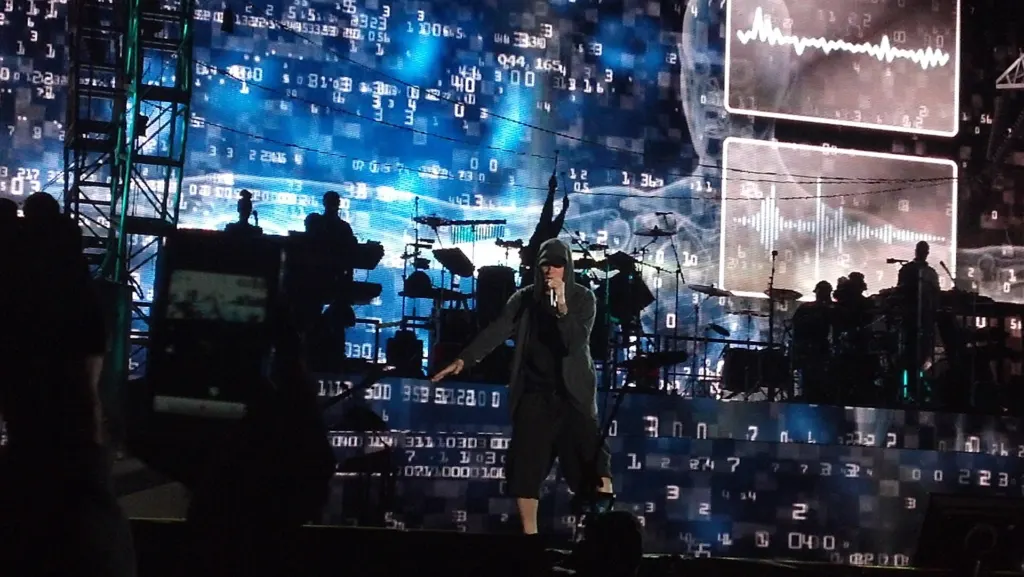
Eminem’s first album came out 30 years ago today, on November 12, 1996, and by his own count almost nobody bought it. In his 2008 book The Way I Am, the Detroit rapper put sales of Infinite at “maybe 70 copies.”
Only about 1,000 copies existed, on cassette and vinyl, for the tiny local label WEB Entertainment. Marshall Mathers hand-sold them around Detroit, straight out of his car trunk.
A basement record with Mr. Porter and Proof
Recording ran from December 1995 to June 1996 in the basement studio of Jeff and Mark Bass, the Bass Brothers, who had signed him to their FBT Productions deal back in 1992. Denaun Porter, credited as Mr. Porter, produced most of the 11 tracks, Proof handled drum programming, and Eminem co-produced. The guest list stayed local: Proof, Eye-Kyu, Moe Men-E, Three and Thyme, plus New York singer Angela Workman.
Life outside the studio was tight. He was cooking and washing dishes for minimum wage at Gilbert’s Lodge in St. Clair Shores, and his daughter Hailie had just been born. Money and fatherhood are the two subjects the songs keep circling. The writing drew on Nas’s Illmatic and Tupac Shakur’s Me Against the World.
Why it sounds nothing like Slim Shady
People around him pushed him toward the smooth, stacked rhymes of New York’s Nas and AZ, and he leaned in. He also built the songs to be “radio-friendly,” hoping Detroit stations would bite. Looking back, he was blunt: “Infinite was me trying to figure out how I wanted my rap style to be, how I wanted to sound on the mic and present myself. It was a growing stage. I felt like Infinite was like the demo that just got pressed up.”
The failure stung, and it changed his direction. Disappointment over Infinite drove him to create the Slim Shady alter ego, which surfaced on the Slim Shady EP in 1997 and powered the albums that followed.
From 70 copies to collector’s item
Before Interscope and Dr. Dre’s Aftermath came calling, a WEB tape was just a local rap cassette. Now original copies have gained real value, partly because the album has never been sold through online music stores. Only the title track reached Spotify, two decades after release. On November 17, 2016, five days past the 20th anniversary, his official YouTube channel posted a Bass Brothers remix of “Infinite” alongside a documentary on how the record was made.
Critics remain lukewarm. Retrospective rankings of his studio albums tend to park Infinite near the bottom, while pointing to “313” and “Tonite” as early signs of the rapper to come.
Infinite by the numbers
- Release: November 12, 1996, on WEB Entertainment
- Copies pressed: about 1,000
- Copies sold, by Eminem’s own estimate: “maybe 70”
- Sell-through on those figures: 70 divided by 1,000, or about 7 percent of the pressing
- Running time: 37 minutes 54 seconds
The Detroit story picks up six years later in our look at how 8 Mile won hip-hop its first Best Original Song Oscar. His hometown ties still show, from the Mom’s Spaghetti stand now open at Ford Field to the new wave of Detroit rap heard on Bruiser Wolf and Conductor Williams’ album The Dealer Wins.
Thirty years on, the title track is still the only song from the 1996 tape available on Spotify.
Further reading
Image: david_hwang, CC BY 2.0 via Wikimedia Commons
This article was produced with AI assistance and reviewed by our Editorial Desk. How we work.