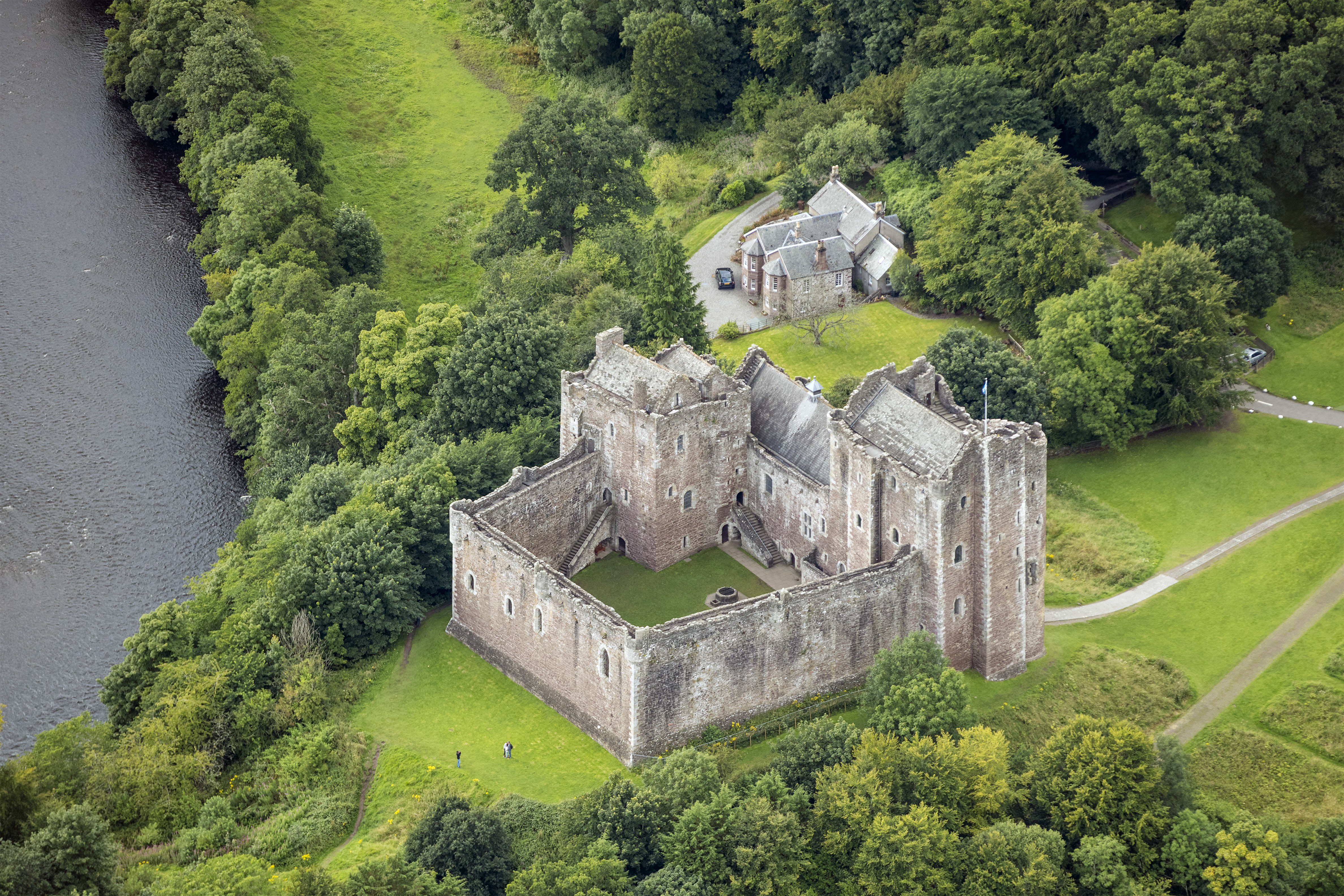
A king handed it to his mistress. A future signer of the Declaration of Independence escaped from it on knotted bedsheets. And in 1974 six British comedians turned it into nearly every castle in Monty Python and the Holy Grail. Doune Castle, a medieval ruin about 8 miles northwest of Stirling, has led a far racier life than most stone towers.
Its screen career keeps growing. The castle stood in for Winterfell in the first season of Game of Thrones and played Castle Leoch, seat of the MacKenzie clan, in Outlander, according to the castle's Wikipedia entry. Historic Environment Scotland, which looks after Doune, now sells an audio guide narrated by Python's Terry Jones that also covers the Outlander shoot with Sam Heughan.
The real drama came first
Doune took its present shape in the late 14th century under Robert Stewart, Duke of Albany, the regent often called Scotland's uncrowned king. It passed to the Crown in 1425, after Albany's son was executed, and became a royal hunting lodge and a home for widowed queens.
Then came the romance. In March 1500, before he married Margaret Tudor, James IV gave the keeping of Doune and lands in Menteith to his mistress, Janet Kennedy, citing the "hartlie luve and invict favoris he has and beris to her." Mary, Queen of Scots, later stayed in the rooms above the kitchen.
During the Jacobite rising of 1745 the castle held government soldiers captured at the Battle of Falkirk. Several escaped by tying bedsheets together and climbing out of a window. One of them was John Witherspoon, a young minister who moved to New Jersey, led the college that became Princeton and signed the Declaration on July 4, 1776, as Witherspoon's biography records. He was the only active clergyman to sign it.
How one castle became many
The Pythons never meant to rely on Doune alone. Shortly before filming, permission to use other Scottish castles was withdrawn, so the crew shot different corners of Doune and framed them tightly to pass for different strongholds. The east wall became the French-held castle, the Great Hall became Camelot, and the kitchen and servery became Castle Anthrax, where Michael Palin's Sir Galahad is pursued by a castle full of eager young women.
The film's money had a rock-and-roll twist. The Holy Grail's production history lists an original budget of £175,350 raised from eight investors, among them Led Zeppelin with £31,500 and Pink Floyd with £21,000. Between them the two bands covered 30% of the budget, a fair price for coconuts and a Trojan Rabbit.
Hollywood found the castle long before the Pythons: MGM shot Ivanhoe there in 1952 with Robert Taylor and Elizabeth Taylor. More recently it appeared in Outlaw King, the 2018 film about Robert the Bruce.
Doune by the numbers
- Lord's tower: almost 29 metres (95 feet) high.
- Great Hall: 20 by 8 metres, with no fireplace; it was probably heated by a central fire.
- Kitchen fireplace: 5.5 metres (18 feet) wide.
- Courtyard well: about 18 metres deep.
The castle was a roofless ruin by 1800 until the 14th Earl of Moray restored it in the 1880s, and the earls gave it to the state in 1984.
For more Westeros-on-location history, see Badiyaa's profile of Jerome Flynn, Game of Thrones' Bronn, and our look at the Pride and Prejudice lake scene that was never in Austen's book.
Sources
- Doune Castle, Wikipedia, 2026
- Doune Castle, Historic Environment Scotland, 2026
- John Witherspoon, Wikipedia, 2026
- Monty Python and the Holy Grail, Wikipedia, 2026
Image: Godot13, CC BY-SA 4.0 via Wikimedia Commons
This article was produced with AI assistance and reviewed by our Editorial Desk. How we work.