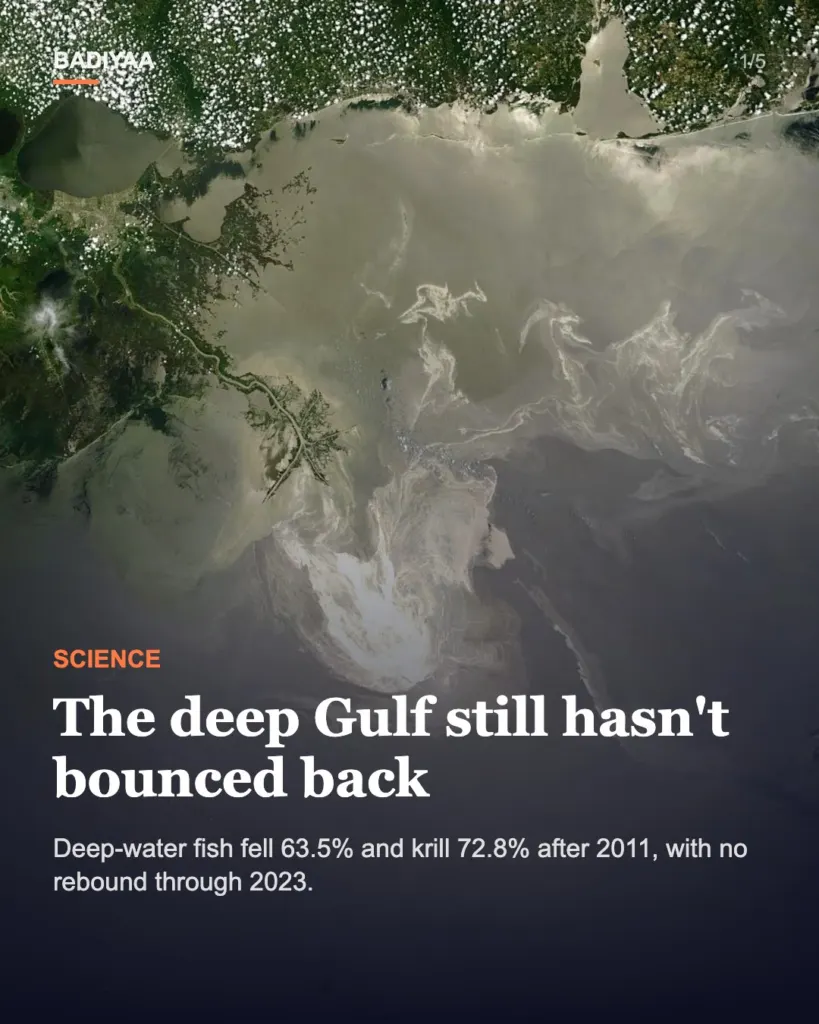
Fish living between about 650 feet and nearly a mile down in the Gulf of Mexico fell by 63.5% after the Deepwater Horizon spill and have shown no return toward their 2011 numbers through 2023, according to a 17-member team led by Tracey Sutton of Nova Southeastern University in Florida. Deep-water crustaceans dropped 62.0% and small squid and octopus 59.7%, the researchers reported on October 19, 2026, in the Proceedings of the National Academy of Sciences.
For every 100 deep-water fish the nets caught per unit of water in 2011, later surveys found about 36. The authors call it the fastest and most severe animal decline yet recorded for the deep open ocean, which they describe as the largest ecosystem type on Earth.
How two sampling programs tracked the deep Gulf for 13 years
The deep-pelagic zone, meaning the open water from about 660 feet (200 m) down to the depths, makes up 90.4% of the Gulf’s volume. It is home to lanternfish, bristlemouths, krill and small squid that rise toward the surface every night to feed and sink again by day, a daily commute that also carries carbon into deep water.
The baseline came from a nine-month campaign that ran from January to September 2011, starting a few months after the well was sealed. Crews worked a 46-station grid and took 1,034 quantitative samples. A second program, DEEPEND, then made nine surveys between 2015 and 2023 and collected 720 more. Both used the same physical net system, six nets opened and closed on command at set depths down to 1,500 m (about 4,900 feet). Hauls were timed around noon and midnight so that migrating animals were caught in both positions.
Two further checks ran alongside. Ship-mounted echosounders measured sound bouncing off animals in the water and found backscatter down by 40% in the top layer at night. And genetic sequencing of three common lanternfish species, a 12-year record the team believes is the longest for any deep-sea species, showed falling genetic diversity in two of them.
Krill fell 72.8% and the dense patches whales need nearly vanished
The biggest losses hit the animals that feed everyone else. Krill dropped 72.8%, bristlemouths of the genus Cyclothone 69.0% and lanternfish 62.9%. That matters because predators from tuna to sperm whales depend on finding dense clusters of prey, not thin, scattered meals. After 2011 those clusters almost disappeared: in only one of 134 full-depth fish assessments did a post-decline haul beat the weakest haul of 2011.
The authors link this to declines in deep-diving whales that other studies had already recorded, including 83.4% for Gervais’ beaked whale and 31% for sperm whales. “We used to have a big resident population of sperm whales right off the Mississippi River, but we haven’t seen a sperm whale in 10 years,” Sutton said in an interview published this week.
Why the researchers point to the spill, and what they ruled out
The team tested other explanations first. Water temperature at 660 to 1,970 feet (200 to 600 m) stayed steady in every survey year, the deep Gulf stayed well oxygenated, and the zooplankton these animals eat was above average in 2013. Identical gear and the same specialists throughout make a sampling artifact unlikely. That leaves the 2010 blowout, which the paper calls “the most parsimonious explanation” for the timing.
The study also proposes how a short spill could have a long tail. Oil compounds turned up in deep-sea fish eggs at least six years later, and oil residues can impair the sense of smell that many deep-sea males appear to use to find mates in the dark. Fewer animals, fewer meetings and lower genetic diversity can feed each other, a pattern ecologists call the Allee effect.
Limits: one region, one baseline year and no direct proof
The strength of evidence here is unusual for the deep sea: three separate methods agree. Jeffrey Drazen, who studies deep-sea ecology at the University of Hawai’i at Manoa and was not involved, described the converging net, acoustic and genetic lines as “unusually strong evidence,” in comments published this week.
Still, the case for the spill is circumstantial. There is no pre-2010 survey on the same grid, so the 2011 campaign stands in for “normal”; the team cross-checked it against 1980s and 1990s data from one eastern Gulf site, which looked closer to 2011 than to later years. The paper is also explicit that oil effects on deep-sea fish eggs have never been tested directly. And the only comparable long series, from the California Current off the US West Coast, is one ecosystem, so the “fastest decline” claim rests on a short list of comparisons.
How big was the spill? Two official figures
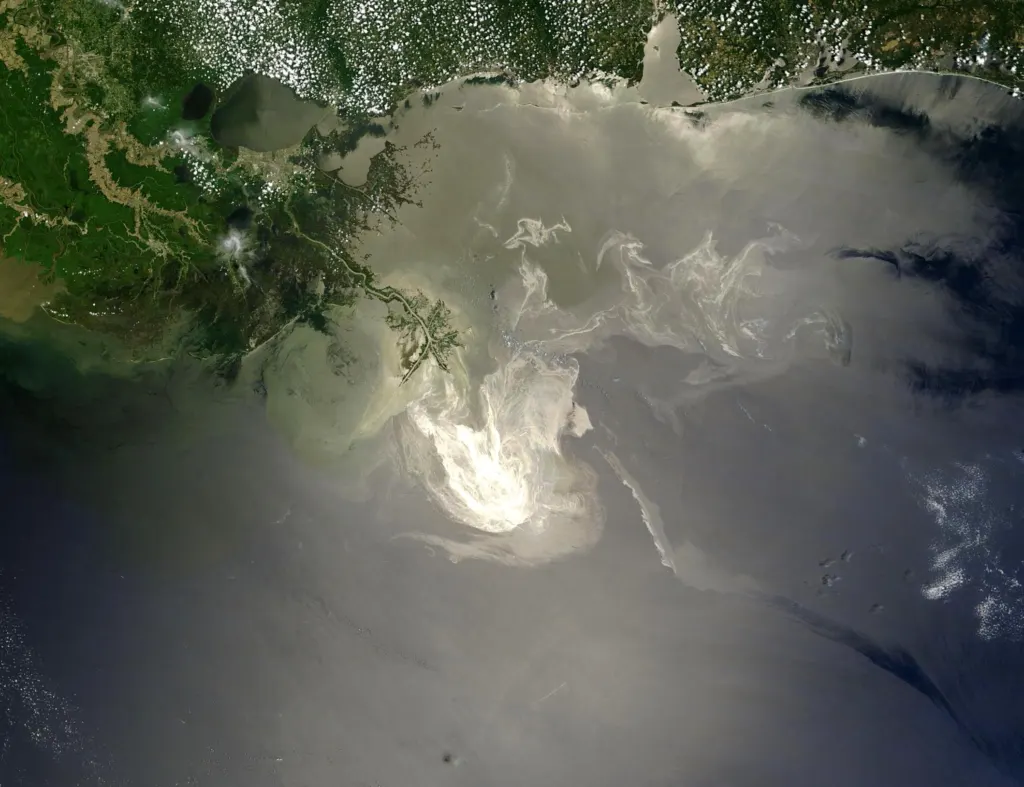
Estimates of the oil released differ. The paper gives a range of 4.0 to 4.9 million barrels over 87 days. NOAA’s account of the incident puts it at about 134 million gallons; at 42 gallons a barrel, that works out to roughly 3.2 million barrels, below the paper’s lower bound. Either way, about 770,000 gallons of dispersant were injected at the wellhead, around 4,900 feet down, between May 15 and July 15, 2010.
An $8.8 billion settlement approved in April 2016 is still funding Gulf restoration. The paper’s message for that work is concrete: the 2023 surveys, 13 years after the well was capped, still showed no sign of the deep Gulf returning to its early-2011 numbers.
Further reading
- PNAS: Immense but not immutable: A sudden and sustained decline in deep-pelagic life
- NOAA Office of Response and Restoration: Deepwater Horizon Oil Spill
Image: NASA/GSFC, MODIS Rapid Response, Public domain via Wikimedia Commons
This article was produced with AI assistance and reviewed by our Editorial Desk. How we work.
Spot an error? Help verify this story
The story in 5 slides