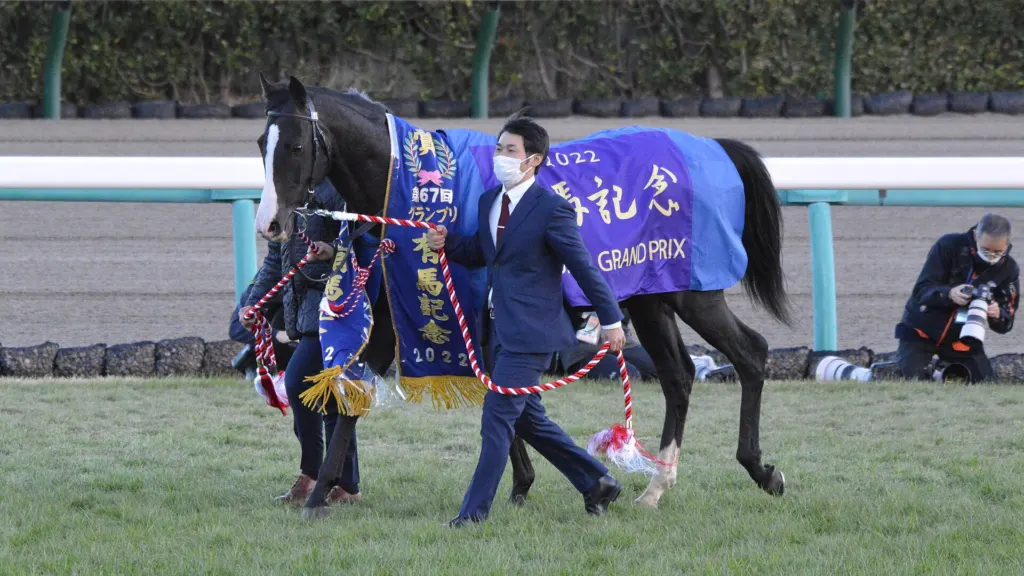
In 1996, fans in Japan put 87.5 billion yen on a single horse race, and Guinness World Records recognized the total as the most ever wagered on one race anywhere. That race was the Arima Kinen, and in Japan it is as much a year-end ritual as a sporting event.
The Grade I race is run over 2,500 meters (about 1 mile and 4.5 furlongs) of right-handed turf at Nakayama Racecourse, east of Tokyo, on the fourth Sunday of December. By that rule the 2026 edition lands on December 27.
A race picked by the fans
What sets the Arima Kinen apart is how the field is chosen. Ten of the 16 starters are picked by a public vote among racing fans, and they must be Japan Racing Association horses. If a top-10 vote-getter skips the race, the next horse in line takes the slot. The other six places go to horses with the most prize money, which is how runners from local racing and abroad can get in.
Voting has exploded lately. In 1984 the leading horse, Mr. C. B., drew 171,979 votes. In 2025 the mare Regaleira topped the ballot with 612,771, about 3.6 times as many. Popularity is no guarantee: Regaleira, the 2024 winner and the first 3-year-old filly in 64 years to take the race, finished fourth in 2025 as the 3-year-old Museum Mile won the 70th running, and the 2024 vote leader, Do Deuce, was scratched before the start.
Why only 16 horses
The course itself explains the small field. The race starts on the outer course just before the far bend, so runners must fight for position at once and wide draws are a handicap, the JRA says, which is why the field is capped at 16. Horses then pass the grandstand and go round again, meeting twice a homestretch hill that climbs two meters in under 150 meters. Three-year-olds carry 56 kg and older horses 58 kg.
Born from a baseball idea
The race was the brainchild of Yoriyasu Arima, a former agriculture minister who became chairman of the Japan Racing Association in 1955 while, by one account, being a complete novice at racing. He did know sports: before World War II he had owned the Tokyo Senators baseball club. Borrowing the idea of baseball’s All-Star Game, he proposed a year-end championship with the runners chosen by fans, to fill Nakayama’s newly rebuilt grandstand.
The first running, then called the Nakayama Grand Prix, took place on December 23, 1956, over 2,600 meters. A course that considered 10,000 spectators a big day drew 27,801. The favorite, Meiji Hikari, won by three and a half lengths.
Seventeen days later, on January 9, 1957, Arima died of acute pneumonia at 72. From the second running on, the race carried his name. The distance was cut to today’s 2,500 meters in 1966. Foreign-trained horses were first allowed in 2000, and the race became an International Grade I in 2007.
The money and the legends
The Japan Racing Association put the 2025 purse at 1.09 billion yen, matching the Japan Cup as the country’s richest, with 500 million yen, or roughly 46% of the pot, going to the winner. Bonuses of up to 300 million yen are paid to a Japan-based horse that sweeps the autumn Tenno Sho, the Japan Cup and the Arima Kinen in the same year.
Six horses have won it twice, including Symboli Rudolf, Oguri Cap and Orfevre. Jockeys Yutaka Take and Kenichi Ikezoe have four wins each. Take is both the youngest winning rider, at 21 on Oguri Cap in 1990, and the oldest, at 54 on Do Deuce in 2023. The fastest time is 2:29.5, set by Zenno Rob Roy in 2004.
The race has also crossed into pop culture. Several editions, including Oguri Cap’s 1990 farewell and Tokai Teio’s 1993 comeback, are retold in the anime and manga franchise Umamusume: Pretty Derby.
For more sports history on Badiyaa, read how Ted Turner launched the Goodwill Games in Moscow in 1986 and how Pelé kept goal in four matches for Santos. The full roll of winners is on the Arima Kinen page.
Further reading
Image: Nadaraikon, CC BY-SA 3.0 via Wikimedia Commons
This article was produced with AI assistance and reviewed by our Editorial Desk. How we work.