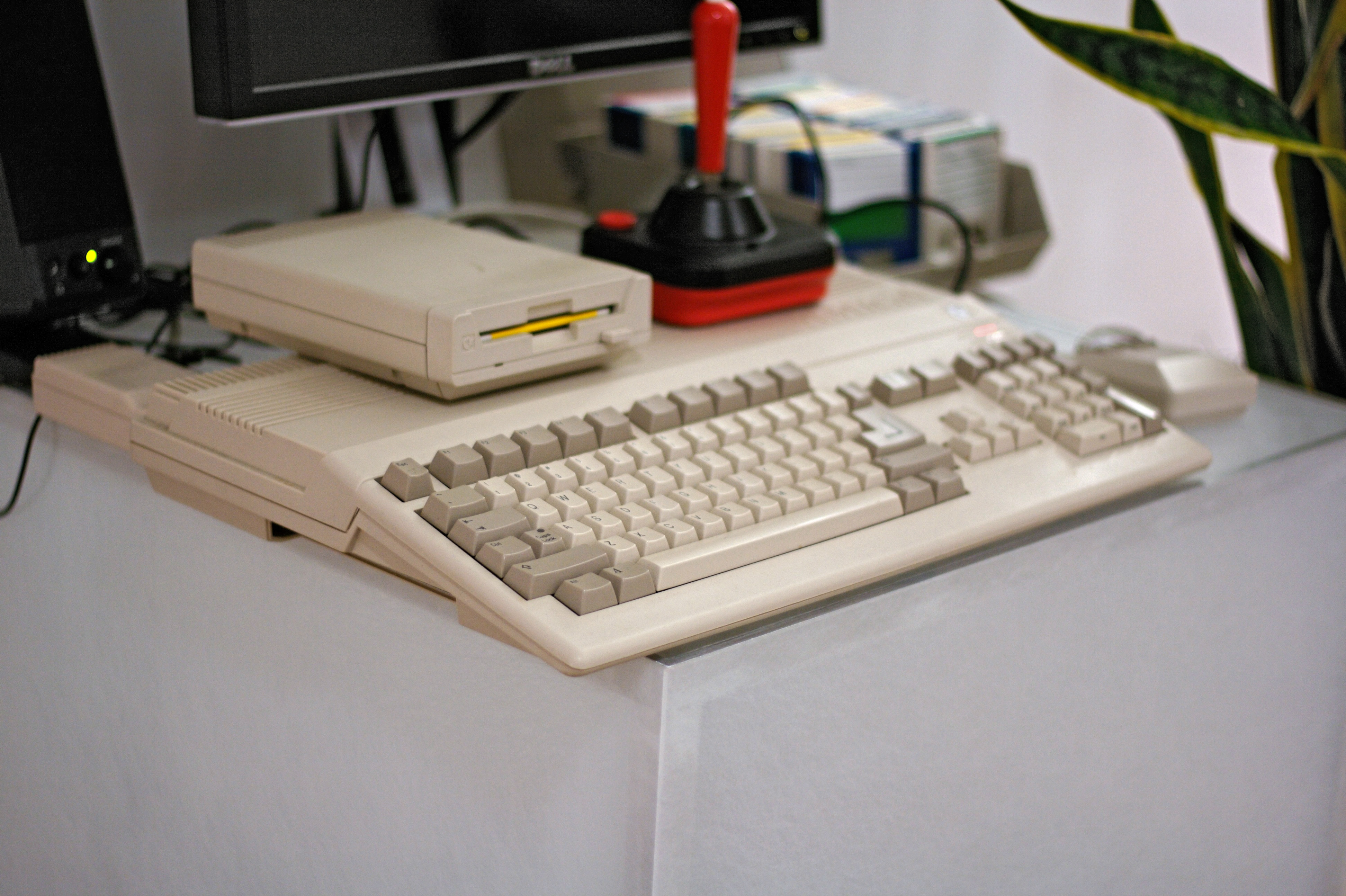
Its codename was Rock Lobster, and it became the best-selling Amiga of them all. The Amiga 500, known to a generation of British kids simply as the A500, landed in the UK and US in October 1987 at £499 or $699, according to the Amiga 500's Wikipedia entry.
For that money, buyers got something the IBM PC and the first Macintosh could not match at home: rich color and multitasking in a wedge-shaped box with the keyboard built in.
What was inside
The A500 ran a Motorola 68000 processor at about 7.16 MHz in North America and 7.09 MHz in PAL countries such as Britain, with 512KB of chip memory. Its graphics drew from a palette of 4,096 colors, and a special mode called Hold-And-Modify could put all 4,096 on screen at once.
The sound chip played four 8-bit channels in stereo, two left and two right, at up to 28 kHz. A 3.5-inch floppy drive was built in, reading 880KB Amiga disks, and the machine had to boot from a floppy every time.
It also had a habit of telling you what was wrong in color. A medium-green screen at start-up meant bad chip memory, red meant a ROM problem, yellow meant the processor had crashed and blue pointed to a faulty custom chip. Cheaper than a repair manual, and a lot more dramatic.
The Batman Pack years
Commodore first showed the A500 at the Consumer Electronics Show in January 1987, alongside the high-end Amiga 2000. It reached the Netherlands in April and the rest of Europe in May before its October launch in Britain and North America.
In mid-1988 the UK price dropped to £399, and from October 1989 to September 1990 British buyers could get the Batman Pack, which bundled Batman, F/A-18 Interceptor, The New Zealand Story and the art program Deluxe Paint 2. Hobbyists loved it, but the A500 lived mostly as a games machine.
Europe was its kingdom. Its low price suited what Wikipedia calls a price-sensitive market, and about 1.16 million units were sold in Germany alone, counting the later A500 Plus. Wikipedia puts lifetime sales at 2.6 million.
The end of the line
The Amiga 500 Plus replaced it in some markets from late 1991, but its new Kickstart 2.04 software broke favorites such as Lotus Esprit Turbo Challenge and SWIV, and some buyers marched back to shops demanding the original. The 500 series ended in 1992, giving way to the Amiga 600.
Commodore International's Wikipedia history records that the company filed for bankruptcy on April 29, 1994, as PCs and 16-bit consoles from Nintendo and Sega took over. The A500's story is told in depth in Jimmy Maher's 2018 MIT Press history, The Future Was Here: The Commodore Amiga.
For more retro computing, see Badiyaa's comparison of The Secret of Monkey Island's many versions, which ran on the Amiga too, and our look at classic Nvidia and ATI tech demos running in the browser.
Sources
- Amiga 500, Wikipedia, 2026
- Commodore International, Wikipedia, 2026
- The Future Was Here: The Commodore Amiga (Jimmy Maher), The MIT Press, 2018
Image: Marcin Wichary, CC BY 2.0 via Wikimedia Commons
This article was produced with AI assistance and reviewed by our Editorial Desk. How we work.