Aerosmith spent more than three decades selling records, yet one 2008 video game earned the Boston band more than any of its albums. That was the claim from Bobby Kotick, then chief executive of Activision-Blizzard, about Guitar Hero: Aerosmith, the first game in the series built around a single rock act.
The numbers behind it were large for a spin-off. The game shifted more than 567,000 copies in its first week and grossed upward of $25 million. Within three months it had passed $50 million in sales and one million copies.
A game built from master tapes
Developer Neversoft released it on June 29, 2008, in North America for PlayStation 2, PlayStation 3, Xbox 360 and Wii, with Windows and Mac versions following that October. Activision published it, and the game came either alone or bundled with a Les Paul-style guitar controller wearing a red Aerosmith faceplate.
The partnership grew out of a small fix. Guitar Hero III had used a weak cover of “Same Old Song and Dance,” so the studio approached guitarist Joe Perry, who supplied the original masters. That favor turned into a full game. Aerosmith tracks make up roughly 70% of the 41-song soundtrack, and the rest come from bands that influenced or opened for them.
The band went further than licensing. Members did motion capture for their digital doubles, and the group re-recorded four songs from its debut album, including “Dream On” and “Mama Kin,” for the game. Career mode walks players from a 1970 high school show in Mendon, Massachusetts, to the band’s Rock and Roll Hall of Fame induction in 2001.
Why a game could outearn albums
Some quick math shows why the claim is plausible. Divide $25 million by 567,000 copies and each first-week sale brought in about $44, roughly three times the price of a typical CD album at the time. A record sold one disc; the game sold dozens of songs at once, often packed with a plastic guitar.
The effect spilled back onto the records. Aerosmith’s catalog sales rose 40% in the weeks after launch, as players went looking for the songs they had just learned to fake on five colored buttons.
Critics were less thrilled. Reviewers called it short and easy for its full price and said its appeal depended almost entirely on how much a player liked Aerosmith. Fans kept buying anyway. In April 2009 discounted Xbox 360 copies sold 110,000 units in North America and outsold the newer Guitar Hero: Metallica that month.
The long tail
By April 2010 the game had passed 3.6 million units, 2.7 million of them in North America. That works out to about 75% of sales coming from one continent, and it made Guitar Hero: Aerosmith the best-selling band-focused music game across both the Guitar Hero and Rock Band franchises.
Anniversary-driven gaming nostalgia keeps resurfacing, from Tony Hawk recreating a Pro Skater 3 level in Los Angeles to The Coalition marking 20 years of Gears of War. Aerosmith’s own catalog is also still drawing crowds: Badiyaa covered Liv Tyler and Alicia Silverstone reuniting 32 years after the Crazy video earlier this month.
The final count on record: 3.6 million copies of a game that started because one guitarist handed over a better tape.
Further reading
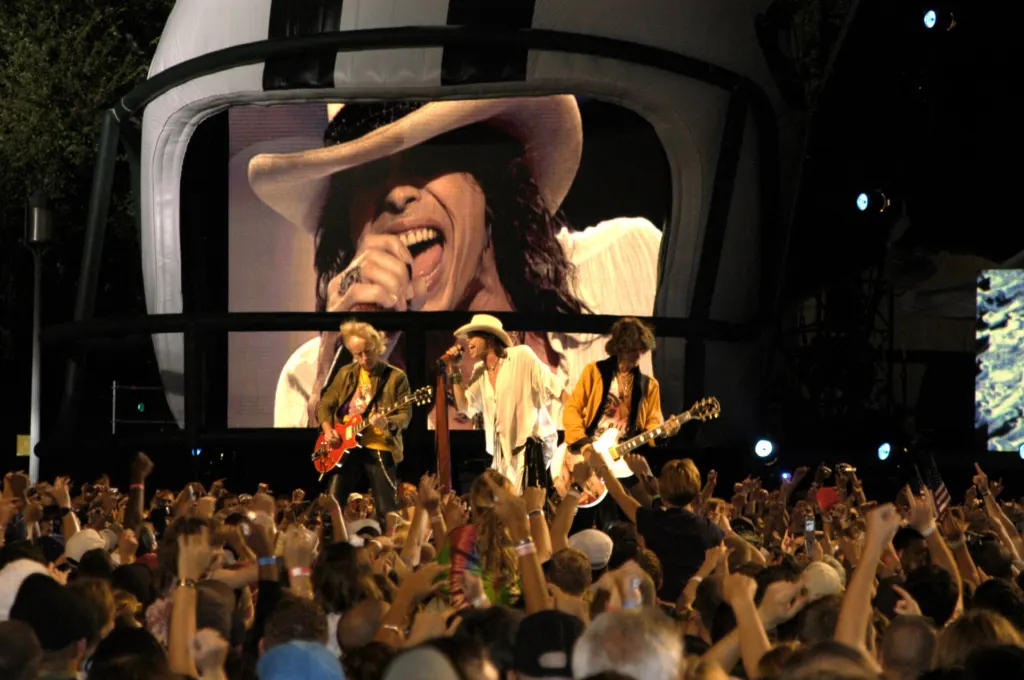
Image: U.S. Navy photo by Photographer’s Mate 2nd Class Rob Rubio, Public domain via Wikimedia Commons
This article was produced with AI assistance and reviewed by our Editorial Desk. How we work.